


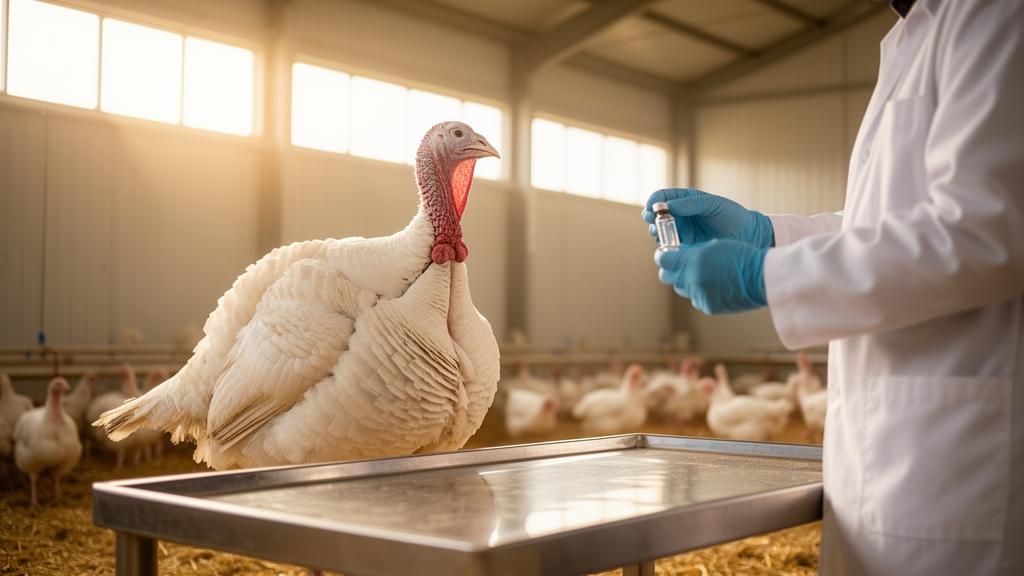
Turkeys are big business. Global production of turkey meat topped 5.8 million tons in 2021, roughly 4.2 percent of all poultry meat produced worldwide, and demand keeps climbing as consumers seek affordable, protein-rich foods. Yet behind every supermarket bird lies decades of quiet genetic bookkeeping: breeders weighing chicks, measuring legs and breasts, and calculating which animals should parent the next generation. A new study from Egyptian researchers, published in Archives Animal Breeding, now adds a molecular twist to that old arithmetic. By pairing a classical selection index with measurements of growth hormone gene expression, the team found that turkeys bred for heavier bodies also carried significantly more growth hormone mRNA in their breast muscle, hinting that the hormone’s gene could one day serve as a molecular marker to speed up genetic improvement.
The birds at the center of the study were not commercial giants but Egyptian black Baladi turkeys, the country’s indigenous breed. Glossy black feathers, moderate body size, and a reputation for surviving harsh conditions and resisting local diseases make the Baladi a valuable reservoir of genetic diversity, even though its growth rate trails that of commercial strains. The breed has long been maintained through uncontrolled natural mating in backyard flocks across the Nile Delta and Upper Egypt, with selection based mainly on visible traits such as body weight, fertility, and survivability. No nationwide breeding or conservation program exists for the breed, which is precisely why the researchers, led by Mohamed H. Khalil of Alexandria University and Mostafa K. Shebl, wanted to quantify how much genetic progress structured selection could deliver.
The experiment began in 2019 at the Poultry Research Centre of Alexandria University, where 193 birds formed the randomly mated base population. From this flock, the heaviest birds at six months of age, 13 males and 55 females, were chosen as parents of a selected line, while a random-bred control line was maintained from the same base. Over the following generation, researchers recorded body weights at hatching and at every month through six months, along with shank length and breast width at six months. The birds were reared under identical floor-pen conditions with feed formulated to standard requirements at each growth stage, ensuring that any differences between the lines reflected genetics rather than management.
The numbers tell a clear story. At six months, selected-line turkeys averaged 4404.61 grams compared with 3967.25 grams in the control line, a statistically significant difference and the only age point where the lines diverged significantly. Regression analysis estimated average monthly growth of 768.03 grams in the selected line versus 710.67 grams in the control. Sex mattered enormously too: males at six months weighed 5599.07 grams on average against 3419.71 grams for females, a striking sexual dimorphism of roughly 63.7 percent. Shank length and breast width were also significantly greater in the selected line, confirming that selection for weight pulled skeletal and muscular dimensions along with it.
To predict future gains, the team constructed a selection index, a statistical tool that combines multiple traits into a single score weighted by heritability, genetic correlations, and economic value. Using the framework of Cunningham, they built an index from body weight, shank length, and breast width at six months, solving matrix equations involving the phenotypic and genetic variance-covariance matrices to derive the optimal weighting factors. The resulting index showed a correlation of 0.84 with the aggregate breeding value, a high accuracy that means the score ranks animals’ genetic merit reliably. The expected genetic gains per generation were substantial: 441.71 grams of body weight, 0.26 centimeters of shank length, and 1.93 centimeters of breast width.
Perhaps the most revealing finding came from dissecting which traits drove the index. Removing breast width from the calculation reduced overall genetic gain by 18.57 percent, the largest contribution of any trait, followed by body weight at 7.69 percent, while shank length contributed a mere 1.28 percent. The genetic correlation between body weight and breast width was an extraordinary 0.97, meaning the two traits are almost entirely controlled by the same genes. For breeders, this makes breast width an exceptionally reliable indirect criterion for improving meat yield, and it explains why the correlated response in body dimensions followed so faithfully from selection on weight alone.
Then came the molecular layer. The researchers sampled the Pectoralis major, the main breast muscle, from 18 birds across both lines and both sexes, extracting RNA and quantifying growth hormone mRNA using quantitative reverse transcription PCR, with beta-actin as the reference gene and the 2-delta-Ct method for normalization. Growth hormone, a polypeptide secreted by the pituitary gland, sits at the heart of the somatotropic axis that governs growth, muscle development, protein synthesis, fat metabolism, and even reproduction in poultry. The selected line showed significantly higher GH expression than the control in both sexes: a relative expression of 1.43 versus 1.01 in males, and 1.76 versus 1.31 in females. Intriguingly, females expressed more GH than males despite being far lighter, echoing earlier reports of sex differences in GH expression.
The authors are careful about what this association does and does not prove. Higher GH-mRNA expression in the selected line is consistent with the idea that molecular mechanisms underpin the phenotypic gains, but the study does not establish causation. The elevated expression may simply reflect the physiology of a heavier phenotype rather than a direct consequence of selection, and the researchers explicitly note that further work is needed to clarify the biology and to validate GH expression as a molecular indicator in breeding programs. Previous studies have linked GH gene polymorphisms and expression patterns to growth traits in chickens and quail, and earlier turkey research found that growth-selected lines showed higher hepatic growth hormone receptor binding, so the new results fit a broader pattern across poultry genetics.
For the Baladi breed, the practical implications are immediate. A selection index with 0.84 accuracy offers smallholder-oriented breeding programs a way to improve growth while preserving the breed’s adaptive traits, and the identification of breast width as the highest-value index trait gives breeders a concrete measurement to prioritize. The GH expression findings open a longer-term possibility: combining conventional phenotypic selection with molecular markers to accelerate gains in indigenous livestock, where genomic tools remain scarce. As global demand for poultry protein grows and indigenous breeds face pressure from commercial crosses, studies like this one show that the old tools of quantitative genetics and the new tools of gene expression can work together, weighing birds in the pen and reading their genes in the laboratory to chart a faster, more informed path of genetic improvement.
Subject of Research: Selection index prediction of genetic gain and growth hormone gene expression in Egyptian Baladi turkeys
Article Title: GH-mRNA expression and prediction of genetic improvement using selection index for body weight traits in turkeys
Article References: Khalil, M. H., Abd El-Motaleb, A. A., Abdel-Rahman, M. M., Amin, E. M., Abousoliman, I., & Shebl, M. K. (2026). GH-mRNA expression and prediction of genetic improvement using selection index for body weight traits in turkeys. Archives Animal Breeding, 69(3), 411-420. https://doi.org/10.5194/aab-69-411-2026
Image Credits: AI Generated
Keywords: turkeys, growth hormone, selection index, genetic improvement, body weight, Baladi, gene expression, qRT-PCR, poultry breeding, heritability, breast width, molecular marker
Cite Scienmag News
Juliet Wilcox. (October 9, 2026). Growth Hormone Gene Expression Rises in Turkeys Bred for Heavier Bodies. Scienmag. https://scienmag.com/growth-hormone-gene-expression-rises-in-turkeys-bred-for-heavier-bodies/
Juliet Wilcox. "Growth Hormone Gene Expression Rises in Turkeys Bred for Heavier Bodies." Scienmag, 9 October 2026, https://scienmag.com/growth-hormone-gene-expression-rises-in-turkeys-bred-for-heavier-bodies/. Accessed 9 October 2026.
Juliet Wilcox. "Growth Hormone Gene Expression Rises in Turkeys Bred for Heavier Bodies." Scienmag. October 9, 2026. https://scienmag.com/growth-hormone-gene-expression-rises-in-turkeys-bred-for-heavier-bodies/


