


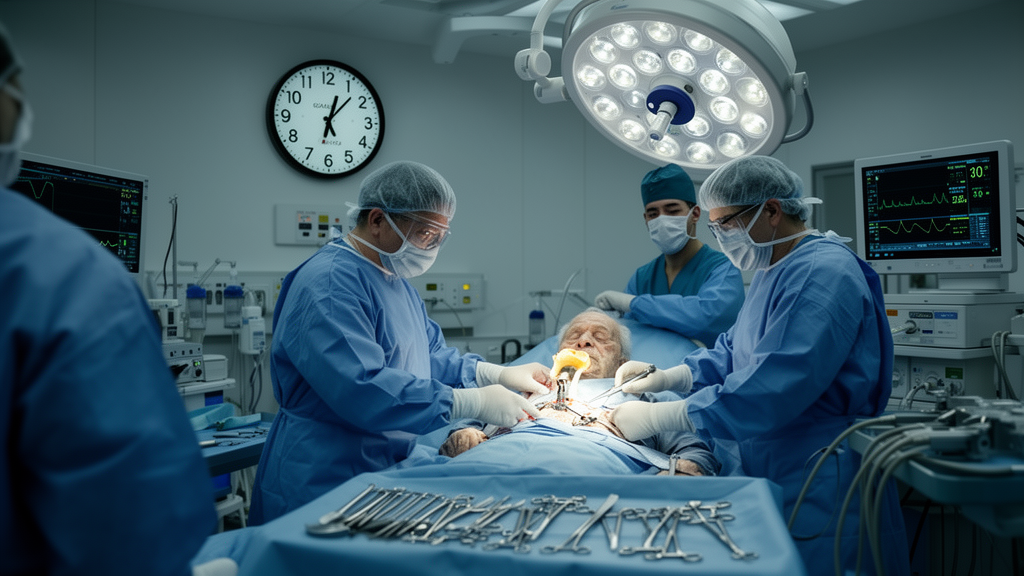
When a hip replacement becomes infected, the clock starts ticking the moment a patient walks through the hospital doors. A new study from a specialized referral centre in Canada suggests that every hour of delay before surgery may quietly raise the risk that the patient will not survive the next three months. The research, published in the Journal of Bone and Joint Infection, examined patients with infected total hip replacements who underwent a joint-preserving operation known as DAIR — debridement, antibiotics, and implant retention. The findings add hip infections to a growing body of evidence that in the fight against implant-associated infections, timing is not just a logistical detail but a matter of life and death.
The study was conducted at a high-volume academic tertiary centre that specializes in the treatment of prosthetic joint infections, a complication that affects a small but meaningful fraction of the growing population of patients living with artificial joints. The researchers reviewed the records of 100 patients who underwent DAIR for acute infections of total hip replacements between 2008 and 2021, each with a minimum of two years of follow-up. Acute infections were defined using the 2018 criteria of the Musculoskeletal Infection Society, and included both infections occurring within six weeks of the original hip operation and sudden hematogenous infections, in which bacteria travel through the bloodstream and seed the implant after a symptom-free period. The average age of the patients was nearly 69 years, and more than half were women.
DAIR is the least invasive surgical option for an acute prosthetic joint infection. Rather than removing the entire implant — as required in single- or two-stage revision surgery — surgeons open the joint, thoroughly wash out the infected tissue with at least six litres of saline, exchange the modular components that bacteria can colonize, and then treat the patient with targeted antibiotics. Compared with full revision, DAIR carries less morbidity, costs less, and is technically simpler. But its Achilles heel is the biofilm: once bacteria have built a mature, protective layer on the metal and plastic surfaces of the implant, neither the immune system nor systemic antibiotics can reliably eradicate them, and the only cure is to remove the hardware entirely.
That biological reality is what makes timing so critical. Preclinical work has shown that immature Staphylococcus aureus biofilms can begin forming on implant surfaces as early as three hours after bacterial attachment, and that mature biofilms can develop within 24 hours. Although those laboratory timelines have not been directly translated to patients, they provide a sobering backdrop for the clinical data. Previous studies had already shown that in infected knee replacements, delays of more than 48 hours from admission to DAIR were associated with higher rates of septic reoperation and postoperative complications. In hip fracture care, too, surgery within 48 hours of admission is a well-established benchmark for reducing death and complications. What remained unknown was whether the same clock governed infected hip replacements.
The answer, according to the new analysis, appears to be yes. The mean time from hospital admission to DAIR in the cohort was 46.4 hours, with a wide spread ranging from 3 to 240 hours, and 27 percent of patients waited more than two days for surgery. Using multivariate regression to untangle the effects of age, health status, infection severity, and other variables, the researchers found that each additional hour of delay from admission to the operating room was associated with roughly a 2 percent increase in the odds of death within 90 days — an odds ratio of 1.02 with a confidence interval of 1.00 to 1.03 and a p-value of 0.04. Notably, the time from the onset of symptoms to surgery showed no significant relationship with any outcome, a finding the authors attribute to the inherent subjectivity and unreliability of patient-reported symptom timelines.
The study also identified other, less modifiable risk factors that shaped patient fates. Increasing age raised the risk of death within one year, with each additional year of life corresponding to a 6 percent increase in odds. Patients classified as McPherson host grade C — those with the poorest overall systemic health — faced dramatically elevated risks compared with grade A patients: a nearly thirteenfold increase in one-year mortality and a more than sevenfold increase in postoperative complications. Low preoperative haemoglobin emerged as a significant predictor of reoperation, with each gram-per-litre decrease raising the odds by about 4 percent. The severity of the local extremity condition also mattered, with grade II extremities carrying more than three times the risk of complications compared with grade I.
The raw outcomes of the cohort were sobering. Just over half of the patients — 52 percent — eventually required reoperation for stubborn infection that DAIR could not cure, and patients averaged 1.5 additional hip surgeries after the initial procedure. Thirty percent were readmitted within 90 days, and mortality reached 3 percent at 30 days, 6 percent at 90 days, and 12 percent at one year. Nearly 70 percent experienced postoperative complications, the vast majority of them severe enough to require surgical intervention. The authors caution that their centre is a regional referral hub for the most complex prosthetic joint infections, which likely inflates these failure rates compared with the 58 to 78 percent success rates reported in broader literature. Indeed, 89 percent of the cohort carried an ASA classification of III or IV, indicating severe systemic disease, and the average body mass index of 31 placed most patients in the obese category.
The microbiology added another layer of complexity. Intraoperative cultures revealed a high prevalence of difficult-to-treat pathogens, including polymicrobial infections, methicillin-resistant Staphylococcus aureus, and gram-negative organisms such as Enterococcus, Klebsiella, Enterobacter, and E. coli. Among the patients who died within a year, a quarter had polymicrobial cultures, and Enterococcus and Enterobacter species each appeared in nearly 17 percent of cases — consistent with prior research linking Enterococcus infections after hip replacement to increased mortality. Antibiotic therapy itself was a long haul: the mean initial regimen lasted 37 days, 42 percent of patients required chronic suppressive antibiotics afterwards, and the total antimicrobial exposure averaged more than 333 days per patient. Interestingly, delays beyond 48 hours did not prolong antibiotic courses, suggesting that the harm of waiting manifests through biology rather than through treatment intensity.
Perhaps the most actionable part of the study is its dissection of why delays happen. The mean time from admission to DAIR was about 6.6 hours longer than in a comparable knee infection cohort from the same institution, and the reasons for the longest delays included operating room availability, the need to optimize medical comorbidities, and the management of anticoagulant medications. Many of these barriers are modifiable. Patients on direct oral anticoagulants or warfarin typically wait days for their blood to thin back to a safe range, but reversal agents could be deployed earlier in time-critical infections. Surgeon availability and familiarity with the procedure also contributed, pointing to the value of streamlined protocols, better resource allocation, and clear institutional pathways to the operating suite.
The authors are careful to acknowledge the limits of their work. The retrospective design introduces selection bias, the single-centre cohort of 100 patients produced wide confidence intervals for some estimates, and the 13-year study window spanned changes in electronic records, surgical technique, and implant technology. The study also could not define a precise cutoff — such as the 48-hour benchmark established in knee and hip fracture care — beyond which outcomes deteriorate. Still, the central message is difficult to ignore: in infected hip replacements, the time between admission and surgery is an objective, measurable, and modifiable factor tied to survival. For hospitals, the implication is that prosthetic joint infections deserve the same urgency as hip fractures, with rapid access to the operating room treated not as a convenience but as a clinical imperative. For patients and their families, the takeaway is simpler still — when an artificial joint becomes infected, hours matter.
Subject of Research: The effect of timing from hospital admission to DAIR surgery on mortality and outcomes in acute total hip prosthetic joint infections
Article Title: Timing from admission to debridement, antibiotic, and implant retention (DAIR) affects mortality risk in total hip prosthetic joint infections
Article References: Legler, J., Morgan, S., Beaulé, P., Abdelbary, H., Grammatopoulos, G., & Garceau, S. (2026). Timing from admission to debridement, antibiotic, and implant retention (DAIR) affects mortality risk in total hip prosthetic joint infections. Journal of Bone and Joint Infection, 11(4), 463-477. https://doi.org/10.5194/jbji-11-463-2026
Image Credits: AI Generated
Keywords: prosthetic joint infection, total hip arthroplasty, DAIR, surgical timing, mortality, biofilm, debridement, antibiotics, implant retention, reoperation, orthopaedic surgery, tertiary referral centre
Cite Scienmag News
Ophelia Keating. (October 9, 2026). Every Hour Counts: Surgical Delays Raise Death Risk in Infected Hip Replacements. Scienmag. https://scienmag.com/every-hour-counts-surgical-delays-raise-death-risk-in-infected-hip-replacements/
Ophelia Keating. "Every Hour Counts: Surgical Delays Raise Death Risk in Infected Hip Replacements." Scienmag, 9 October 2026, https://scienmag.com/every-hour-counts-surgical-delays-raise-death-risk-in-infected-hip-replacements/. Accessed 9 October 2026.
Ophelia Keating. "Every Hour Counts: Surgical Delays Raise Death Risk in Infected Hip Replacements." Scienmag. October 9, 2026. https://scienmag.com/every-hour-counts-surgical-delays-raise-death-risk-in-infected-hip-replacements/


