


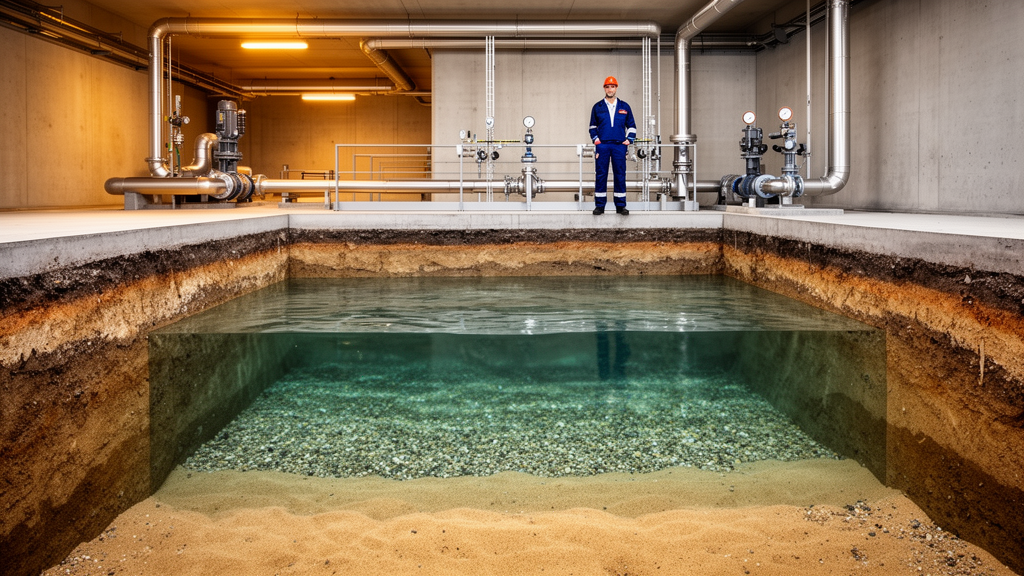
Central Europe has long been considered a water-secure corner of the world, but the relentless droughts of 2018, 2019, 2020 and 2022 shattered that assumption. In the Berlin-Brandenburg region, one of the driest parts of Germany, groundwater levels have fallen by more than two metres in two decades, river discharge has dropped by roughly forty percent since 1980, and the water balance of the catchment southeast of the capital now runs a deficit of around 319 million cubic metres per year. A new study published in Natural Hazards and Earth System Sciences argues that a large part of the solution may lie directly beneath the region’s feet: storing surplus river water in deep, confined aquifers during wet years, then pumping it back out when drought strikes.
The research, led by Abdelrahman Ahmed Ali Abdelrahman of the Hydrogeology Department at Technische Universität Berlin together with colleagues from the Potsdam Institute for Climate Impact Research, Adelphi Research, and Freie Universität Berlin, presents a scalable framework for evaluating Aquifer Storage, Transfer and Recovery, or ASTR. Unlike conventional aquifer storage and recovery, which uses the same well for injection and extraction, ASTR separates the two: water is injected at one site and recovered at another, allowing the aquifer itself to act as a vast subterranean reservoir and treatment system. The approach is well established in some parts of the world but has been largely overlooked in Central Europe, where managed recharge has historically focused on unconfined aquifers and induced bank filtration along rivers and lakes.
The timing of the study is no accident. Berlin’s public water utility supplied 214 million cubic metres of drinking water in 2024, and the region faces a double squeeze in the coming decades. The planned phase-out of lignite mining by 2038 will eliminate mine-water discharges that currently augment river flows, removing up to 126 million cubic metres per year during dry summers. At the same time, regional water demand is projected to rise by around 50 million cubic metres by 2050 as the population grows and climate change intensifies evaporative stress. Annual precipitation in the study catchment averages just 534 to 631 millimetres, while evapotranspiration claims 529 to 673 millimetres, leaving sandy soils with little capacity to buffer dry spells.
To assess whether ASTR could realistically work here, the team built a four-component framework designed to be transferable to other sedimentary basins. First, they quantified drought using two complementary indices: the Standardized Precipitation Evapotranspiration Index, or SPEI, computed from ERA5 reanalysis data at one, three, six and twelve-month accumulation periods, and the non-parametric Standardized Groundwater Index, or SGI, calculated month by month from 176 long-term monitoring wells spanning three aquifer complexes. The comparison revealed that groundwater anomalies in the confined system track annual-scale climatic water balances closely, with the twelve-month SPEI showing the strongest correlation with groundwater levels at zero lag, a Pearson coefficient of 0.734. Shorter-timescale meteorological droughts, by contrast, barely registered in the deep aquifer, which responds primarily to accumulated climatic anomalies rather than individual wet or dry months.
Second, the researchers mapped where ASTR could physically be implemented using a GIS-based multi-criteria decision analysis. They scored the landscape on six criteria derived from a three-dimensional hydrogeological model of the North German Basin: the storativity of the confined Saalian aquifer, which serves as the region’s primary water source; its horizontal hydraulic conductivity; the depth to the aquifer top; land-use compatibility; the distance to source water; and groundwater travel times to existing extraction wells. Absolute exclusion zones, including water bodies, wetlands and drinking-water protection zones, were masked out. The result was striking: 62.8 percent of the catchment, some 2,154 square kilometres, was classified as viable for ASTR, with 19.5 percent rated highly suitable. A sensitivity analysis using three different weighting schemes confirmed that the spatial pattern of high-suitability zones remained essentially unchanged, indicating that geology, not subjective weighting, controls where storage is feasible.
Third, the team tackled the thorniest question: how much surface water can actually be diverted without harming river ecosystems? Drawing on daily discharge records from 27 gauging stations covering 1980 to 2024, they compared two abstraction regimes. The first, more permissive approach applies a fixed hydroecological flow limit combined with a rule allowing up to twenty percent of instantaneous flow to be captured once the limit is exceeded. The second, stricter approach permits abstraction only during specific high-flow windows, preserving median flows and channel-maintenance floods. The trade-off was clear: the permissive rule yields larger volumes but with greater year-to-year variability, while the restrictive rule produces smaller but more ecologically conservative captures.
The water-availability results revealed a pronounced upstream-downstream gradient. Upstream sites offered modest potential, sometimes offsetting only a tenth of local groundwater extraction, whereas high-potential downstream sites could deliver mean annual recharge volumes of 1.6 to 4.3 million cubic metres, offsetting between 6 and 79 percent of local withdrawals, and in wet years exceeding them entirely. At the catchment scale, the total mean annual divertible volume came to 23 million cubic metres under the permissive approach and 18.2 million cubic metres under the restrictive one, rising to nearly 50 and 62 million cubic metres respectively in high-flow years. Crucially, the severe drought year of 2018 slashed available volumes by 40 to 100 percent across sites, a finding the authors say underscores the core logic of ASTR: it is designed to bank wet-period surpluses, not to depend on drought-time flows.
The economics add a compelling dimension. Drawing on published European cost benchmarks of 0.30 to 0.60 euros per cubic metre of recharged water, the researchers estimate that managing the mean annual volumes would cost roughly 5.5 to 13.8 million euros per year. Producing an equivalent volume of new drinking water in the region costs about 1.80 euros per cubic metre, implying potential annual savings of 21.6 to 34.5 million euros under average conditions, and up to 82.7 to 105.5 million euros in wet years. The authors caution that these are screening-level figures and that site-specific capital, rehabilitation and operational costs could shift the calculus, but the order-of-magnitude gap between recharging water underground and manufacturing it conventionally is difficult to ignore.
The framework’s real significance may lie beyond Brandenburg. Its components, drought indices, multi-criteria suitability mapping, ecological flow thresholds and economic screening, rely on data types that most water-stressed regions already collect, making the approach genuinely transferable to other confined multi-layer aquifer systems across Europe and beyond. The authors are careful about what remains to be done: transient groundwater-flow modelling is needed to evaluate hydraulic responses and recovery efficiency, field campaigns must assess vertical conductivity, leakage and geochemical compatibility, and only about a third of the region’s surface-water network was monitored densely enough to include in the analysis. Pilot-scale trials, refined cost estimates and governance frameworks covering water rights and cost-sharing will all be essential before injection wells start filling the Saalian sands.
Still, the study reframes how a supposedly water-rich continent might prepare for a drier future. Rather than building new reservoirs on the surface, where evaporation and land conflicts loom large, the Berlin-Brandenburg analysis suggests that the region’s glacially deposited aquifer layers, sandwiched between confining tills and shielded from deeper saline groundwater by the Rupelian Clay, can serve as a natural drought bank. Groundwater in the confined system already moves in step with the annual climatic water balance, and the geology appears far more permissive than the scarcity of ASTR projects in Central Europe would suggest. As droughts grow longer and hotter through the twenty-first century, the study argues, the smartest reservoir may be the one nobody can see, provided societies learn to fill it when the rivers run high and to draw it down only when they run dry.
Subject of Research: Managed aquifer recharge and aquifer storage, transfer and recovery feasibility in confined multi-layer aquifers for drought resilience in the Berlin-Brandenburg region
Article Title: Managed aquifer recharge in confined multi-layer aquifers: a scalable framework for drought resilience in central Europe
Article References: Abdelrahman, A. A. A., Koch, H., Hossain, M., Heim, R., Hauke, C., & Engelhardt, I. (2026). Managed aquifer recharge in confined multi-layer aquifers: a scalable framework for drought resilience in central Europe. Natural Hazards and Earth System Sciences, 26(10), 4641-4661. https://doi.org/10.5194/nhess-26-4641-2026
Image Credits: AI Generated
DOI: 10.5194/nhess-26-4641-2026
Keywords: managed aquifer recharge, aquifer storage and recovery, drought resilience, groundwater, Berlin-Brandenburg, water scarcity, ecological flows, GIS multi-criteria decision analysis, SPEI, SGI, confined aquifers, water security
Cite Scienmag News
Sloane Callahan. (October 9, 2026). Storing Drought-Proof Water Underground: Berlin’s Aquifers Could Save Millions. Scienmag. https://scienmag.com/storing-drought-proof-water-underground-berlins-aquifers-could-save-millions/
Sloane Callahan. "Storing Drought-Proof Water Underground: Berlin’s Aquifers Could Save Millions." Scienmag, 9 October 2026, https://scienmag.com/storing-drought-proof-water-underground-berlins-aquifers-could-save-millions/. Accessed 9 October 2026.
Sloane Callahan. "Storing Drought-Proof Water Underground: Berlin’s Aquifers Could Save Millions." Scienmag. October 9, 2026. https://scienmag.com/storing-drought-proof-water-underground-berlins-aquifers-could-save-millions/


