


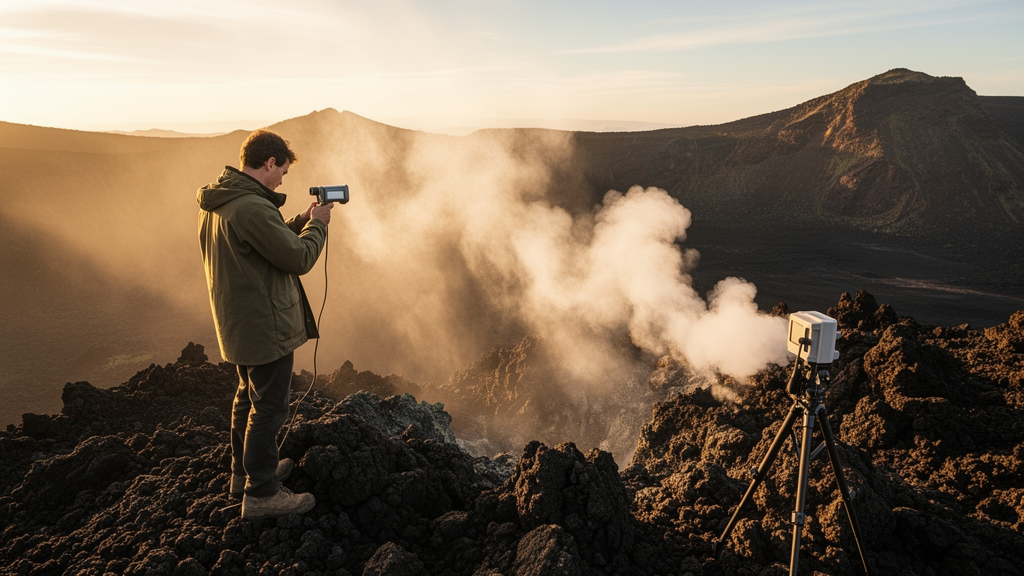
Volcanoes are among the most powerful and least predictable forces on Earth, and the gases they exhale are among the best clues scientists have about what is happening deep beneath the surface. For decades, researchers have dreamed of reading the chemical composition of a volcanic plume continuously, safely, and automatically, without having to point an instrument at glowing lava or wait for the sun to line up perfectly with the plume. A new feasibility study published in the journal Atmospheric Measurement Techniques by a team at Heidelberg University and the Istituto Nazionale di Geofisica e Vulcanologia suggests that this dream is now within reach for some volcanic gases, while remaining stubbornly out of reach for the most famous one of all: carbon dioxide.
The core idea behind the new study is elegantly simple. Instead of relying on a hot light source such as lava, an artificial lamp, or direct sunlight, the proposed instrument would read sunlight that has been scattered by the sky itself. The light travels down from the sun, bounces off molecules and aerosols in the atmosphere, passes through the volcanic plume, and is collected by a telescope pointed at whatever patch of sky happens to contain the plume. Because the sky is always glowing with scattered sunlight, the instrument does not depend on a favorable solar geometry, a clear line of sight to hot rock, or an ongoing eruption. That freedom of viewing geometry is precisely what makes continuous, automated monitoring possible rather than campaign-based.
Today’s operational volcanic gas monitoring exploits exactly this trick, but only in the ultraviolet and visible part of the spectrum, where scattered sunlight is abundant. The workhorse technique, differential optical absorption spectroscopy, is deployed worldwide in networks such as the Network for Observation of Volcanic and Atmospheric Change, or NOVAC, and it measures sulfur dioxide superbly. The problem is that sulfur dioxide is only one character in a much richer chemical story. Gases such as hydrogen chloride, hydrogen fluoride, water vapor, and carbon dioxide absorb infrared light rather than ultraviolet light, so the standard UV instruments simply cannot see them. The Heidelberg team asked a deceptively straightforward question: is there enough near-infrared sunlight scattered from the sky to measure those infrared-absorbing gases with a passive Fourier transform infrared, or FTIR, spectrometer?
Answering that question required the researchers to predict, with quantitative rigor, how well such an instrument would actually perform. They built a physics-based instrument model that tracks the optical power delivered to the detector, the responsivity of the infrared photodiode, and the dominant noise sources, which shift from thermal noise in the detector’s shunt resistance under dark skies to unavoidable shot noise under bright ones. The model captures the classic trade-offs of FTIR spectroscopy: signal quality improves only with the square root of measurement time, degrades linearly with finer spectral resolution, and scales with the light-gathering capacity of the optics. Crucially, the team validated the model in the laboratory using an integrating sphere at seven different brightness levels, deliberately spanning the transition between the two noise regimes. Every measured signal-to-noise ratio fell within the model’s predicted interval, giving the authors confidence that their forecasts for a real volcano were grounded in reality rather than optimism.
To translate spectral quality into gas measurements, the researchers combined the instrument model with an information-content analysis anchored in real atmospheric observations. They chose Mount Etna in Sicily as their test case, and for good reason: Etna is one of the largest halogen point sources on the planet, one of the strongest volcanic emitters of carbon dioxide, and one of the most significant continuous gas emitters worldwide. Radiometrically calibrated measurements of the near-infrared sky brightness at Etna, recorded during a 2021 campaign, allowed the team to bracket the expected light levels, from a crisp clear sky to an aerosol-laden one, a range spanning roughly an order of magnitude. Additional sky spectra recorded from the roof of the Institute of Environmental Physics in Heidelberg let the team capture the systematic errors that plague real total-column retrievals, errors that a purely synthetic study would have missed.
The verdict on carbon dioxide is sobering. Carbon dioxide is everywhere in the atmosphere at roughly 420 parts per million, so a volcanic plume adds only a modest enhancement on top of a large and variable background. Combine that with the fact that relatively little sunlight is scattered in the near-infrared, and the numbers become brutal: even under bright skies, reaching a detection limit comparable to the expected plume enhancement takes about five minutes of averaging, and under dark conditions up to two and a half hours. Plume transects, the standard method for quantifying emissions, require many individual measurements at a precision roughly ten times better than the signal itself, which pushes the required averaging time for carbon dioxide to eight hours or even days. In practical terms, scanning a plume for carbon dioxide with this technique is out of reach, although single snapshot measurements of plume composition remain conceivable.
The halogen gases tell a completely different story. Hydrogen chloride and hydrogen fluoride have essentially no atmospheric background, so whatever the instrument sees is almost purely volcanic signal. The analysis shows that these species can be detected within seconds under bright skies and within a few minutes under dark conditions at a strongly emitting volcano like Etna. Even for the demanding precision required of plume transects, the halogens need between five minutes and three hours of averaging, which is far more favorable than carbon dioxide but still slower than the five to fifteen minutes typical of the NOVAC sulfur dioxide network. The team’s performance estimates also line up closely with historical mid-infrared measurements at Popocatépetl volcano in Mexico from 1998, which lends independent credibility to the numbers.
Perhaps the most actionable outcome of the study is a proposed multi-instrument strategy that plays to the strengths of each technique. The FTIR instrument would be paired with a co-aligned ultraviolet spectrometer measuring sulfur dioxide along the identical light path, allowing the researchers to compute gas ratios such as hydrogen chloride to sulfur dioxide directly. Those ratios, multiplied by the sulfur dioxide fluxes already delivered around the clock by established monitoring networks, would yield continuous estimates of halogen emissions, a quantity that is currently very hard to obtain. An additional sulfur dioxide camera could track the plume’s position in real time, ensuring the paired instruments always sample the plume’s core. For carbon dioxide, this route is not entirely excluded, but the authors caution that limited precision and the sensitivity of a background-dominated retrieval to radiative transfer errors make the outcome difficult to predict.
That radiative transfer challenge deserves emphasis, because it is the next great hurdle. The light path in a scattered-sunlight observation divides conceptually into three segments: the portion behind the plume where sunlight is scattered into the viewing direction, the portion inside the plume where the target gases accumulate, and the portion between the plume and the observer. Accurately modeling this path depends on aerosol load, aerosol type, and height distributions, all of which are highly variable and poorly constrained for instantaneous local measurements. For gases that exist only in the plume, such as the halogens, observations of plume geometry may suffice. For carbon dioxide, the authors suggest using methane as a proxy gas: it shares a similar background distribution, is not emitted by the volcano in relevant amounts, and absorbs at wavelengths close to the carbon dioxide lines, so it experiences nearly the same light path.
The study’s framework, an instrument noise model validated in the laboratory and coupled to an information-content analysis grounded in real measurements, is deliberately transferable. It can be applied to other instruments, spectral regions, target species, and emission sources before any hardware is built. Intriguingly, the authors point out that anthropogenic super-emitters such as power plants and industrial facilities produce carbon dioxide enhancements far larger than those of a volcanic plume, meaning that sky-scattered sunlight measurements of carbon dioxide may well prove feasible in that context even if volcanoes remain a stretch. For volcanology, the immediate path forward is clear: pair the new near-infrared capability with the ultraviolet instruments already in the field, and continuous, automated monitoring of halogen emissions, and with it a sharper window into the processes that drive eruptions, moves from aspiration to engineering.
Subject of Research: Feasibility of passive near-infrared FTIR spectroscopy of sky-scattered sunlight for measuring volcanic gas emissions
Article Title: Feasibility of measuring volcanic gas composition using sky-scattered sunlight and FTIR spectroscopy
Article References: Schmitt, T. D., Sindram, M., Löw, B. A., Weis, L., Kleinschek, R., Bobrowski, N., & Butz, A. (2026). Feasibility of measuring volcanic gas composition using sky-scattered sunlight and FTIR spectroscopy. Atmospheric Measurement Techniques, 19(18), 6145-6157. https://doi.org/10.5194/amt-19-6145-2026
Image Credits: AI Generated
Keywords: volcanic gases, FTIR spectroscopy, remote sensing, carbon dioxide, hydrogen chloride, hydrogen fluoride, sulfur dioxide, Mount Etna, scattered sunlight, near-infrared, volcano monitoring, radiative transfer
Cite Scienmag News
Russell Cooper. (October 9, 2026). Volcanic Gases Caught in Scattered Sunlight: New Infrared Method Shows Promise and Limits. Scienmag. https://scienmag.com/volcanic-gases-caught-in-scattered-sunlight-new-infrared-method-shows-promise-and-limits/
Russell Cooper. "Volcanic Gases Caught in Scattered Sunlight: New Infrared Method Shows Promise and Limits." Scienmag, 9 October 2026, https://scienmag.com/volcanic-gases-caught-in-scattered-sunlight-new-infrared-method-shows-promise-and-limits/. Accessed 9 October 2026.
Russell Cooper. "Volcanic Gases Caught in Scattered Sunlight: New Infrared Method Shows Promise and Limits." Scienmag. October 9, 2026. https://scienmag.com/volcanic-gases-caught-in-scattered-sunlight-new-infrared-method-shows-promise-and-limits/


