


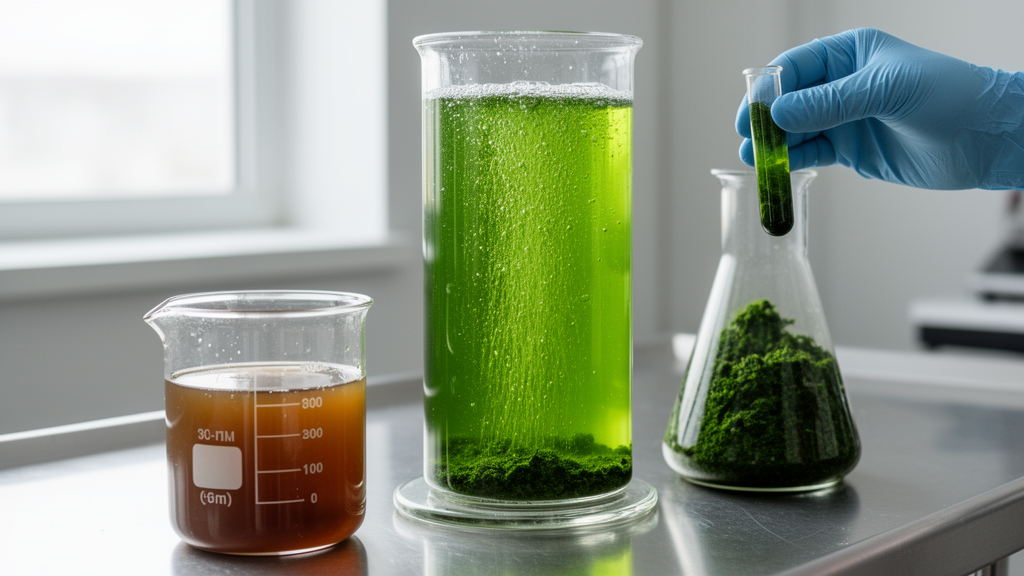
A team of researchers in southern Brazil has isolated a native strain of the green microalga Tetradesmus obliquus from domestic wastewater and shown that it can simultaneously strip pollutants from sewage and produce biomass packed with protein and polyunsaturated fatty acids. The study, published in Environmental Science and Pollution Research, offers a compelling glimpse of how wastewater treatment and biomass production could be fused into a single circular process, turning an expensive disposal problem into a source of valuable biomolecules.
The appeal of microalgae in wastewater treatment lies in their basic biology. These photosynthetic microorganisms feed on exactly the compounds that make sewage an environmental hazard: nitrogen and phosphorus compounds that otherwise drive eutrophication, the oxygen-depleting overgrowth of aquatic ecosystems. Conventional treatment plants remove these nutrients through energy-intensive physicochemical and biological processes that also generate secondary sludge. Microalgae, by contrast, assimilate ammonium and phosphate directly into their cells, converting pollutants into biomass that can then be harvested for feed, fertilizers, nutraceuticals, or biofuels. The catch has always been economics: large-scale algal cultivation demands enormous quantities of freshwater and synthetic nutrients, precisely the inputs that wastewater could replace.
The Brazilian team, led by researchers at the Federal University of Pelotas, tackled this challenge by working with a strain isolated directly from local wastewater, on the logic that microorganisms adapted to local conditions and effluent variability should outperform laboratory strains in real-world systems. Molecular identification confirmed the isolate as Tetradesmus obliquus: sequencing of the 18S ribosomal RNA gene revealed 99.69 percent identity with reference sequences, and phylogenetic analysis placed the strain, designated CICLO_00125, within a well-supported Tetradesmus obliquus clade. Microscopy showed the characteristic four-cell coenobia and ellipsoidal cells typical of the species, a genus already recognized for rapid growth, high nutrient uptake, and metabolic plasticity in eutrophic environments.
The experimental design paired two wastewater matrices with three inoculation densities. Raw domestic wastewater, collected before any treatment, was compared with primary-treated wastewater that had undergone mesh filtration, chemical flocculation with aluminum sulfate, and sedimentation. Each effluent was inoculated with the alga at 10, 20, or 30 percent of the culture volume, and the six combinations were cultivated for 14 days in aerated flasks under continuous LED illumination, alongside uninoculated controls. This setup allowed the researchers to disentangle two variables that are rarely evaluated together: how much the effluent has been pretreated, and how many algal cells are added at the start.
The two effluents turned out to be strikingly different cultivation environments. Raw wastewater carried higher concentrations of ammonium, phosphate, iron, and manganese, along with high turbidity that limits light penetration. Primary treatment removed nearly all the suspended particles and trace metals, dropping optical density from 0.34 to 0.07 and pushing iron and manganese below detection, but it also stripped away some nutrients, reducing phosphate from 7.22 to 4.03 milligrams per liter. The clarified effluent offered better light for photosynthesis but a leaner nutritional menu, a trade-off that shaped everything that followed.
The standout bioremediation result came from the lowest inoculum density in treated wastewater. There, the alga removed 62.46 percent of ammonium and an impressive 98.56 percent of phosphate over 14 days, while simultaneously achieving the highest specific growth rate of the entire study, 0.16 per day, and the highest biomass productivity, 42.54 milligrams per liter per day. Counterintuitively, adding more cells did not improve removal. At the two higher inoculum densities in treated wastewater, phosphate removal collapsed to 42.80 percent and a mere 7.59 percent, even though final biomass concentrations were comparable. The researchers attribute this to self-shading: denser cultures reduce the light reaching each individual cell, and light drives the energy-hungry active transport of phosphate and its storage as polyphosphate, the so-called luxury uptake mechanism. High pH values above 10 in those dense cultures confirmed that bulk photosynthesis continued, pointing the finger at per-cell irradiance rather than culture-wide metabolic failure.
Nutrient removal in the raw wastewater followed a different logic. Turbidity constrained algal photosynthesis, but the effluent’s rich organic load fueled resident bacteria, which likely contributed substantially to ammonium transformation through nitrification and other microbial processes. The highest volumetric ammonium removal rate of the study, 3.40 milligrams per liter per day, occurred in raw wastewater at the highest inoculum density, under conditions least favorable to algal photosynthesis, a hint that the microalgae-bacteria consortium, not the alga alone, was doing much of the work. The authors are careful to note that bacterial contributions were not directly quantified, since nitrogen fluxes and community composition were not measured, but the pattern is consistent with a growing literature on metabolically coupled algal-bacterial systems, in which algae supply oxygen for bacterial nitrification while bacteria release carbon dioxide that feeds algal growth.
Metal removal added another dimension to the bioremediation story. Iron concentrations fell by up to 99 percent in inoculated treatments, and in the treated wastewater both iron and manganese dropped below detection limits, with manganese removal efficiencies of 80 to 100 percent. Because removal did not scale with inoculum density, the researchers conclude that a rapid, saturable passive biosorption onto cell-surface and exopolysaccharide functional groups dominates the process, followed by slower intracellular uptake, with abiotic co-precipitation of metal hydroxides at elevated pH contributing as well. The consistently lower residual metal concentrations in inoculated cultures compared with controls mark the alga’s contribution clearly.
Perhaps the most commercially intriguing finding is that the two wastewaters yielded biochemically distinct biomass. Biomass grown in raw wastewater accumulated significantly more carbohydrates, up to 32.68 percent, and more chlorophyll, reaching 14.46 milligrams per gram, likely a photoacclimation response to the dim, turbid environment. Biomass from treated wastewater, especially at the lowest inoculum, contained up to 45.83 percent protein, a level comparable to conventional protein crops, and a lipid fraction in which polyunsaturated fatty acids made up 72.70 to 78.90 percent of the total, dominated by alpha-linolenic and linoleic acids, the omega-3 and omega-6 essential fatty acids prized in nutrition. The researchers link this PUFA enrichment to the thylakoid membrane lipids that proliferate in fast-growing, light-replete cells. Putative long-chain PUFAs, including signals matching docosahexaenoic acid, appeared at levels higher than typically reported for this genus, though the authors caution that these identifications are preliminary and based on relative peak areas rather than absolute yields.
The study stops short of declaring the technology ready for prime time. Harvesting dilute algal cultures remains an energy bottleneck, effluent composition varies seasonally, and non-sterile cultivation carries contamination risks, while the fate of trace contaminants in wastewater-grown biomass would need application-specific assessment before any use in feed or food. Still, the demonstration that a single, locally adapted algal strain can clean real sewage, remove trace metals, and produce biomass whose composition can be steered between carbohydrate-rich and protein-and-PUFA-rich profiles simply by choosing the effluent and the inoculum density, is a meaningful step toward wastewater treatment plants that do not just dispose of waste but harvest it. Pilot-scale trials with techno-economic and life-cycle analysis are the logical next test for this circular bioeconomy vision.
Subject of Research: Bioremediation of domestic wastewater by a native Tetradesmus obliquus strain for production of protein- and PUFA-rich microalgal biomass
Article Title: Integration of domestic wastewater and native Tetradesmus obliquus for bioremediation and production of biomass rich in protein and polyunsaturated fatty acids
Article References: do Amaral, D. S., Werner, L., Pagano, A. D., Leitzke, A. F., Hakbart Boneman, D., La Rosa Novo, D., Nunes, L. S., Bueno, D. T., Laporta, L. V., Crizel, R. L., Filho, A. V., Campos, V. F., & de Pereira, C. M. P. (2026). Integration of domestic wastewater and native Tetradesmus obliquus for bioremediation and production of biomass rich in protein and polyunsaturated fatty acids. Environmental Science and Pollution Research, 33(30), 15417-15442. https://doi.org/10.1007/s11356-026-38213-w
Image Credits: AI Generated
DOI: 10.1007/s11356-026-38213-w
Keywords: Tetradesmus obliquus, microalgae, wastewater treatment, bioremediation, polyunsaturated fatty acids, protein, biomass productivity, inoculum density, circular bioeconomy, nutrient removal, eutrophication, biosorption
Cite Scienmag News
Violet Maxwell. (October 9, 2026). Native Algae Strain Turns Sewage Into Protein-Rich Biomass While Cleaning Wastewater. Scienmag. https://scienmag.com/native-algae-strain-turns-sewage-into-protein-rich-biomass-while-cleaning-wastewater/
Violet Maxwell. "Native Algae Strain Turns Sewage Into Protein-Rich Biomass While Cleaning Wastewater." Scienmag, 9 October 2026, https://scienmag.com/native-algae-strain-turns-sewage-into-protein-rich-biomass-while-cleaning-wastewater/. Accessed 9 October 2026.
Violet Maxwell. "Native Algae Strain Turns Sewage Into Protein-Rich Biomass While Cleaning Wastewater." Scienmag. October 9, 2026. https://scienmag.com/native-algae-strain-turns-sewage-into-protein-rich-biomass-while-cleaning-wastewater/


