


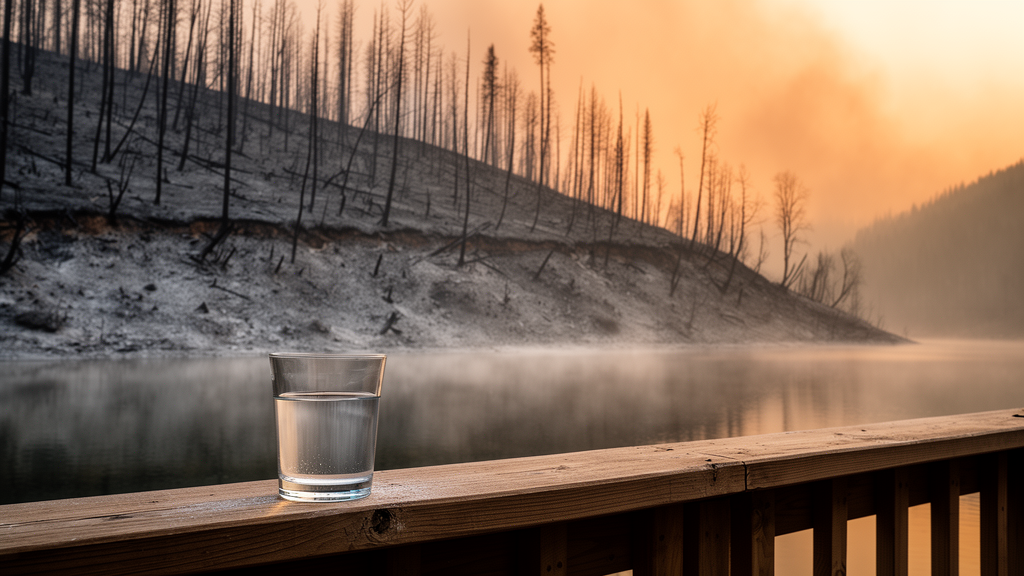
When a wildfire tears through a forest, the most visible damage is written in charred trees and ash-covered soil. But some of the most consequential damage may be invisible, dissolved in the water that flows off burned landscapes in the weeks and months that follow. A new scoping review published in PLOS Water suggests that wildfires are a far more significant driver of arsenic contamination in water resources than previously appreciated, and that communities downstream of burned areas may need to think seriously about testing their drinking water supplies.
The review, conducted by Jordan Willeford, Leigh Moorhead, Kai Malone, Alexis Payton, Janice S. Lee, Julia E. Rager, and Stephen D. LeDuc, set out to answer three deceptively simple questions: Does the type of fuel burned influence how arsenic is mobilized by wildfire? What pathways carry arsenic into water most often? And how do arsenic concentrations in surface water and groundwater actually change after a fire? To answer them, the team systematically queried Google Scholar, PubMed, and Web of Science using Boolean search strings, then screened the results against PECO criteria, a structured framework that evaluates the Population, Exposure, Comparator, and Outcome of each study. Only twenty articles survived the screen, a strikingly small body of evidence given the scale of the problem.
That small number is itself one of the review’s most important findings. Arsenic contamination of water is one of the most heavily studied topics in environmental health, with well-documented crises from Bangladesh to the American Southwest. Yet the specific question of how wildfire alters the fate and transport of arsenic has been almost entirely neglected. As fire seasons lengthen and burn areas expand across the western United States, Australia, southern Europe, and beyond, that gap in knowledge is becoming harder to ignore.
The headline result is unambiguous. Sixteen of the twenty studies reviewed, a full eighty percent, reported an increase or a likely increase in arsenic in water bodies after wildfire. Arsenic is a naturally occurring metalloid found in soils and rocks, but it is also concentrated by human activity, particularly mining, agriculture, and industrial processes. When vegetation burns, the organic matter that binds arsenic in place is destroyed, and the element can be released from ash and soil particles. Intense heat can also alter soil chemistry, changing the mineral phases that normally lock arsenic away. The result is a reservoir of mobilizable arsenic sitting on a landscape that has just lost the vegetation and soil structure that would otherwise keep runoff in check.
When the researchers examined pathways, one route dominated above all others: runoff to surface water. Burned watersheds lose the canopy and ground cover that intercept rainfall, and fire can create water-repellent soil layers that dramatically increase overland flow. The first major storms after a fire therefore flush ash, sediment, and dissolved contaminants into streams and reservoirs with remarkable efficiency. This mechanism explains why post-fire arsenic spikes tend to be episodic rather than persistent, arriving in pulses tied to precipitation events rather than as steady elevations.
The concentrations documented in the review tell a nuanced story. In most cases, average arsenic values in surface waters did not exceed drinking water standards, which the World Health Organization and the United States Environmental Protection Agency set at ten micrograms per liter. But averages can obscure the extremes, and six of the twenty studies reported instances where standards were exceeded. Most alarmingly, one study documented exceedances not just in raw source water but in treated drinking water itself, meaning the contamination survived conventional treatment processes. The single largest dissolved arsenic value in the surveyed literature, seventy micrograms per liter, seven times the regulatory limit, was measured downstream of a legacy mining operation after a wildfire.
That finding points to a critical pattern: human activities concentrate arsenic on the landscape, and wildfire then mobilizes it. Burned agricultural areas showed elevated downstream arsenic, likely reflecting historical use of arsenical pesticides and herbicides, as well as arsenic present in irrigation-deposited sediments. Urbanized areas burned by fire produced similar results, consistent with arsenic in treated wood, industrial residues, and contaminated soils. In other words, the wildland-urban interface and post-industrial landscapes may represent the highest-risk settings of all, where the raw material for contamination is already stockpiled and a fire provides the trigger.
Groundwater tells a different and less settled story. Only three studies in the review examined groundwater, and their findings were inconsistent. One documented an increase in post-wildfire arsenic, while the other two found no change. This uncertainty is scientifically interesting and practically important. Surface water contamination arrives quickly and visibly, often forcing utilities to shut intakes or issue advisories. Groundwater contamination, by contrast, could unfold slowly and invisibly over years as arsenic-laden recharge percolates through aquifers. The limited evidence base means no one can yet say how worried private well owners near burned areas should be, which is precisely why more research is urgently needed.
The public health implications extend beyond the numbers. Arsenic is a potent carcinogen, linked to skin, bladder, and lung cancers, as well as cardiovascular disease and developmental effects, and chronic low-level exposure is a recognized global health burden. Millions of people in the western United States rely on surface water from forested watersheds that are increasingly burning, and many rural households depend on private wells that are not routinely tested for anything, let alone post-fire contamination spikes. The review’s authors suggest that communities may need to test drinking water supplies for arsenic following wildfire, especially where mining, agricultural, or urbanized areas have burned. That recommendation is inexpensive to implement and could prevent exposures during the vulnerable window immediately after a fire.
What emerges from this review is a picture of a hazard that is growing precisely as the climate warms and fire regimes intensify, yet remains poorly monitored and poorly understood. Twenty studies is not enough to predict which watersheds are most at risk, how long contamination persists, or whether treatment systems can reliably cope with post-fire arsenic pulses. But the consistency of the signal, with the overwhelming majority of studies showing mobilization, suggests that arsenic deserves a place alongside sediment, nutrients, and mercury in the standard toolkit of post-fire water quality assessment. As wildfires continue to reshape landscapes around the world, the water flowing off those burned slopes may carry risks that no one is currently measuring.
Subject of Research: Wildfire-driven mobilization of arsenic into surface water and groundwater resources
Article Title: Wildfire mobilization of arsenic into water resources: A scoping review of current literature
Article References: Willeford, J., Moorhead, L., Malone, K., Payton, A., Lee, J. S., Rager, J. E., & LeDuc, S. D. (2026). Wildfire mobilization of arsenic into water resources: A scoping review of current literature. PLOS Water, 5(8), e0000549. https://doi.org/10.1371/journal.pwat.0000549
Image Credits: AI Generated
DOI: 10.1371/journal.pwat.0000549
Keywords: wildfire, arsenic, water quality, drinking water, surface water, groundwater, contaminant mobilization, scoping review, runoff, mining, public health, watershed
Cite Scienmag News
Violet Maxwell. (October 9, 2026). Wildfires Are Quietly Pushing Toxic Arsenic Into the Water We Drink. Scienmag. https://scienmag.com/wildfires-are-quietly-pushing-toxic-arsenic-into-the-water-we-drink/
Violet Maxwell. "Wildfires Are Quietly Pushing Toxic Arsenic Into the Water We Drink." Scienmag, 9 October 2026, https://scienmag.com/wildfires-are-quietly-pushing-toxic-arsenic-into-the-water-we-drink/. Accessed 9 October 2026.
Violet Maxwell. "Wildfires Are Quietly Pushing Toxic Arsenic Into the Water We Drink." Scienmag. October 9, 2026. https://scienmag.com/wildfires-are-quietly-pushing-toxic-arsenic-into-the-water-we-drink/


