


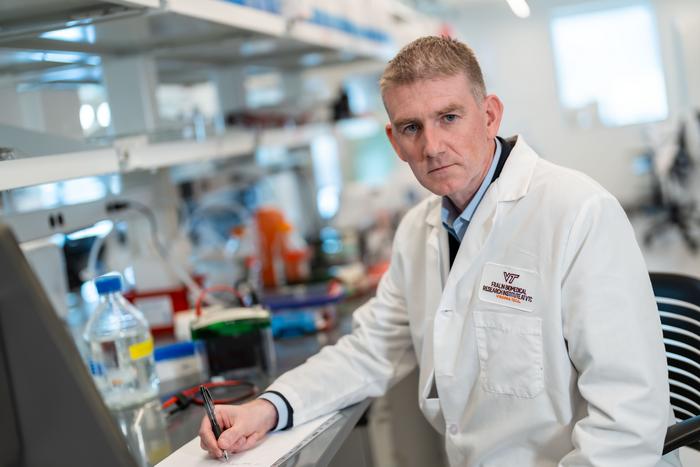
Patients in remission after battling a high-risk blood cancer are likely to have better outcomes if no trace of the cancer is detectable before the patients receive donor blood cells.

Credit: Clayton Metz/Virginia Tech
Patients in remission after battling a high-risk blood cancer are likely to have better outcomes if no trace of the cancer is detectable before the patients receive donor blood cells.
The finding in today’s (11 a.m. May 2) edition of JAMA Oncology emphasizes the importance and practicality of testing for measurable residual disease (MRD) — a condition that refers to evidence of lingering cancer cells in the body after people receive apparently successful chemotherapy treatment in adults with acute myeloid leukemia.
“The good news is this testing is doable,” said Christopher Hourigan, a Virginia Tech professor of the Fralin Biomedical Research Institute who directs the institute’s new Cancer Research Center in Washington, D.C. “We had previously shown this genetic approach massively outperformed the current testing being done clinically. This work goes further and shows you don’t need to be at a specialized center with customized technology and high levels of expertise – testing can be done using commercially available kits potentially at any major modern hospital lab. It is now a matter of implementation.”
In a study of 537 patients with AML treated throughout the United States, scientists used a method called targeted ultra-deep DNA sequencing to see if they could find specific, leftover cancer-related gene mutations in the blood of patients who were in remission, but still awaiting a bone marrow transplant from donors to restore their healthy blood supply.
The scientists were looking at DNA in blood for mutations in the FLT3 gene, which is among the most common seen in patients with AML. They found that if as little as 1 in 10,000 molecules of DNA tested contained a mutation, it corresponded with a higher risk of the cancer returning, and lower chances of survival with current standard treatments.
“Genetic testing is just one tool,” said Hourigan, who is also a professor of internal medicine at the Virginia Tech Carilion School of Medicine. “It’s not the total answer but it can help us personalize our therapy more, so long as the guide rails are in place for safety, as we understand better how beneficial prior treatments have been to the individual patient. We don’t want to treat a number. We’re treating the person. But if it helps that person, then, yes, we should use the number.”
Hourigan is the corresponding author of the study, and Laura Dillon and Gege Gui of the Laboratory of Myeloid Malignancies of the National Heart, Lung, and Blood Institute are first authors of the research.
Hourigan was an ad hoc member of the U.S. Food and Drug Administration’s Oncologic Drugs Advisory Committee that voted 12-0 earlier this month in favor of using measurable residual disease testing in those with another high-risk blood cancer called Multiple Myeloma.
Before joining Virginia Tech in April, Hourigan led the Laboratory of Myeloid Malignancies in the intramural research program of the National Heart, Lung, and Blood Institute at the National Institutes of Health. The study was supported by the Intramural Research Program of the National Heart, Lung, and Blood Institute.
Journal
JAMA Oncology
Method of Research
Data/statistical analysis
Subject of Research
People
Article Title
Measurable Residual FLT3-ITD before Allogeneic Transplant for Acute Myeloid Leukemia
Article Publication Date
2-May-2024
COI Statement
–Hourigan: The National Heart, Lung, and Blood Institute receives research funding for the laboratory of Dr. Hourigan from the Foundation of the NIH AML MRD Biomarkers Consortium.
–Andrew: Employee of Astra Zeneca
–Huang, Gerhold, Holman, D’Angelo: Employee of Invivoscribe, Inc.
–Miller: Equity holder, holder of stock options, and employee of Invivoscribe, Inc.
–Higgins: Employee and stockholder of TwinStrand Biosciences, Inc.
–Salk: Consultant and stockholder of TwinStrand Biosciences, Inc.
–Auletta: Advisory board for Takeda and AscellaHealth
–El Chaer: Consultant for SPD Oncology, Amgen, CTI BioPharma, AbbVie, Association of Community Cancer Centers. Clinical Trial Grant Support (PI) to the University of Virginia from Amgen, BMS, Celgene, SPD Oncology, Sanofi, Bristol Myers Squibb, FibroGen, PharmaEssentia, BioSight, MEI Pharma, Novartis, Arog pharmaceuticals. Travel grant from DAVA Oncology.
–Jimenez Jimenez: Research funding from AbbVie.
–De Lima: Advisory board for Pfizer and Bristol Myers Scribb. Data safety monitoring board for Novartis and AbbVie. Research funding from Miltenyi Biotec.
–Kebriaei: Consultancy and honoraris from Pfiizer and Jazz Pharmaceuticals.
Cite Scienmag News
Nathaniel Bowman. (May 2, 2024). Testing for residual cancer cells before blood cell transplant therapy is important and practical, new study finds. Scienmag. https://scienmag.com/testing-for-residual-cancer-cells-before-blood-cell-transplant-therapy-is-important-and-practical-new-study-finds/
Nathaniel Bowman. "Testing for residual cancer cells before blood cell transplant therapy is important and practical, new study finds." Scienmag, 2 May 2024, https://scienmag.com/testing-for-residual-cancer-cells-before-blood-cell-transplant-therapy-is-important-and-practical-new-study-finds/. Accessed 3 September 2026.
Nathaniel Bowman. "Testing for residual cancer cells before blood cell transplant therapy is important and practical, new study finds." Scienmag. May 2, 2024. https://scienmag.com/testing-for-residual-cancer-cells-before-blood-cell-transplant-therapy-is-important-and-practical-new-study-finds/

