


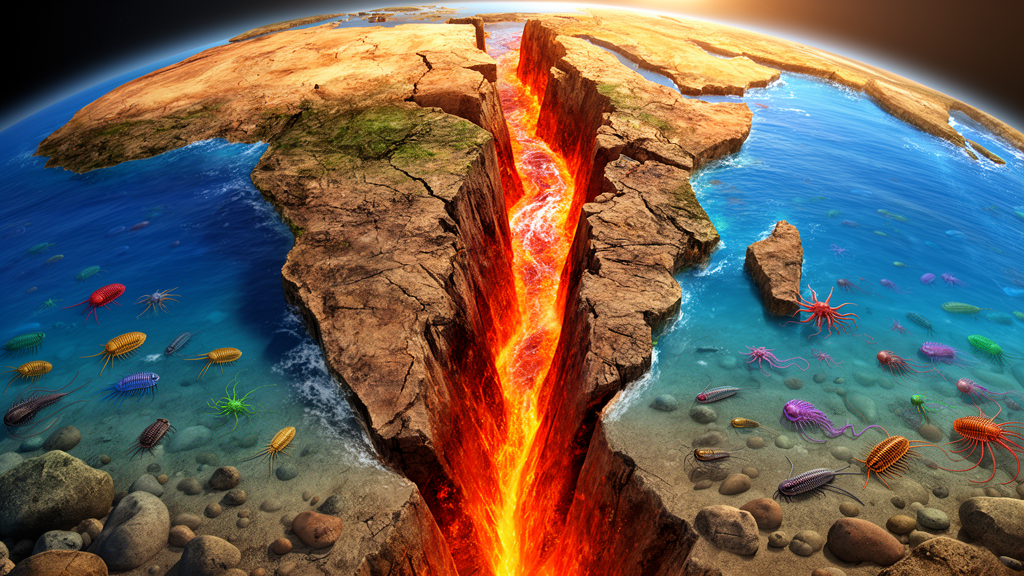
For most of Earth history, the planet was a place where complex life simply could not gain a foothold. Then, within a geologically narrow window around 540 million years ago, nearly every major animal body plan appears in the fossil record in an event so abrupt and so consequential that scientists have named it the Cambrian explosion. A new synthesis published in Continent & Life Evolution argues that the answer to this enduring mystery does not lie in biology alone, but in the deep machinery of the solid Earth. A team led by Dr. Jinlong Yao of Northwest University, together with colleagues including Guochun Zhao of Northwest University and The University of Hong Kong, presents a comprehensive model of what they call multi-factors coupling and multi-sphere driving, in which tectonics, surface environments, and the geomagnetic field interacted to create the conditions that animals needed to radiate across the oceans.
The starting point of the argument is a simple observation about what makes Earth unusual. Among the known planets, Earth alone combines life, an oxidized atmosphere, plate tectonics, stable continental crust, and a particular balance between the height of continents and the depth of ocean basins. These are not independent curiosities; they are the fundamental elements of habitability. Over geological timescales, the authors argue, tectonic movement and the supercontinent cycle have been the main engines of continental formation and of the exchange of elements and energy between oceans and continents, and between the surface spheres and the solid Earth. Understanding how those exchanges accelerated and reorganized in the late Neoproterozoic is, in their view, the key to understanding why animals appeared when they did.
A central claim of the paper concerns the timing of modern plate tectonics. Although some characteristics of plate tectonics may have operated locally as early as the Archean or Paleoproterozoic, Yao argues that a truly global modern plate tectonic regime was not established until the assembly of Gondwana during the Neoproterozoic to Early Paleozoic. The evidence cited includes whole-plate deep subduction, a global tectonic reorganization, extensive metamorphic records, and a bimodal distribution of metamorphic temperature-pressure ratios that matches that of the modern Earth. In other words, the planet’s tectonic operating system was upgraded at almost exactly the moment complex life was preparing its debut, and the authors contend that this is no coincidence.
The model constructs a co-evolutionary chain linking the supercontinent cycle, surface environment, and life evolution: the breakup of Rodinia, the Snowball Earth glaciations, the Neoproterozoic Oxygenation Event, the Gondwanan orogens and their carbon cycling, and finally the Cambrian explosion. The chain begins when the breakup of Rodinia triggered large igneous province eruptions and massive carbon dioxide degassing. The warming that followed was then reversed by the weathering of the fresh basalts, which consumed CO2 and drove the planet into the extreme glaciations known as Snowball Earth. Paradoxically, this planetary deep freeze set the stage for biological innovation, because the extreme greenhouse climate that followed the glaciations, combined with a major rise in atmospheric oxygen, laid the ecological foundation for the Ediacaran biota and, ultimately, the Cambrian radiation.
The assembly of Gondwana then supplied the sustained push. Collisional orogeny formed a super-orogenic belt roughly 9,000 kilometers long, located at middle to low latitudes where chemical weathering is most intense. Mountain building on this scale denuded enormous volumes of rock and delivered large quantities of nutrient elements, most notably phosphorus, into the ocean. Phosphorus is the limiting nutrient for marine productivity, and its enhanced delivery fueled a boom in primary production that drove and sustained the Neoproterozoic Oxygenation Event. The resulting surface environment of continuous oxygenation, sufficient nutrients, and relatively stable climate provided the energy supply, the material basis for biomineralization, and the ecological stability that large-scale metazoan radiation required.
Equally important, the authors highlight what they call orogen-driven carbon cycling as a thermostat that kept the climate within livable bounds. The vast subduction-accretionary orogens formed during Gondwanan assembly acted as both carbon source and carbon sink. Subduction-zone metamorphic decarbonation and arc volcanism continuously released CO2, preventing the Earth from sliding into a permanent icehouse as weathering of young mountains stripped carbon from the atmosphere. At the same time, intense silicate weathering consumed CO2 and produced a negative feedback cooling effect. Together, these two opposing fluxes maintained surface temperature above the threshold suitable for life across tens of millions of years, giving evolution the long, stable runway it needed.
The most provocative element of the model involves the geomagnetic field. At the Ediacaran-Cambrian boundary, the strength of Earth’s magnetic field dropped to an extremely low level, and the frequency of polarity reversals reached as high as 20 to 25 per million years, indicating that the geodynamo mechanism had effectively collapsed. The authors propose that the initial formation of Earth’s inner core may be related to the cooling of the planet’s interior caused by whole-plate deep subduction under the new tectonic regime, tying the behavior of the core directly to the behavior of the surface. A weakened magnetic field would have allowed enhanced penetration of high-energy particles and ultraviolet-B radiation, exerting extinction pressure on the vulnerable Ediacaran biota.
That same radiation stress, however, may have been a creative force. The authors suggest that the environmental pressure of a weak magnetic field conferred selective advantages on animals capable of vertical burrowing, of building biomineralized shells, or of free swimming, all of which are hallmarks of Cambrian faunas. In this view, the collapse of the geomagnetic shield did not merely permit the Cambrian explosion; it actively accelerated it, filtering out old body plans and rewarding the innovations that define the modern animal phyla. The coupling of tectonics, surface oxygenation, nutrient delivery, climate stability, and geomagnetic stress jointly provided the genetic and environmental triggers, the material basis, and the ecological space that the explosion required.
The significance of the synthesis extends well beyond the Cambrian. The authors identify tectonics and the supercontinent cycle as the primary driving forces behind the evolution of Earth’s habitability, with plate tectonics and mantle plumes acting together as the pumps that move elements and energy between the planet’s spheres. Because multi-sphere driving mechanisms have repeatedly triggered extreme events in the evolution of life and environment, ultimately shaping a habitable planet with an oxidizing ocean and atmosphere and rich biodiversity, this line of research has become a focus of international Earth science. The implications reach into natural hazard assessment, resource distribution, environmental change, climate evolution, and the search for habitability on other planets, where the presence or absence of active tectonics may ultimately determine whether a world can sustain a biosphere at all.
What emerges is a picture of the Cambrian explosion not as a single cause but as a cascade, in which the breakup of one supercontinent froze the planet, the assembly of another fed and oxygenated its oceans, and a faltering magnetic field pruned and selected the survivors. Earth evolved from an early uninhabitable body into a planet with a fully coupled multi-sphere system and flourishing life through the steady, patient work of tectonics redistributing matter and energy across its interior, surface, and atmosphere. The paper, Material cycling across Earth’s spheres and triggers of Cambrian explosion: a tectonic perspective, was published in Continent & Life Evolution, and it invites scientists to read the fossil record not merely as a history of organisms, but as a history of the planet that made them possible.
Subject of Research: Tectonically driven cross-sphere material cycling and its role in triggering the Cambrian explosion
Article Title: Material cycling across Earth’s spheres and triggers of Cambrian explosion: A tectonic perspective
Article References: Material cycling across Earth’s spheres and triggers of Cambrian explosion: A tectonic perspective. (n.d.). Original publication
Image Credits: AI Generated
DOI: Not provided
Keywords: Cambrian explosion, plate tectonics, supercontinent cycle, Rodinia, Gondwana, Snowball Earth, Neoproterozoic Oxygenation Event, geomagnetic field, carbon cycling, phosphorus, Earth habitability, mantle plumes
Cite Scienmag News
Grant Pearson. (October 9, 2026). Tectonic Upheaval, Supercontinent Breakup, and the Trigger of the Cambrian Explosion. Scienmag. https://scienmag.com/tectonic-upheaval-supercontinent-breakup-and-the-trigger-of-the-cambrian-explosion/
Grant Pearson. "Tectonic Upheaval, Supercontinent Breakup, and the Trigger of the Cambrian Explosion." Scienmag, 9 October 2026, https://scienmag.com/tectonic-upheaval-supercontinent-breakup-and-the-trigger-of-the-cambrian-explosion/. Accessed 9 October 2026.
Grant Pearson. "Tectonic Upheaval, Supercontinent Breakup, and the Trigger of the Cambrian Explosion." Scienmag. October 9, 2026. https://scienmag.com/tectonic-upheaval-supercontinent-breakup-and-the-trigger-of-the-cambrian-explosion/


