


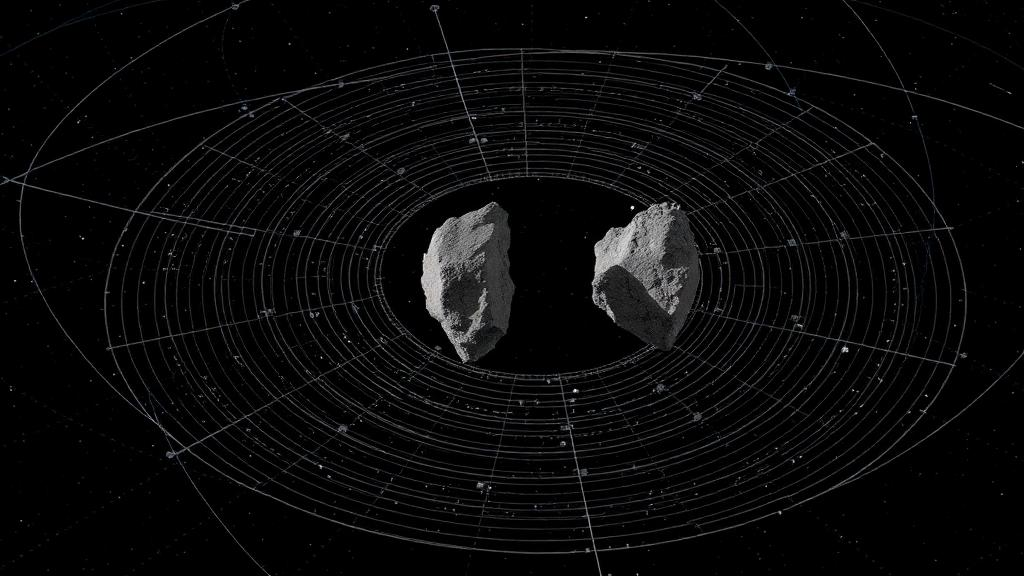
Binary asteroid systems have quietly become one of the most consequential subjects in modern space science. Roughly one in six near-Earth asteroids may be a binary pair, two rocky bodies locked in a mutual gravitational embrace as they trace orbits that carry them across the paths of planets. Understanding how those orbits evolve over months, years, and centuries is no longer an academic curiosity: it underpins planetary defense planning, the assessment of impact threats, and the emerging ambition to mine asteroids for space resources. Yet the mathematics of two irregular, spinning bodies orbiting one another is notoriously unforgiving, and even the most widely used numerical tools begin to betray their users when simulations stretch over long timescales. A research team led by Guo Yongxin of the College of Physics at Liaoning University believes it has found a way past that barrier, and the results, published in Space: Science & Technology, suggest a new standard for long-term orbital prediction.
The difficulty lies in what dynamicists call the full two-body problem. In the classical two-body problem familiar from introductory physics, two point masses attract each other with a force that depends only on the distance between them, and the resulting orbits can be described with elegant, closed-form solutions. Real asteroids are nothing like point masses. They are irregular, lumpy objects whose gravitational fields vary across their surfaces and change as they tumble. When two such bodies orbit each other, the gravitational potential of each depends simultaneously on where the other body is and how it is oriented. Translation and rotation become inseparably coupled: the way one asteroid spins alters the forces and torques acting on its companion, and vice versa. The model complexity that emerges from this coupling substantially exceeds anything in the classical problem, and it demands numerical methods that can handle both motions at once without quietly corrupting the physics.
Conventional integrators struggle here in a specific and well-understood way. Explicit Runge–Kutta methods, the workhorses of scientific computing, are prized for their accuracy over short intervals, but they carry no built-in respect for the deep geometric structure of mechanical systems. Hamiltonian systems, which describe most of celestial mechanics, possess a symplectic structure, a hidden scaffolding that constrains how trajectories can behave over time. They also conserve total energy and angular momentum exactly in principle. Runge–Kutta schemes preserve none of this. In long simulations, the numerical energy drifts, angular momentum wanders, and the computed orbit slowly departs from reality, not because the model is wrong but because the algorithm is systematically bleeding away the very quantities that define the motion. For a mission planner trying to predict where a binary asteroid will be a decade from now, that drift is not a technical footnote; it is a fundamental credibility problem.
Geometrically aware methods have existed for some time. Lie group variational integrators, built on the discrete Hamilton’s principle, are designed to preserve the symplectic structure and the Lie group properties of a rotating, translating system. They perform admirably in tests, holding energy and momentum nearly constant over long runs. But they carry a heavy computational price. Their implicit equations are formulated directly on Lie group elements, the full rotation-and-translation objects themselves, and solving those equations at every time step incurs substantial overhead. For researchers who need to run many long simulations, whether to map the phase space of a binary system or to propagate uncertainty for a deflection mission, that cost adds up quickly. The core challenge, as Guo’s team frames it, is to build a method that simultaneously achieves numerical accuracy, structure preservation, and computational efficiency, three goals that have historically pulled in different directions.
The team’s answer is a Hamel variational integrator tailored to a double-dumbbell model of a binary asteroid system. The modeling begins with a simplification grounded in the physics of real binaries: because the two asteroids in a binary system are typically separated by distances that are small compared with their orbital scales, and because their masses are not wildly different, each pair can be represented as a rigid dumbbell, two masses connected by a massless rod. Two such dumbbells together form a full two-body system in which every essential coupling survives. To describe the configuration of these dumbbells, the researchers employ the special Euclidean group SE(3), the mathematical structure that uniformly represents both position and attitude in three-dimensional space. Crucially, they attach a body-fixed coordinate frame to the second dumbbell and reduce the entire system motion to the evolution of the relative position and attitude of the first dumbbell with respect to the second.
This choice of framework does two important things at once. First, it avoids the singularity problems that plague Euler angle representations of rotation, in which certain orientations cause the coordinate description to break down and the equations to blow up. Second, it naturally captures the coupling between translational and rotational motion, because position and attitude live in the same mathematical object rather than being patched together from separate variables. The reduction to relative motion also shrinks the dimensionality of the problem, focusing the computation on what actually matters for the orbital evolution: how the two bodies move relative to one another, not how the pair as a whole drifts through space.
The integrator itself is constructed from the discrete Hamilton’s principle, the variational foundation that underlies all of Hamiltonian mechanics. The core idea of the Hamel formulation is to use the body-frame motion framework provided by left-invariant vector fields on the Lie group, expressing both the continuous and the discrete equations of motion entirely on the Lie algebra, the linear space that sits underneath the group. In practice, the researchers first derive the continuous Euler–Lagrange and Hamilton equations from Hamilton’s principle, then apply the discrete version of that principle to construct a discrete Lagrangian, yielding discrete equations of motion on the Lie algebra. Because all of the implicit equations are formulated at the algebra level rather than on the group elements themselves, their computational complexity is lower than that of standard Lie group variational integrators. Through a discrete Legendre transform, the team establishes an explicit iterative scheme in Hamiltonian form: within each time step, the state update is accomplished by solving the implicit equations on the Lie algebra, sequentially obtaining the evolution of the relative position, the relative attitude, and each momentum variable.
The payoff is a method that preserves both the symplectic and the Lie group structures of the system while maintaining long-term conservation of total energy and angular momentum to a degree that conventional schemes cannot match. To demonstrate this, the team ran systematic numerical simulations using both regular-shaped and irregular-shaped dumbbell models. In the regular case, the energy evolution tells a clean story: kinetic and potential energies undergo periodic interconversion, with the two dumbbells reaching their closest approach at the ninth unit of time, where potential energy bottoms out and kinetic energy peaks, while the total energy remains constant throughout. When the researchers compared their method against both the Lie group variational integrator and the classical Runge–Kutta scheme, both geometric methods outperformed Runge–Kutta in energy error and in orthogonality error, the measure of how well the computed rotation matrices retain their geometric validity. The Hamel integrator demonstrated the superior structure-preserving performance of the three.
Computational efficiency favored the new method as well. CPU time comparisons revealed that the Hamel variational integrator achieves slightly higher efficiency than the Lie group variational integrator, a direct consequence of formulating the implicit equations on the Lie algebra rather than on Lie group elements. The irregular-shaped examples drove the contrast home even more sharply. There, the Runge–Kutta method failed to preserve the orthogonality of the rotation matrix, and that failure cascaded: force and torque computation errors accumulated substantially over time, steadily poisoning the simulation. The Hamel integrator, by contrast, consistently maintained low errors across the same runs. Perhaps most intriguingly, a comparison of the barycentric trajectories of the two dumbbell models showed that irregular shape induces a noticeable deviation in the y-direction of the system’s center-of-mass path, direct evidence that the lumpy geometry of real celestial bodies exerts a non-negligible influence on full two-body motion, an effect that smoother models would simply miss.
The implications extend well beyond a single paper. For planetary defense, the ability to predict the long-term dynamical behavior of binary asteroids with methods that neither drift in energy nor degrade in geometric fidelity offers tangible methodological support for mission planning, from flyby trajectory design to more ambitious intervention concepts. For the study of near-Earth objects generally, where roughly sixteen percent may be binaries, it means that the orbital evolution of these systems can finally be simulated with a tool that balances structure preservation against computational cost. And for the broader field of computational mechanics, the work is a demonstration that the Hamel formulation, long appreciated by geometric mechanicians, can be turned into a practical engine for real astrophysical problems. As humanity’s stakes in the small-body population rise, from resource utilization to impact hazard assessment, algorithms that respect the geometry of motion may prove as important as the telescopes that find the asteroids in the first place.
Subject of Research: Structure-preserving numerical simulation of the full two-body dynamics of binary asteroid systems using Hamel variational integrators
Article Title: The orbital evolution of 2 binary asteroid systems based on Hamel’s variational integrators
Article References: The orbital evolution of 2 binary asteroid systems based on Hamel’s variational integrators. (n.d.). Original publication
Image Credits: AI Generated
DOI: Not provided
Keywords: binary asteroids, variational integrators, Hamel formulation, full two-body problem, symplectic structure, Lie group methods, SE(3), orbital evolution, planetary defense, near-Earth asteroids, computational dynamics, Space: Science & Technology
Cite Scienmag News
Grant Pearson. (October 8, 2026). New Variational Integrator Tracks Binary Asteroid Orbits With Unprecedented Long-Term Accuracy. Scienmag. https://scienmag.com/new-variational-integrator-tracks-binary-asteroid-orbits-with-unprecedented-long-term-accuracy/
Grant Pearson. "New Variational Integrator Tracks Binary Asteroid Orbits With Unprecedented Long-Term Accuracy." Scienmag, 8 October 2026, https://scienmag.com/new-variational-integrator-tracks-binary-asteroid-orbits-with-unprecedented-long-term-accuracy/. Accessed 8 October 2026.
Grant Pearson. "New Variational Integrator Tracks Binary Asteroid Orbits With Unprecedented Long-Term Accuracy." Scienmag. October 8, 2026. https://scienmag.com/new-variational-integrator-tracks-binary-asteroid-orbits-with-unprecedented-long-term-accuracy/


