


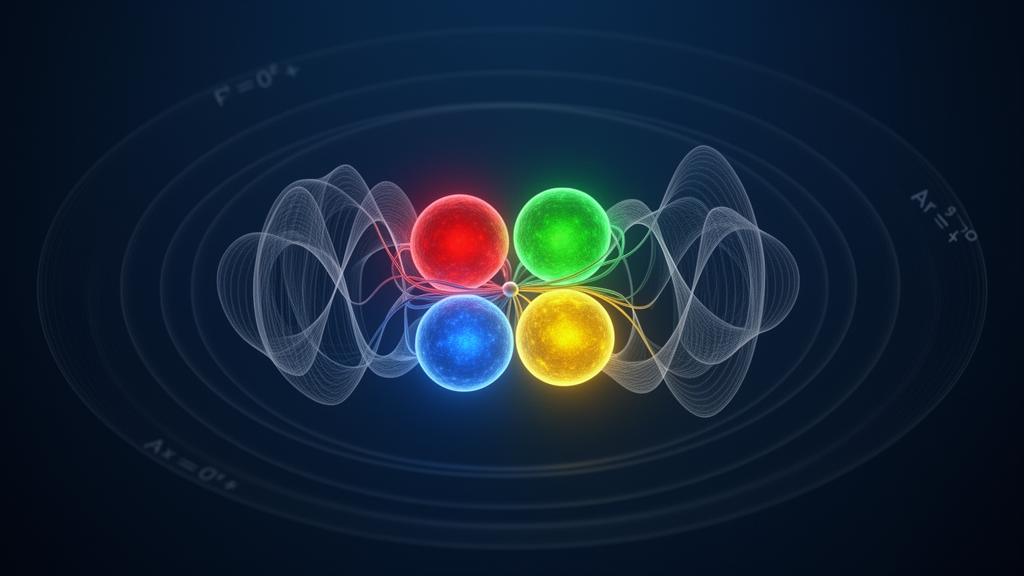
For two decades, particle physicists have been haunted by particles that refuse to fit the rulebook. The standard picture of matter says quarks come in twos and threes: quark-antiquark pairs form mesons, and triplets of quarks form baryons like the protons inside every atom. Yet since 2003, experiments have surfaced a growing zoo of “XYZ” states that defy this tidy classification. Now, a new theoretical study published in The European Physical Journal C offers a fresh, computationally elegant attack on one of the deepest questions in modern physics: how heavy are these four-quark exotics, and what holds them together?
The research, carried out by Pranami Baishya and Bhaskar Jyoti Hazarika of the Center for Theoretical Studies at Pandu College in Guwahati, India, focuses on tetraquarks, hypothetical particles built from two quarks and two antiquarks. Rather than treating all four quarks as loose constituents, the authors adopt the diquark-antidiquark picture: a tightly bound quark pair acts as a single effective object, the diquark, which then binds with its antimatter counterpart. This two-body simplification transforms an intractable four-body problem into something a desktop computer can handle, while still capturing what many theorists believe is the essential binding mechanism of these exotic states.
The mathematical engine of the study is the spinless Salpeter equation, a relativistic upgrade of the familiar Schrödinger equation from introductory quantum mechanics. Where the Schrödinger equation assumes particles move slowly compared to light, the Salpeter equation replaces the kinetic energy with the square-root form demanded by special relativity: the square root of the momentum squared plus the mass squared. This matters enormously for tetraquarks, because the constituent masses and binding energies involved often sit in a regime where non-relativistic approximations begin to break down. The equation retains relativistic accuracy while remaining far more tractable than fully relativistic frameworks like the Bethe-Salpeter equation.
To describe the force between the diquark and antidiquark, the team employed the celebrated Cornell potential, a phenomenological formula that has anchored heavy-quark physics since the late 1970s. The potential combines two essential behaviors of the strong nuclear force: a Coulomb-like term that dominates at short distances, proportional to the strong coupling constant divided by the separation, and a linear term that grows with distance, reflecting the string-like confinement that prevents quarks from ever being pulled apart. The string tension was fixed at 0.1 GeV squared, with a phenomenological constant of minus 0.8 GeV, while the strong coupling constant was scanned across a physically motivated range from 0.20 to 0.64, chosen from a parameter space established by earlier rigorous constraints on the Cornell model.
The technical heart of the paper lies in a variational calculation. The authors assumed a simple exponential trial wave function for the ground state, characterized by a single adjustable parameter beta that controls the spatial size of the bound state. By computing the expectation value of the full Hamiltonian and minimizing it with respect to beta, they derived an analytical mass formula for tetraquark ground states. Relativistic corrections were then handled through first-order perturbation theory: the leading correction to the kinetic energy, suppressed by factors of velocity squared over the speed of light squared, was treated as a small perturbation. Remarkably, the team also derived the first-order correction to the wave function itself, showing explicitly how relativistic effects mix the first excited state into the ground state and thereby reshape the internal structure of the tetraquark.
The model was put to the test against four landmark tetraquark candidates spanning the heavy-quark spectrum. The X(3872), discovered by the Belle Collaboration in 2003, is the most famous exotic hadron and served as the benchmark hidden-charm state. The X(4700) probes heavier hidden-charm configurations. The X(6900), reported by the LHCb Collaboration in 2020 as a narrow structure in the J/psi-pair mass spectrum, is widely interpreted as a fully charmed tetraquark containing two charm quarks and two charm antiquarks. Finally, the fully bottom tetraquark Tbbbb, composed of four bottom quarks, remains experimentally unobserved but theoretically compelling as a potentially deeply bound multiquark system.
The results reveal a striking pattern of successes and shortfalls. For the X(3872), the calculated mass deviated from the experimental value of 3.871 GeV by a mere 0.013 GeV, an agreement the authors describe as excellent and which validates the variational approach for certain heavy-light configurations. Even more impressive was the fully bottom sector: the predicted mass of 18.853 GeV for Tbbbb landed just 0.027 GeV from the theoretical benchmark of 18.826 GeV reported by Karliner and colleagues, suggesting that the spinless Salpeter framework with the Cornell potential is particularly well suited to fully heavy systems, where spin-dependent interactions are comparatively suppressed by the sheer mass of the quarks involved.
The charm sector proved more stubborn. The calculated mass of the X(6900) candidate fell short of the LHCb measurement of 6.905 GeV by roughly 0.785 GeV, and the X(4700) showed a similarly large deviation. The authors suggest these gaps may signal that additional physics is at play in charm systems: higher-order relativistic corrections, coupled-channel dynamics in which the tetraquark mixes with nearby meson-meson states, or spin-dependent interactions that the spinless framework deliberately omits. The discrepancy is itself scientifically valuable, pointing theorists toward which dynamical ingredients a more complete description must include.
Perhaps the most intriguing finding concerns the behavior of the strong coupling constant across excitation modes. For ground states, light tetraquarks favored a coupling of 0.20 while heavy tetraquarks preferred 0.34, and an optimal global description of all states emerged around 0.36. But for excited 2S and 1P states, the pattern inverted: light tetraquarks demanded a much larger coupling of 0.64, while heavy tetraquarks converged to 0.20. The authors interpret this as evidence of distinct effective interaction regimes. Enhanced coupling in excited light tetraquarks may indicate a transition toward more spatially extended, molecular-like configurations probing the long-distance confinement regime, whereas the persistently low coupling in excited heavy tetraquarks implies the heavy-quark core stays compact even under radial or orbital excitation. This differential response could ultimately help distinguish between compact diquark-antidiquark and loose molecular interpretations of tetraquark states, one of the liveliest debates in hadron physics.
The study also found that calculated masses decrease mildly as the coupling constant grows, a direct consequence of the attractive Coulomb term deepening the potential well, and that 2S excited states sit systematically above their 1P counterparts within the model. The variational parameter beta grew steadily with coupling strength for every configuration, confirming that stronger interactions squeeze the bound state into a more compact spatial footprint, with the fully bottom system exhibiting by far the largest beta values. Looking ahead, the authors identify clear paths for refinement: incorporating spin-dependent forces, extending the perturbative treatment to higher orders in velocity squared, and investigating decay properties that would offer direct experimental handles on internal structure. As accelerator experiments continue to churn out new four-quark candidates, simple yet disciplined frameworks like this one provide the quantitative scaffolding on which our understanding of the nonperturbative strong force, the last great uncharted territory of the Standard Model, will continue to be built.
Subject of Research: Theoretical calculation of heavy tetraquark mass spectra using the spinless Salpeter equation and Cornell potential in a diquark-antidiquark model
Article Title: Mass spectra of tetraquark states from the spinless Salpeter equation
Article References: Baishya, P., & Hazarika, B. J. (2026). Mass spectra of tetraquark states from the spinless Salpeter equation. The European Physical Journal C, 86(10), Article 1155. https://doi.org/10.1140/epjc/s10052-026-16342-3
Image Credits: AI Generated
DOI: 10.1140/epjc/s10052-026-16342-3
Keywords: tetraquarks, spinless Salpeter equation, Cornell potential, diquark-antidiquark model, quantum chromodynamics, exotic hadrons, X(3872), X(6900), fully heavy tetraquarks, variational method, relativistic corrections, strong coupling constant
Cite Scienmag News
Katie Riggs. (October 8, 2026). Cracking the Tetraquark Code: A Relativistic Equation Weighs Nature’s Strangest Particles. Scienmag. https://scienmag.com/cracking-the-tetraquark-code-a-relativistic-equation-weighs-natures-strangest-particles/
Katie Riggs. "Cracking the Tetraquark Code: A Relativistic Equation Weighs Nature’s Strangest Particles." Scienmag, 8 October 2026, https://scienmag.com/cracking-the-tetraquark-code-a-relativistic-equation-weighs-natures-strangest-particles/. Accessed 8 October 2026.
Katie Riggs. "Cracking the Tetraquark Code: A Relativistic Equation Weighs Nature’s Strangest Particles." Scienmag. October 8, 2026. https://scienmag.com/cracking-the-tetraquark-code-a-relativistic-equation-weighs-natures-strangest-particles/


