


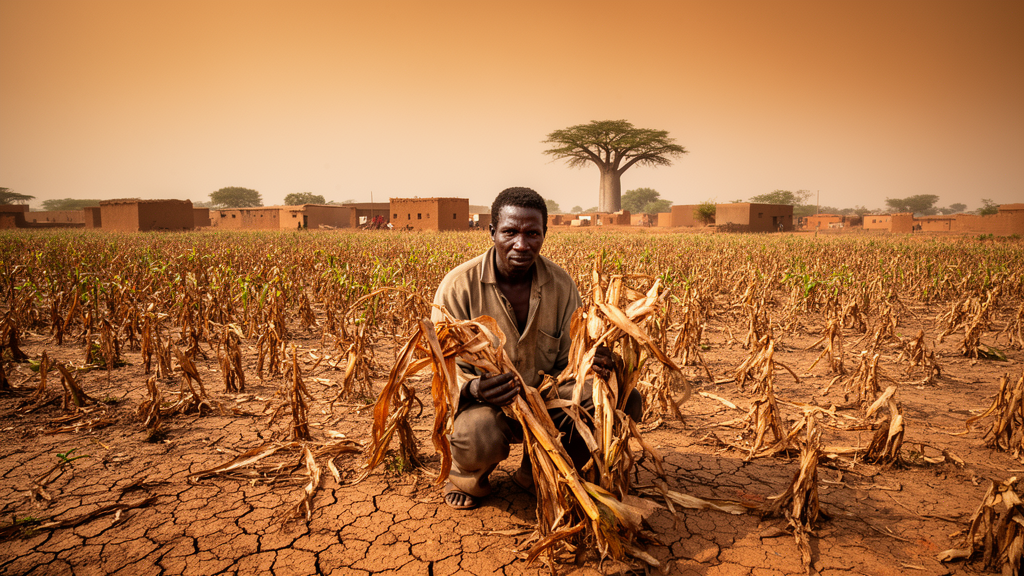
Northern Ghana, a semi-arid belt where more than 80 percent of households depend on rain-fed agriculture, is heading toward a future in which drought is no longer an occasional hazard but a structural condition of farming life. A new empirical modelling study published in PLOS Climate projects that yields of maize, millet, sorghum, and groundnuts could fall by 25 to 60 percent by 2050, with the pressure continuing to build through the end of the century. The research, led by Theophilus Francis Kofitio with Peace Korshiwor Amoatey and Evans Asenso, combines state-of-the-art climate simulations with satellite observations and household-level vulnerability data to map, in unusually fine detail, where drought will strike hardest and who will suffer most.
The study’s technical foundation rests on the latest generation of global climate models, the Coupled Model Intercomparison Project Phase 6, known as CMIP6. Rather than relying on a single simulation, the team integrated outputs from five models—MRI-ESM2-0, EC-Earth3, IPSL-CM6A-LR, CESM2, and HadGEM3-GC31-LL—and downscaled them to a resolution of 0.25 degrees, fine enough to distinguish rainfall patterns across districts of northern Ghana. Because raw global models often carry systematic biases in the tropics, the researchers applied bias correction before feeding the projections into their drought assessment, a step that materially improves the reliability of regional rainfall and temperature estimates.
Validation of the model ensemble against observed reference datasets showed strong performance. For annual precipitation, the corrected models achieved a correlation coefficient of 0.95 with a root mean square error of 3.4 millimetres, while temperature simulations were even tighter, with correlations of 0.99 and errors ranging from 0.47 to 0.74 degrees Celsius. These figures matter because drought vulnerability modelling is only as credible as the climate inputs beneath it. A model that misrepresents the baseline climate will misrepresent the future, and the high validation scores give the projections a firmer empirical footing than many earlier regional assessments.
On top of the climate projections, the researchers deployed a battery of drought indices, each capturing a different face of water stress. The Standardized Precipitation Index tracks rainfall deficits against long-term averages; the Reconnaissance Drought Index balances precipitation against atmospheric demand; the Normalized Difference Drought Index draws on satellite reflectance to detect vegetation stress; and the Soil Moisture Index measures water actually available in the ground. By combining these indices with MODIS satellite-derived vegetation greenness, population density, and land use and land cover data within a geographic information system, the team generated composite vulnerability maps that integrate exposure, sensitivity, and adaptive capacity at the district scale.
The projections were run across three time horizons—2026 to 2050, 2051 to 2075, and 2076 to 2100—under two emissions scenarios. SSP1-2.6 represents a low-emissions pathway consistent with ambitious global mitigation, while SSP5-8.5 describes a fossil-fuel-intensive future. The spread between these scenarios frames the range of possible outcomes, and in both cases the direction of travel is the same: hotter, drier, and more drought-prone. Mean temperatures in the region are projected to rise by 2.0 to 3.9 degrees Celsius by 2100, while rainfall could decline by as much as 19 percent, a combination that compounds water stress through both reduced supply and increased evaporative demand.
The consequences for staple crops are stark. Maize, the region’s most important cereal, shows the strongest negative correlation with drought severity of any crop examined, with a correlation coefficient of −0.72 at a statistical significance level below 0.01. Mann-Kendall trend tests, applied at the 95 percent confidence level, confirm that these yield declines are part of a coherent trend rather than random year-to-year noise. Millet and sorghum, traditionally more drought-tolerant, fare somewhat better in relative terms, but the projected 25 to 60 percent yield losses across all four crops by mid-century would represent a fundamental shock to food production systems that already operate close to the margin.
The vulnerability mapping reveals why the human stakes are so high. Roughly 84 percent of the study area is classified as highly vulnerable to drought, a verdict driven less by climate exposure alone than by the region’s limited capacity to cope. More than 80 percent of agricultural production depends on rainfall with no irrigation buffer, over 49 percent of households already experience food insecurity, less than 23 percent of available cropland is under cultivation, and water bodies cover under 5 percent of the landscape. Each of these indicators points to a system with almost no slack: when the rains fail, there is little infrastructure, stored water, or diversified income to absorb the shock.
The authors are candid about the uncertainties that remain. Precipitation projections in the Sahel and West Africa are notoriously difficult, and the five CMIP6 models show divergent rainfall trajectories, with some models even displaying conflicting temperature trends in certain periods. These disagreements do not undermine the overall signal of increasing drought severity, which is consistent across the ensemble, but they do complicate the task of predicting exactly when and where the worst impacts will land. The study’s multi-model, multi-index approach is partly a response to this problem: by triangulating across models and drought metrics, the researchers aim to distinguish robust findings from model-specific artefacts.
What distinguishes this work from many climate impact studies is its insistence on connecting biophysical modelling to livelihoods. Drought indices and yield correlations describe the hazard, but the composite vulnerability maps place that hazard alongside the social and economic conditions that turn a dry spell into a hunger crisis. The framework is designed to be replicable at the district level, giving local planners a tool to identify which communities need intervention first, rather than waiting for national averages to obscure acute local distress.
The policy implications are pointed. The study calls for district-level drought preparedness planning, expansion of solar-powered irrigation to break the dependence on rainfall, index-based crop insurance to transfer residual risk, and the promotion of climate-smart agricultural practices such as drought-tolerant varieties and soil moisture conservation. It explicitly aligns these recommendations with the United Nations Office for Disaster Risk Reduction and the Sendai Framework for Disaster Risk Reduction, arguing that drought resilience in northern Ghana should be treated as a disaster risk governance priority, not merely an agricultural problem. Without such measures, the modelling suggests, a region that contributes little to global emissions will bear some of their heaviest consequences, with crop failures ripening into food insecurity for hundreds of thousands of farming households well before the middle of the century.
Subject of Research: Drought vulnerability and crop production impacts under climate change in northern Ghana
Article Title: Drought vulnerability assessment and its severe impact on crop production and livelihood of people: An empirical modelling of northern Ghana
Article References: Kofitio, T. F., Amoatey, P. K., & Asenso, E. (2026). Drought vulnerability assessment and its severe impact on crop production and livelihood of people: An empirical modelling of northern Ghana. PLOS Climate, 5(9), e0001038. https://doi.org/10.1371/journal.pclm.0001038
Image Credits: AI Generated
DOI: 10.1371/journal.pclm.0001038
Keywords: drought vulnerability, northern Ghana, CMIP6, crop yields, food security, rain-fed agriculture, climate projections, Standardized Precipitation Index, maize, Sendai Framework, climate-smart agriculture, semi-arid regions
Cite Scienmag News
Alan Morgan. (October 9, 2026). Northern Ghana Faces 25-60% Crop Losses as Droughts Intensify, Models Warn. Scienmag. https://scienmag.com/northern-ghana-faces-25-60-crop-losses-as-droughts-intensify-models-warn/
Alan Morgan. "Northern Ghana Faces 25-60% Crop Losses as Droughts Intensify, Models Warn." Scienmag, 9 October 2026, https://scienmag.com/northern-ghana-faces-25-60-crop-losses-as-droughts-intensify-models-warn/. Accessed 9 October 2026.
Alan Morgan. "Northern Ghana Faces 25-60% Crop Losses as Droughts Intensify, Models Warn." Scienmag. October 9, 2026. https://scienmag.com/northern-ghana-faces-25-60-crop-losses-as-droughts-intensify-models-warn/


