


Beneath nearly 1.4 kilometers of Greenland ice, in sediments drilled more than half a century ago at a Cold War-era military base, scientists have uncovered a vivid snapshot of what the world’s second-largest ice sheet endured during one of the longest warm spells of the Pleistocene. A team led by John Michael N. Aguilar and Elizabeth K. Thomas of the University at Buffalo analyzed molecular fossils extracted from subglacial sediment recovered at Camp Century in northwestern Greenland, and their results, published in the journal Climate of the Past, show that summers roughly 416,000 years ago were about 4.7 degrees Celsius warmer than the late twentieth century. Remarkably, that warmth was similar to conditions during the peak of the current interglacial, the Holocene, yet the ice sheet at Camp Century had retreated more than 100 kilometers behind its modern margin. The finding carries a sobering implication for the future: moderate warmth, sustained long enough, can drive major ice loss.
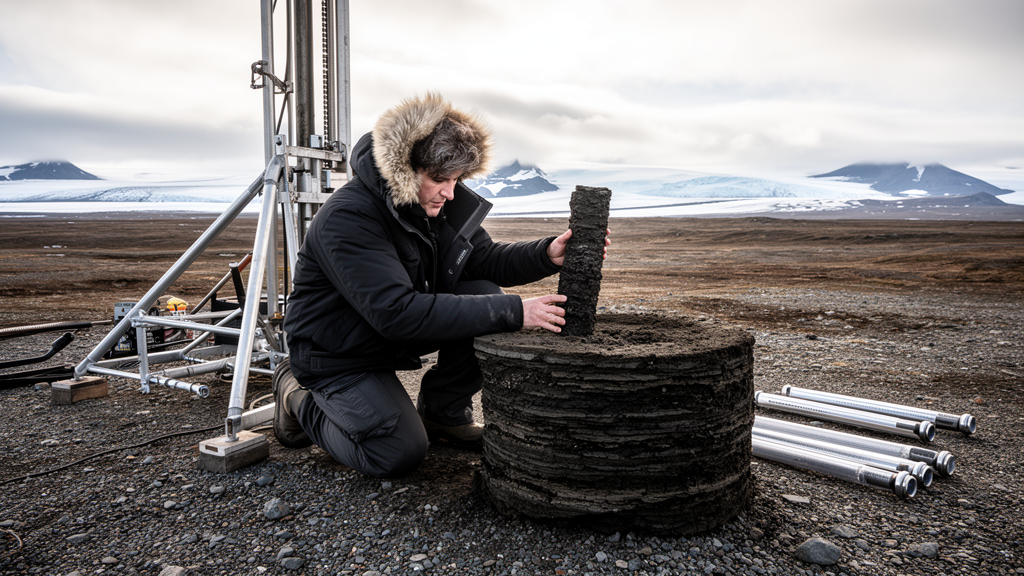
The sediments themselves are an extraordinary scientific resource. In 1966, engineers drilling through the Greenland Ice Sheet at Camp Century accidentally recovered 3.44 meters of sediment from the ice-bed interface, material that then languished in freezer storage for decades before modern analytical techniques caught up with it. The core’s upper layers, dated by luminescence methods to approximately 416,000 plus or minus 38,000 years ago, correspond to Marine Isotope Stage 11, an interglacial period renowned among paleoclimate scientists for its unusual length and relative mildness. Deeper units in the core are far older, likely dating to the Pliocene or early Pleistocene, between roughly 1.4 and 3.2 million years ago, making the Camp Century archive one of the few terrestrial windows into Greenland’s climate deep past.
To reconstruct temperature, the researchers turned to branched glycerol dialkyl glycerol tetraethers, or brGDGTs, membrane lipids produced by bacteria that live in soils and lake sediments. The chemical structure of these compounds varies systematically with temperature, allowing scientists to use them as molecular thermometers. Chemical fingerprints in the Camp Century samples, including a branched-to-isoprenoid tetraether index above 0.97 and distributions closely matching those of modern high-latitude lakes, indicated that the lipids were produced primarily in aquatic settings rather than soils. This makes sense given the modern landscape of northwestern Greenland, where shallow lakes dot more than 80 percent of the ice-free terrain in some areas. The team applied two temperature calibrations developed specifically from Arctic lake datasets, propagating calibration errors and analytical uncertainty into their final estimates.
The temperature results were striking in their consistency. Across the MIS 11 sediments, inferred temperatures for the months above freezing ranged from about 4.4 to 6.7 degrees Celsius, with mean anomalies of 4.3 to 5.2 degrees above the elevation-corrected modern baseline. Even the older, deeper units told a similar story, with anomalies of roughly 4.1 to 4.5 degrees. Because the Camp Century bed sits at only about 530 meters above sea level today, the researchers carefully corrected for the fact that an ice-free landscape would sit higher, around 810 meters after the crust rebounded from the removed ice load, applying lapse rates of roughly minus 5 degrees Celsius per kilometer. All units, spanning millions of years, pointed to interglacial summers in northwestern Greenland that were consistently warmer than the late twentieth century but broadly similar to each other.
The water isotope evidence added a second, equally important dimension. The team measured the hydrogen isotope composition of plant waxes, specifically n-alkanoic acids, preserved in the sediments. Long-chain waxes from terrestrial plants record summer precipitation isotopes modified by evaporation in leaves, while mid-chain waxes from aquatic plants reflect lake water, which in open Arctic basins largely mirrors summer precipitation. By combining these precipitation isotope reconstructions with the independently derived temperatures, the researchers could subtract the effect of local condensation temperature and estimate the isotope composition of the atmospheric vapor itself. Summer vapor during MIS 11 was 22 plus or minus 18 per mil enriched in deuterium relative to modern values, a signal the authors interpret as a substantially greater contribution of moisture evaporated and transpired locally rather than transported from distant oceans.
This moisture story is physically intuitive. Today, only about 30 percent of summer moisture arriving near Pituffik, the nearest meteorological station, comes from nearby land and seas in the high-latitude Arctic; the remaining 70 percent travels from remote Atlantic and Pacific sources, arriving isotopically depleted after long distillation. During MIS 11, with the ice sheet margin more than 100 kilometers inland of the coast, a vast expanse of vegetated tundra replaced reflective ice. Reduced snow and ice cover and expanded plant biomass would have boosted summer evapotranspiration across Greenland and neighboring North America, flooding the regional atmosphere with isotopically heavy, locally sourced vapor. The deuterium enrichment recorded at Camp Century is far larger than the modest Holocene vapor anomaly observed at nearby Secret Lake, suggesting the ice-free footprint during MIS 11 exceeded anything the Holocene produced.
Placing Camp Century in context required a careful meta-analysis of published Greenland paleoclimate records, standardized to the same 1950 to 2000 baseline. Eight Holocene brGDGT records from southwestern Greenland showed warm-season anomalies of about 3 plus or minus 2 degrees, two to three degrees cooler than the Camp Century reconstruction, though the difference may partly reflect the northwestern site’s higher latitude. Chironomid-based July temperature reconstructions, which capture peak summer rather than the full above-freezing season, suggested Holocene anomalies near 7 degrees, while Last Interglacial estimates from northwestern Greenland reached nearly 10 degrees, clearly warmer than MIS 11. The comparison also highlighted a methodological subtlety: brGDGTs record the temperature of all months above freezing, a season that lengthens as climate warms, so their anomalies are inherently smaller than July-based proxies under identical forcing. Accounting for these seasonal biases, the authors conclude that MIS 11 summers in northwestern Greenland resembled, or slightly exceeded, peak Holocene warmth.
The ice sheet implications are where the study becomes genuinely unsettling. Marine sediment records and ice sheet modeling indicate that the southern dome of the Greenland Ice Sheet retreated dramatically during MIS 11, an interglacial whose warm phase lasted on the order of 30,000 years, far longer than the briefer but sometimes warmer stages 9 and 5, during which the ice sheet apparently persisted. The new Camp Century data show that northwestern Greenland experienced similarly moderate temperatures during MIS 11, yet the site was ice-free, something it never was even during the warmest Holocene millennia. Modeling work cited by the authors demonstrates that sustained moderate summer anomalies over roughly 16,000 years can produce substantial mass loss. The lesson is that duration matters as much as magnitude: a climate only modestly warmer than the Holocene, maintained for tens of millennia, was sufficient to push the ice sheet margin deep inland.
That lesson lands with force in the twenty-first century. Projections assessed by the Intergovernmental Panel on Climate Change suggest the Arctic will experience mean annual surface temperatures 3.0 to 10.6 degrees Celsius above the 1950 to 2000 baseline by 2100, a range whose lower bound already brackets the Camp Century MIS 11 reconstruction. Modern warming at high latitudes is concentrated in winter, which may moderate summer-season anomalies, but cloud and ice-albedo feedbacks in the latest climate models substantially increase the ice sheet’s sensitivity to any given amount of warming. Unlike MIS 11, today’s warming is being driven by greenhouse gas emissions on a timescale of centuries rather than orbital cycles, and it will not naturally subside on geological timescales unless emissions fall. The Camp Century sediments, preserved by accident beneath the ice and rescued from Cold War storage, thus deliver a message that is both ancient and urgently contemporary: to protect the Greenland Ice Sheet and the 7.4 meters of global sea level rise it holds in reserve, humanity must limit not only how hot summers become but how long the warmth endures.
Subject of Research: Reconstruction of summer temperature and moisture sources in northwestern Greenland during Marine Isotope Stage 11 using subglacial biomarkers from Camp Century
Article Title: Holocene-like summer climate during Marine Isotope Stage 11 in northwestern Greenland
Article References: Holocene-like summer climate during Marine Isotope Stage 11 in northwestern Greenland. (n.d.). https://doi.org/10.5194/cp-22-1757-2026
Image Credits: AI Generated
Keywords: Greenland Ice Sheet, Camp Century, Marine Isotope Stage 11, biomarkers, brGDGTs, plant waxes, paleoclimate, sea level rise, interglacial, hydrogen isotopes, Arctic warming, subglacial sediments
Cite Scienmag News
Sloane Callahan. (October 8, 2026). Ancient Greenland Sediments Reveal Summers 4.7 Degrees Warmer 400,000 Years Ago. Scienmag. https://scienmag.com/ancient-greenland-sediments-reveal-summers-4-7-degrees-warmer-400000-years-ago/
Sloane Callahan. "Ancient Greenland Sediments Reveal Summers 4.7 Degrees Warmer 400,000 Years Ago." Scienmag, 8 October 2026, https://scienmag.com/ancient-greenland-sediments-reveal-summers-4-7-degrees-warmer-400000-years-ago/. Accessed 8 October 2026.
Sloane Callahan. "Ancient Greenland Sediments Reveal Summers 4.7 Degrees Warmer 400,000 Years Ago." Scienmag. October 8, 2026. https://scienmag.com/ancient-greenland-sediments-reveal-summers-4-7-degrees-warmer-400000-years-ago/


