


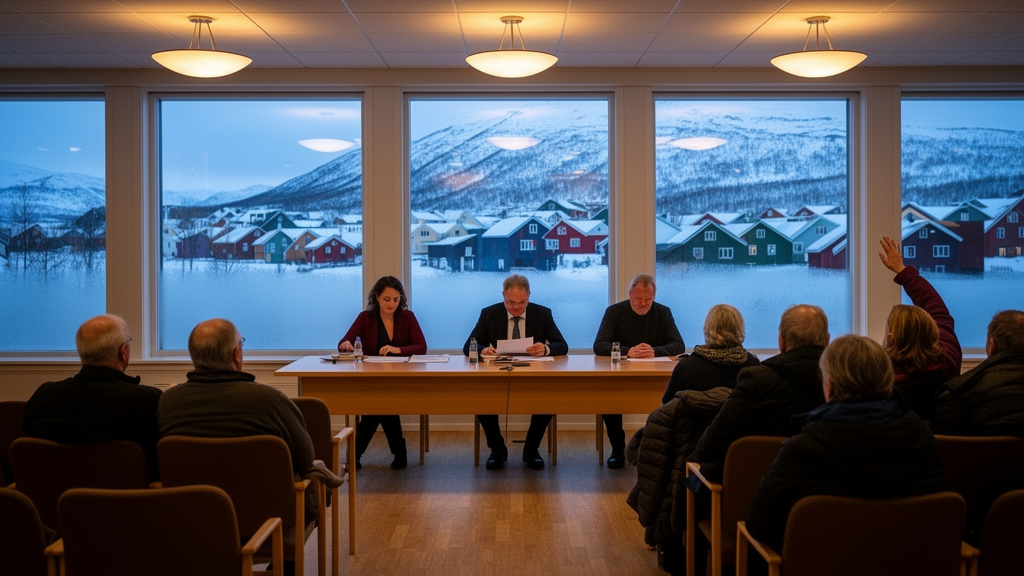
In the municipalities of the Norwegian Arctic, residents are being invited to take part in the planning processes that shape their communities, but a new study suggests that many of these invitations amount to little more than theater. Research published in PLOS Sustainability and Transformation examined how citizen participation actually functions in spatial planning at the municipal level in northern Norway, and the findings paint a sobering picture of democratic practice in one of Europe’s most rapidly changing regions. Drawing on interviews with 75 residents of highly diverse backgrounds, the study identified ten distinct forms of citizen participation in planning processes. Strikingly, only two of those forms gave citizens any real opportunity to influence decisions, and even then only on matters that were less relevant to sustainability outcomes.
The research comes at a critical moment for the global sustainability agenda. Achieving the Sustainable Development Goals, the United Nations framework that guides development policy worldwide, requires action at every level of society, from international treaties down to the decisions made in town halls and municipal planning offices. Norway, often held up as a model of good governance and environmental stewardship, shares responsibility for SDG-based sustainable development with its local authorities, including municipalities and counties. The country’s Planning and Building Act contains a purpose clause stipulating that planning shall promote sustainable development for the benefit of individuals, society, and future generations. On paper, then, the legal architecture for locally grounded sustainability appears robust. The question the study set out to answer was whether that architecture translates into genuine citizen influence on the ground.
To investigate, the researcher conducted semi-structured interviews with 75 residents whose backgrounds varied widely, capturing a broad cross-section of the people who live in and around Arctic municipalities. The interviews were then subjected to inductive thematic analysis, a qualitative method in which codes and themes emerge from the data itself rather than being imposed in advance. The analysis coded forms of citizen participation, their characteristics, and their links with sustainability and transformation. To give the findings analytical teeth, the forms were further mapped onto two well-established frameworks in democratic theory: Arnstein’s ladder of citizen participation, first published in 1969, and Fung’s cube of democracy, a more recent model that assesses participation according to who takes part, how they communicate and decide, and how much authority they wield.
Arnstein’s ladder remains one of the most influential metaphors in participatory planning. It arranges forms of participation along a spectrum from nonparticipation, through tokenism, to genuine citizen power, in which residents hold real decision-making authority. At the bottom rungs sit manipulation and therapy, where authorities merely inform or placate citizens without any intention of listening. In the middle sit informing, consultation, and placation, where citizens may be heard but hold no power to ensure their views are acted upon. Only at the top of the ladder do partnerships, delegated power, and citizen control appear. Fung’s cube adds further dimensions, distinguishing between the selectivity of participants, the intensity of communication and decision-making, and the extent of authority transferred to participants. Together, these frameworks provide a rigorous vocabulary for distinguishing authentic participation from its imitations.
When the ten forms of participation identified in the Norwegian Arctic were placed on these frameworks, the results were unambiguous. The overwhelming majority of the forms fell into the tokenistic range. Citizens were informed of plans that had already been drafted, invited to comment within narrow windows, or consulted in ways that left no trace in the final decisions. Only two forms offered citizens the opportunity to influence outcomes at all, and even those opportunities were confined to matters of comparatively low relevance to sustainability. In other words, when residents did manage to leave a mark on the planning process, they tended to do so on peripheral issues, while the decisions that mattered most for climate adaptation, land use, and industrial development were made elsewhere, by other actors, through other channels.
This gap between process and influence matters because the content of citizens’ concerns diverged sharply from the priorities of local authorities. Across the interviews, lay citizens emphasized the importance of focusing on climate adaptation, nature conservation, and local values. For many residents of Arctic municipalities, the natural environment is not an abstract policy concern but a foundation of daily life, identity, and community well-being. The study found that local sustainability values were strongly linked to the importance of nature in people’s lives, a connection that residents articulated repeatedly and with conviction. Citizens wanted planning processes to protect the landscapes, ecosystems, and ways of life that make the Arctic distinctive, and they saw sustainability as inseparable from those commitments.
Local authorities, by contrast, saw green industry, power plants, and the economy as fundamental. The divergence is not simply a matter of taste or preference; it reflects fundamentally different understandings of what sustainable development means and for whom. In the Norwegian Arctic, as in many peripheral regions, municipal economies are often tied to energy production, resource extraction, and industrial development framed as green transition. Wind power installations, hydropower facilities, and other infrastructure projects are frequently presented as contributions to national and global climate goals. Yet the study found that lay citizens, some politicians, and some planners believed these developments were destructive to local sustainability values. A project that reduces national emissions on a spreadsheet may, from the perspective of a coastal community, fragment a landscape, disrupt wildlife, and erode the very relationship with nature that sustains local life.
The consequence of this divergence, filtered through tokenistic participation, is a planning system that fails on multiple fronts simultaneously. According to the study, the current practice of participation in planning processes in the sampled municipalities lacks genuine cooperation, fails to incorporate local knowledge, and hardly leads to citizens’ influence. Local knowledge, the accumulated, place-based understanding that residents hold about their environment, its seasonal rhythms, its vulnerabilities, and its significance, represents exactly the kind of diverse knowledge that the Planning and Building Act’s purpose clause envisions being included in planning. When that knowledge is excluded, plans become not only less democratic but also less informed, less resilient, and less likely to succeed. The study’s conclusion is blunt: citizens’ priorities do not affect the decisions that are made.
The downstream effects extend beyond individual planning disputes. When residents conclude that participation is a sham process with participation, as the study’s evocative original title puts it, they disengage. The research found that the tokenistic character of participation hinders local engagement in planning processes, undermining the willingness of people to invest time and energy in consultations that they reasonably expect to be ignored. This creates a self-reinforcing cycle: because citizens do not believe participation matters, participation becomes thinner and less representative; because participation is thin, the knowledge and legitimacy that could flow from it are absent; and because those inputs are absent, the resulting plans feel imposed rather than shared, deepening distrust. For a region facing rapid change from climate shifts, industrial expansion, and demographic pressure, the erosion of engagement is itself a sustainability problem.
Ultimately, the study connects these local failures to the global project of sustainable development. The SDGs cannot be achieved by national governments alone; they depend on synergy among all societal actors, including the residents whose lives are most directly shaped by local planning. Norway’s legal framework explicitly assigns municipalities a role in promoting sustainable development for future generations, and spatial planning is one of the most powerful instruments available for that transformation. But instruments are only as effective as their use. If participation remains confined to the lower rungs of Arnstein’s ladder, if consultation continues to function as ritual rather than dialogue, and if the values of local communities remain systematically subordinated to economic and industrial priorities, then the promise of SDG-based planning in the Norwegian Arctic will remain unfulfilled. The study’s ten forms of participation offer, in effect, a diagnostic map: they show precisely where the current system falls short, and by implication, what genuine citizen power would need to look like if the region’s planning processes are ever to deliver sustainability that local people recognize as their own.
Subject of Research: Citizen participation in municipal spatial planning for sustainable development in the Norwegian Arctic
Article Title: “It is a sham process with participation.” Ten forms of citizen participation for sustainable development in the Norwegian Arctic
Article References: Roos, R. (2026). “It is a sham process with participation.” Ten forms of citizen participation for sustainable development in the Norwegian Arctic. PLOS Sustainability and Transformation, 5(9), e0000193. https://doi.org/10.1371/journal.pstr.0000193
Image Credits: AI Generated
DOI: 10.1371/journal.pstr.0000193
Keywords: citizen participation, Norwegian Arctic, spatial planning, sustainable development, SDGs, Arnstein's ladder, local knowledge, municipalities, climate adaptation, nature conservation, green industry, Planning and Building Act
Cite Scienmag News
Courtney Benton. (October 8, 2026). Sham Participation: How Norwegian Arctic Citizens Are Shut Out of Planning Decisions. Scienmag. https://scienmag.com/sham-participation-how-norwegian-arctic-citizens-are-shut-out-of-planning-decisions/
Courtney Benton. "Sham Participation: How Norwegian Arctic Citizens Are Shut Out of Planning Decisions." Scienmag, 8 October 2026, https://scienmag.com/sham-participation-how-norwegian-arctic-citizens-are-shut-out-of-planning-decisions/. Accessed 8 October 2026.
Courtney Benton. "Sham Participation: How Norwegian Arctic Citizens Are Shut Out of Planning Decisions." Scienmag. October 8, 2026. https://scienmag.com/sham-participation-how-norwegian-arctic-citizens-are-shut-out-of-planning-decisions/


