


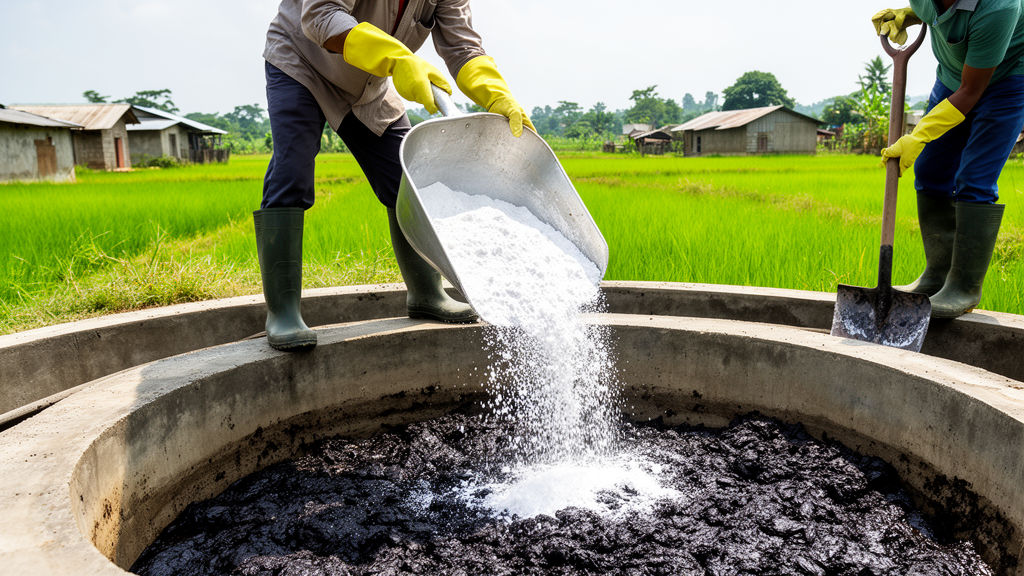
In rural Cambodia, where billions of people worldwide still rely on on-site sanitation systems that are rarely emptied safely, a team of researchers has reported encouraging evidence that a simple, low-cost intervention can reduce the microbial hazards lurking in household soils. The study, published in PLOS Water, examined a novel sanitation service known as limed on-site burial, or LOB, in which household fecal sludge is treated with lime and buried directly beneath or near the household latrine. By tracking fecal indicator bacteria in surface soils before, immediately after, and thirty days after the service, the researchers set out to determine whether this decentralized approach truly protects communities or merely relocates the risk underground.
The scale of the underlying problem is difficult to overstate. Roughly 3.4 billion people depend on on-site sanitation technologies such as pit latrines and septic tanks, and when these systems fill up, the sludge they contain must go somewhere. In an ideal world, that sludge would travel to a dedicated treatment plant where pathogens are destroyed under controlled conditions. In practice, fecal sludge treatment plants are often non-existent, non-functional, or financially non-viable in low-resource settings, because they demand costly infrastructure, skilled operators, and continuous energy and chemical supplies. As a result, sludge is frequently dumped into open fields, waterways, or shallow pits, creating direct pathways for fecal pathogens to re-enter human contact through soil, water, crops, and dust.
On-site burial has emerged as one of the few practical alternatives in such contexts. The concept is deceptively simple: rather than transporting sludge off-site, it is buried in place, allowing natural attenuation processes in the soil to reduce pathogen concentrations over time. Yet burial done poorly can be nearly as hazardous as dumping. Shallow graves can expose workers and residents to fresh fecal material, and heavy rains can mobilize contaminants into groundwater or surface runoff. The Cambodian pilot study addressed these concerns by refining the burial method with two key elements: burying the sludge at a depth of at least one meter and covering it with a layer of soil at least thirty centimeters thick, with lime applied to accelerate the inactivation of pathogens.
Lime, or calcium hydroxide, has long been used in sanitation engineering because it raises pH dramatically, creating a chemical environment hostile to most fecal microorganisms. Viruses, bacteria, and helminth eggs differ widely in their sensitivity to alkaline conditions, but sustained high pH is generally lethal to vegetative bacterial cells and damaging to many viruses. By combining lime treatment with deep burial and an adequate soil cap, the LOB service layers multiple barriers between the sludge and the people living above it. The question the researchers posed was whether these barriers actually translate into measurable protection at the soil surface, where children play, adults walk barefoot, and food is often prepared.
To answer it, the team sampled surface soils at four strategically chosen points: at the entrance to the toilet, at the center of the burial location, and at the two edges of the burial zone. Sampling occurred at three time points—immediately before the LOB service, immediately after it, and thirty days later. The target analyte was Escherichia coli, the workhorse indicator organism of fecal contamination monitoring worldwide. E. coli is not always the most dangerous pathogen in fecal sludge, but its presence and concentration in soil serve as a reliable proxy for the broader community of fecal organisms, including more virulent bacteria, viruses, and parasites that are far harder to culture and quantify in field conditions.
The results were striking in their consistency. E. coli concentrations in surface soils did not increase at any point as a result of the LOB service. More than that, the statistical analysis suggested that concentrations likely decreased, both immediately after the intervention and again thirty days later. Immediately following the service, the estimated change was a reduction of 0.23 log10 units, with a confidence interval spanning from 0.46 to 0.01 log10 units. Thirty days after the service, the estimated reduction deepened to 0.76 log10 units, with a confidence interval of 0.98 to 0.55 log10 units. In practical terms, a reduction of nearly three-quarters of a log10 unit corresponds to cutting indicator bacteria levels by more than eighty percent, a meaningful decline for a household environment that had previously accumulated contamination from an active latrine.
These findings carry particular weight because they confirm, with field data, recommendations that had previously rested largely on engineering judgment. The practice of burying fecal sludge one meter underground and capping it with at least thirty centimeters of soil is now supported by direct evidence that surface soils do not become more contaminated—and likely become cleaner—when the procedure is followed. The soil cap acts as a physical barrier preventing direct contact and suppressing the resuspension of contaminated particles, while the depth of burial ensures that the sludge sits within a zone where moisture, temperature, and microbial competition from native soil organisms gradually degrade the fecal material. The lime treatment adds a chemical barrier that begins killing pathogens before natural attenuation even has time to work.
The study also highlights the value of rigorous before-and-after environmental monitoring in sanitation research. Many interventions in low-resource settings are adopted on the basis of plausibility rather than measurement, and their actual performance in the field goes unverified. By sampling at multiple spatial points around each burial site and at multiple time points, the researchers could distinguish the effect of the service from background variation in soil contamination. The choice of sampling locations was deliberate: the toilet entrance represents the area of greatest human contact, while the center and edges of the burial zone capture any lateral migration of contamination from the buried sludge. Finding no increases at any of these points suggests that the burial design effectively contains the hazard.
For the rural Cambodian communities where the service was pilot tested, the implications are immediate. A household can have its full latrine emptied and the sludge safely buried on its own property without waiting for a vacuum truck that may never come, or paying for transport to a treatment plant that may not exist. The service model also offers dignity and convenience, since the household latrine can be returned to use quickly after emptying. For sanitation planners, the study provides a template for standardizing LOB procedures—specifying burial depth, soil cap thickness, and lime application—so that the favorable outcomes observed in this pilot can be reproduced reliably at scale.
The broader significance reaches to the United Nations Sustainable Development Goals, specifically target 6.2, which calls for adequate and equitable sanitation and hygiene for all and an end to open defecation. For the billions of people served by on-site systems, the safe management of fecal sludge along the entire service chain remains one of the most stubborn gaps in global sanitation progress. Decentralized, evidence-verified methods such as limed on-site burial cannot replace centralized treatment everywhere, but they offer a realistic and affordable pathway for challenging regions where conventional infrastructure is out of reach. If the outcomes confirmed in this Cambodian study can be standardized and replicated across other low-resource contexts, a practice once viewed as a makeshift fallback may take its place as a legitimate, science-backed component of safely managed sanitation.
Subject of Research: Microbial safety of limed on-site burial of household fecal sludge in rural Cambodian surface soils
Article Title: Microbial hazards in surface soils after limed on-site burial of household fecal sludge in rural Cambodia
Article References: Harper, J., Abdel Sattar, R., Kozole, T., Vichet, Y., Prummanh, Y., Stokes, J., & Capone, D. (2026). Microbial hazards in surface soils after limed on-site burial of household fecal sludge in rural Cambodia. PLOS Water, 5(8), e0000598. https://doi.org/10.1371/journal.pwat.0000598
Image Credits: AI Generated
DOI: 10.1371/journal.pwat.0000598
Keywords: fecal sludge, sanitation, E. coli, limed on-site burial, Cambodia, soil contamination, on-site sanitation, public health, Sustainable Development Goals, low-resource settings, pathogen inactivation, PLOS Water
Cite Scienmag News
Phoebe Ingram. (October 8, 2026). Lime-Treated Burial of Fecal Sludge Shows Promise for Safer Rural Sanitation. Scienmag. https://scienmag.com/lime-treated-burial-of-fecal-sludge-shows-promise-for-safer-rural-sanitation/
Phoebe Ingram. "Lime-Treated Burial of Fecal Sludge Shows Promise for Safer Rural Sanitation." Scienmag, 8 October 2026, https://scienmag.com/lime-treated-burial-of-fecal-sludge-shows-promise-for-safer-rural-sanitation/. Accessed 8 October 2026.
Phoebe Ingram. "Lime-Treated Burial of Fecal Sludge Shows Promise for Safer Rural Sanitation." Scienmag. October 8, 2026. https://scienmag.com/lime-treated-burial-of-fecal-sludge-shows-promise-for-safer-rural-sanitation/


