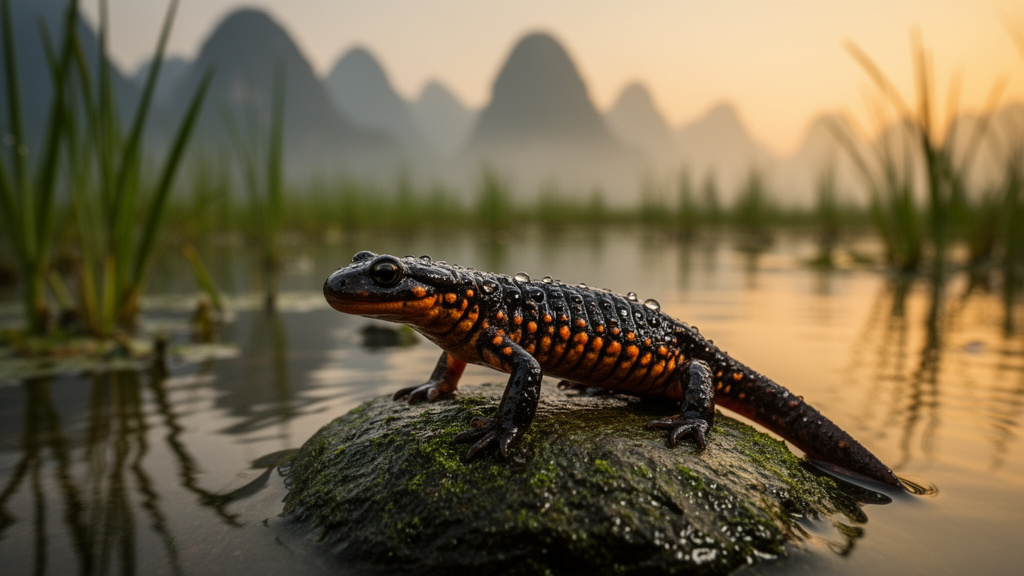
A taxonomic study combining mitochondrial sequencing, phylogenetic analysis, automated species delimitation and morphometric comparisons identified six salamanders collected at Tianhu Lake in northeastern Guangxi, China, as a previously undescribed species of the genus Tylototriton. The researchers formally named it Tylototriton guilinensis sp. nov. and proposed “Guilin Crocodile Newt” as its English common name.
The six specimens were collected at Tianhu Lake, Quanzhou County, Guilin City, Guangxi Zhuang Autonomous Region, during May and July 2025. They were initially identified as T. asperrimus. Following collection, the animals were photographed, euthanized and preserved in 75% ethanol, while liver samples were stored in 99% ethanol for genetic analysis. Voucher specimens were deposited at Guangxi Normal University, and the study followed the ethical guidelines of the university’s ethics committee.
For the molecular analysis, the researchers amplified and sequenced partial fragments of the mitochondrial ND2 and 16S rRNA genes. The final alignments were 1,041 and 843 base pairs, respectively, producing a concatenated matrix of 1,884 base pairs. Maximum-likelihood and Bayesian analyses yielded congruent phylogenetic trees. The Tianhu Lake specimens formed a highly supported lineage within the T. asperrimus species group and was resolved as the sister lineage to a clade containing T. gaowangjienensis and T. dabienicus.
Genetic distances provided additional support for separating the specimens. Under the Kimura 2-parameter model, ND2 divergence between the new lineage and other recognized Tylototriton species ranged from 1.47% against T. dabienicus to 14.01% against T. uyenoi. Its divergence from T. dabienicus and T. gaowangjienensis was 1.47%–1.63%, comparable to some distances among recently described species. Automated species delimitation with the Assemble Species by Automatic Partitioning method identified the Tianhu Lake samples as one of 38 operational taxonomic units in the sampled genus.
Morphological analysis also distinguished the population from its two closest relatives. Principal-component analysis based on size-standardized measurements from adult males separated the Guilin specimens from T. gaowangjienensis and T. dabienicus; the first two components accounted for 56.188% of the total variance. T-tests found significant differences in head length, head width, tail height, hand length, thigh length and total length between Guilin males and males of both close relatives, with p-values below 0.05. The five measured Guilin males averaged 117.9 ± 9.5 mm in total length.
The new species was characterized by a head wider than long, a truncated, nearly square snout in dorsal view, flattened and largely continuous rib nodules forming a dorsolateral fold, and finger tips extending beyond the snout when the forelimbs were stretched forward. It lacked orange rib nodules and orange parotoid markings. The holotype, GXNU YU001042, was an adult male collected at Tianhu Lake on 16 July 2025. It measured 131.0 mm in total length, including a 67.8 mm snout–vent length and a 72.2 mm tail. These measurements and coloration observations describe the holotype and measured specimens, rather than establishing uniform traits across the species.
The species was found in a roadside pond and adjacent marsh wetlands within evergreen broadleaf forest and marsh habitat at elevations of 1,600–1,800 metres. During the May survey, which coincided with the breeding season, the researchers observed aggregations in marshes and ponds after 19:30, although they detected no eggs or larvae. The confirmed distribution was limited to the type locality. Based on the six collected specimens and the restricted known range, the species’ wider distribution, population size and other biological and ecological traits remain uncertain.
The study also revised the identification of Tylototriton specimens collected in Baise, southwestern Guangxi, that had previously been assigned to T. asperrimus. These specimens clustered strongly with T. sini, and the authors consequently revised that population’s identification to T. sini. In addition, specimens assigned to T. asperrimus from its type locality at Mount Dayao, Jinxiu, formed two highly supported mitochondrial subclades separated by 1.27% genetic distance. The authors considered this divergence comparable to that among some recognized species and stated that further studies are needed to clarify the genetic structure of T. asperrimus and the diversity of the genus in Guangxi.
With the inclusion of T. guilinensis, the authors recognized three Tylototriton species in Guangxi: T. asperrimus, T. sini and the newly described T. guilinensis. Two of these occur in northeastern Guangxi. The authors reported that the newly known habitat faces disturbance from wind-power development and road construction, and they called for wider field surveys to establish its distribution range, population size and other key biological and ecological traits, together with measures to reduce interference and illegal capture.
Subject of Research: Description and taxonomic identification of a new Tylototriton salamander species from northeastern Guangxi, China
Article Title: A new species of genus Tylototriton ( Caudata , Salamandridae ) from northeastern Guangxi, China
Article References: Xiao, W., Chen, X., Wu, X., Pan, Y., Chen, J., Yu, G., & Huang, H. (2026). A new species of genus Tylototriton (Caudata, Salamandridae) from northeastern Guangxi, China. Zoosystematics and Evolution, 102(2), 671-686. https://doi.org/10.3897/zse.102.184792
Image Credits: AI Generated
Keywords: Tylototriton guilinensis, new species, salamander, Guangxi, Guilin, mitochondrial phylogeny, species delimitation, morphometrics, taxonomy, species, genus, Tylototriton
Cite Scienmag News
Juliet Wilcox. (October 20, 2026). Taxonomic study identifies Tylototriton guilinensis from northeastern Guangxi. Scienmag. https://scienmag.com/taxonomic-study-identifies-tylototriton-guilinensis-from-northeastern-guangxi/
Juliet Wilcox. "Taxonomic study identifies Tylototriton guilinensis from northeastern Guangxi." Scienmag, 20 October 2026, https://scienmag.com/taxonomic-study-identifies-tylototriton-guilinensis-from-northeastern-guangxi/. Accessed 20 October 2026.
Juliet Wilcox. "Taxonomic study identifies Tylototriton guilinensis from northeastern Guangxi." Scienmag. October 20, 2026. https://scienmag.com/taxonomic-study-identifies-tylototriton-guilinensis-from-northeastern-guangxi/