


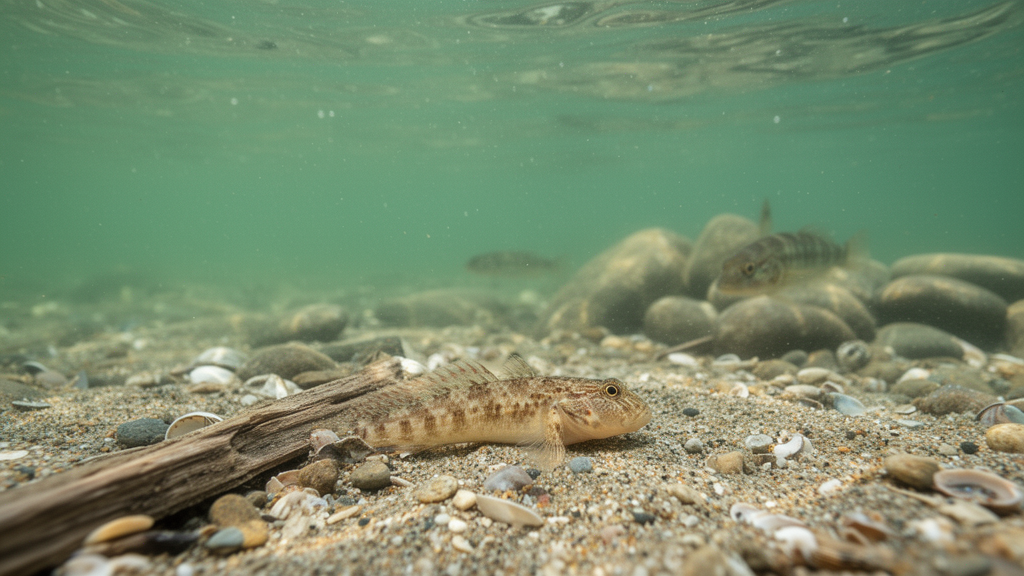
An observational field study of 410 gobiids collected from the southwestern Caspian Sea estimated length-weight relationships for four endemic species: Benthophilus persicus, B. baeri, Knipowitschia longecaudata and Hyrcanogobius bergi. Combined regression slopes ranged from 2.874 for B. baeri to 3.408 for H. bergi, with coefficients of determination ranging from 0.918 to 0.965.
The researchers collected the fish between 1996 and 2017 from coastal waters at Astara, Bandar Anzali and Chaboksar. Beach seining, scuba diving and deepwater bottom beam trawls were used to obtain the specimens. The fish were identified morphologically, fixed in 10% formalin and deposited in the Zoological Museum of Shiraz University, Collection of the Biology Department. Sex was determined from the external morphology of the urogenital papillae.
Each specimen was measured to the nearest 0.1 mm for total length and standard length with a digital caliper under a stereomicroscope, while total weight was recorded to the nearest 0.001 g. The sample comprised 199 B. persicus, 40 B. baeri, 135 K. longecaudata and 36 H. bergi. There were 99 males and 100 females of B. persicus, 20 of each sex for B. baeri, 72 males and 63 females of K. longecaudata, and 25 males and 11 females of H. bergi.
For each species and sex, the researchers modelled total weight as a function of total length using the equation W = aL^b, in which W is total weight in grams, L is total length in centimetres, a is the regression intercept and b is the slope of the log-transformed regression. Outliers were inspected on log-log plots, 95% confidence intervals were estimated for the intercept and slope, and regression significance was tested with ANOVA. Student’s t-test and covariance analysis compared slopes between sexes, while Bailey’s t-test assessed deviations from a slope of 3.
For B. persicus, the combined slope was 3.075, with a 95% confidence interval of 2.993–3.157 and an r² of 0.965. The combined estimate for B. baeri was 2.874, with a 95% confidence interval of 2.617–3.130 and an r² of 0.931. For K. longecaudata, the combined slope was 3.361, with a 95% confidence interval of 3.189–3.533 and an r² of 0.918. The combined estimate for H. bergi was 3.408, with a 95% confidence interval of 3.061–3.755 and an r² of 0.921.
Statistical comparisons indicated significant differences between male and female slopes in all four species. Sex-specific slopes for B. baeri were 2.840 for males and 3.039 for females, while those for K. longecaudata were 3.311 for males and 3.471 for females. The B. persicus slopes were 3.144 for males and 3.011 for females, and the H. bergi slopes were 3.630 for males and 3.050 for females. Bailey’s t-test found that slopes for both sexes in all four species deviated significantly from the expected value of 3.
ANOVA detected highly significant sex differences in total length, standard length and weight for B. persicus, with p-values below 0.001, but not for the other three species. In B. baeri and K. longecaudata, the higher female slopes indicated that sampled females were heavier than males of the same total length. The authors noted that this pattern might be associated with differences in gonadal development or nutritional status, rather than establishing either factor as a cause.
All four combined slopes fell within the expected range of 2.5–3.5 cited by the study, although the sex-specific estimate for male H. bergi was 3.630. The authors described the length-weight relationships as preliminary because they could not exclude shrinkage over years in preservation fluid. Some estimates may therefore differ from those obtained with freshly collected specimens. They said measurements of fresh and formalin-fixed fish after 12–96 hours and after 10–50 days could reveal shrinkage rates and support calculation of a correction factor.
Knowledge of these Caspian gobies remains limited because many species are known from only a few expeditions and the four studied species occupy habitats that are difficult to sample. The study reported that the IUCN Red List contains no information for B. persicus, while the other three species are categorized as Least Concern, but available population-trend data are sparse. The authors identified increased sampling, more reliable distribution metadata and biological and ecological data as necessary for determining the conservation status of these species.
Subject of Research: Length-weight relationships of four endemic gobiid species in the southwestern Caspian Sea
Article Title: Length-weight relationships of four difficult-to-sample Caspian endemic gobies ( Teleostei : Gobiidae ): Benthophilus persicus , Benthophilus baeri , Knipowitschia longecaudata , and Hyrcanogobius bergi
Article References: Zarei, F., Esmaeili, H. R., Abbasi, K., & Sadeghi, R. (2024). Length-weight relationships of four difficult-to-sample Caspian endemic gobies (Teleostei: Gobiidae): Benthophilus persicus, Benthophilus baeri, Knipowitschia longecaudata, and Hyrcanogobius bergi. Caucasiana, 3, 25-29. https://doi.org/10.3897/caucasiana.3.e118074
Image Credits: AI Generated
DOI: 10.3897/caucasiana.3.e118074
Keywords: Caspian Sea, gobiid fish, length-weight relationships, field sampling, allometric growth, Benthophilus persicus, Benthophilus baeri, Knipowitschia longecaudata, Hyrcanogobius bergi, fish conservation, Length-weight, relationships
Cite Scienmag News
Margaret Porter. (October 20, 2026). Field study estimates length-weight relationships for four endemic southwestern Caspian gobies. Scienmag. https://scienmag.com/field-study-estimates-length-weight-relationships-for-four-endemic-southwestern-caspian-gobies/
Margaret Porter. "Field study estimates length-weight relationships for four endemic southwestern Caspian gobies." Scienmag, 20 October 2026, https://scienmag.com/field-study-estimates-length-weight-relationships-for-four-endemic-southwestern-caspian-gobies/. Accessed 20 October 2026.
Margaret Porter. "Field study estimates length-weight relationships for four endemic southwestern Caspian gobies." Scienmag. October 20, 2026. https://scienmag.com/field-study-estimates-length-weight-relationships-for-four-endemic-southwestern-caspian-gobies/


