


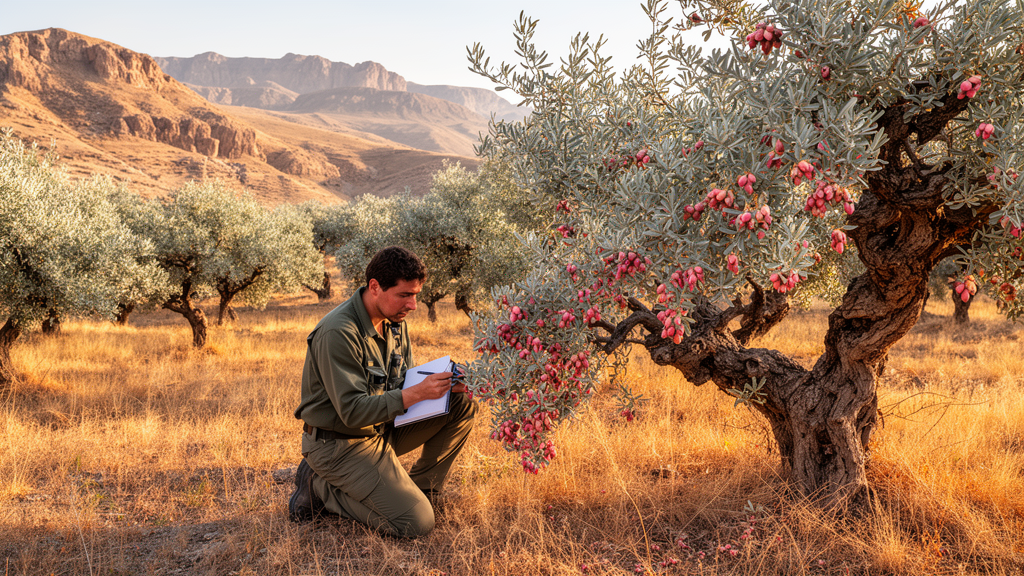
Now, a detailed vegetation survey has concluded that these open woodlands are not a degraded version of some other habitat, but a distinct type of vegetation worthy of recognition at the highest rank in plant community classification. The study, published in Vegetation Classification and Survey, formally proposes a new vegetation class, Pistacietea verae, encompassing the pistachio open woodlands that stretch from the Zagros and Alborz mountains of Iran to the Pamir-Alai and western Tian Shan of Tajikistan and neighbouring countries. For decades, pistachio groves were variously treated as shrubland, as sparse forest, or as a secondary growth phase replacing true forests.
Russian and Tajik authors disagreed about how to classify the so-called šhiblyak, a thermophilous shrub vegetation dominated by genera such as Acer, Crataegus, Celtis, Pistacia and Prunus. Some placed it within mesophilous forest vegetation, others within xerophytic open woodlands known in Russian as redkolesa. The new analysis shows that pistachio stands deserve to be separated from all of these categories.
To test the distinctiveness of the pistachio woodlands, the researchers assembled two datasets. The first contained 110 vegetation plots, or relevés, sampled in Tajikistan and Iran, covering groves dominated by Pistacia vera in the east and by Pistacia khinjuk and Pistacia eurycarpa in the west. The second was a comparative dataset of 1,276 relevés that added floristically related woody and grassland communities from across the Irano-Turanian and Mediterranean regions, including broad-leaved forests, juniper stands, Mediterranean oak forests, shrubland, tall-forb communities and pseudosteppes.
The two datasets were classified separately using a modified TWINSPAN algorithm with pseudospecies cut levels of 0, 2, 10 and 25 percent, with total inertia serving as a measure of cluster heterogeneity. Diagnostic species were identified with the phi coefficient as a fidelity measure, and non-metric multidimensional scaling was used to visualise the relationships among the distinguished groups. Climatic differences among the most similar vegetation types were tested with the Kruskal-Wallis rank sum test, using climate layers from the CHELSA database.
In total, 616 taxa of vascular plants were recorded in the 110 pistachio plots, a remarkably high figure that underscores the species richness of these open woodlands. The ordination showed that although the pistachio groves are internally heterogeneous, they form a clearly distinct group, most closely related to pseudosteppes and to šhiblyak shrubland but separable from both. Crucially, the pistachio stands shared almost no diagnostic species with juniper open woods, despite a similar open structure and a common evolutionary origin in the ancient proto-šhiblyak vegetation that arose during the aridification of Central Asia.
Climate separated the groves from their neighbours as well. Pistachio woodlands occur in semi-arid to sub-humid zones with hot summers and mild winters, receiving roughly 200 to 400 millimetres of precipitation annually in the lower belts, far less than the upper montane forests. Compared with šhiblyak and juniper stands, the pistachio groves showed significantly higher mean annual temperature and warmer coldest quarters, and the least precipitation in the warmest quarter.
They also harboured the highest richness of Irano-Turanian floristic elements among the compared vegetation types, along with a notable Mediterranean component. On the basis of this evidence, the authors propose the new class Pistacietea verae, with the order Pistacietalia verae and the type alliance Pistacion verae. Within the class they recognise two associations: Pistacietum verae, the eastern group dominated by Pistacia vera and centred on the Pamir-Alai, western Tian Shan and Kopet-Dagh, and Pistacietum khinjuk, the western group of the Zagros, Alborz and central and southern Iranian mountains.
The diagnostic species lists are long and distinctive, including plants such as Aegilops triuncialis, Bromus popovii, Prunus verrucosa, Eremurus roseolus, Ferula tadshikorum and many endemics of Tajikistan, alongside western counterparts such as Achillea nobilis subsp. neilreichii, Arum rupicola, Nepeta macrosiphon and Pyrus glabra. The endemism is striking. The study catalogues dozens of species endemic to Tajikistan that occur in pistachio open woodlands, and identifies a subset whose ecological optimum lies precisely in this habitat, including Ajuga turkestanica, Astragalus quisqualis, Cousinia grigoriewii, Euphorbia sogdiana, Onobrychis baldshuanica, Oxytropis linczevskii and Tulipa subquinquefolia.
These are mostly thermophilous, shade-tolerant plants that form a characteristic mantle around pistachio trees. The authors note that further sampling across the full range of Pistacia vera and P. khinjuk would likely reveal many more regional endemics. The origin of this vegetation reaches deep into geological time.
Molecular studies suggest the genus Pistacia evolved in Middle Asia as the climate aridified after the retreat of the Paratethys Sea in the Miocene, with P. vera and P. khinjuk emerging as the oldest and most widespread members of the lineage. As aridification intensified through the Miocene and Pliocene, this ancient vegetation diversified into the pistachio open woodlands of the warmest lowlands, the walnut forests of mid-altitude valleys and the juniper woods of the subalpine belt. The savanna-like physiognomy of the groves, with umbrella-crowned trees scattered over a grassy understorey, reflects both climate and a long history of grazing.
Wild herbivores such as saiga, dzheyran, urial and kulan once roamed these woodlands alongside predators including Persian lions and Caspian tigers; after Quaternary megafauna extinctions, domestic goats, sheep and cattle took their place. Centuries of pastoralism, logging and burning have thinned the canopy and encouraged heliophilous herbs from the surrounding pseudosteppes, yet the open structure persists even on inaccessible rock ledges where only wild urials graze. The authors argue that recognising Pistacietea verae as a distinct class is essential for conservation.
Formal classification at the class level, the researchers conclude, provides the framework needed for effective conservation strategies in these ecologically significant and still understudied ecosystems, and future work in the Hindu Kush, Kopet-Dagh and the southeastern Caucasus should reveal more of their internal diversity.
Subject of Research: Syntaxonomy and ecology of wild pistachio open woodlands in the Irano-Turanian region
Article Title: The Pistacietea verae : a new class of open, deciduous woodlands in Middle and Southwestern Asia
Article References: Nowak, A., Świerszcz, S., Naqinezhad, A., Nowak, S., & Nobis, M. (2024). The Pistacietea verae: a new class of open, deciduous woodlands in Middle and Southwestern Asia. Vegetation Classification and Survey, 5, 109-126. https://doi.org/10.3897/vcs.104841
Image Credits: AI Generated
DOI: 10.3897/VCS.104841
Keywords: pistachio, Pistacietea verae, vegetation classification, Irano-Turanian region, open woodlands, Tajikistan, Iran, endemic species, phytosociology, Pistacia vera, Pistacia khinjuk, conservation
Cite Scienmag News
Margaret Porter. (October 20, 2026). Research report: The Pistacietea verae : a new class of open, deciduous woodlands in Middle and Southwestern Asia. Scienmag. https://scienmag.com/research-report-the-pistacietea-verae-a-new-class-of-open-deciduous-woodlands-in-middle-and-southwestern-asia/
Margaret Porter. "Research report: The Pistacietea verae : a new class of open, deciduous woodlands in Middle and Southwestern Asia." Scienmag, 20 October 2026, https://scienmag.com/research-report-the-pistacietea-verae-a-new-class-of-open-deciduous-woodlands-in-middle-and-southwestern-asia/. Accessed 20 October 2026.
Margaret Porter. "Research report: The Pistacietea verae : a new class of open, deciduous woodlands in Middle and Southwestern Asia." Scienmag. October 20, 2026. https://scienmag.com/research-report-the-pistacietea-verae-a-new-class-of-open-deciduous-woodlands-in-middle-and-southwestern-asia/


