


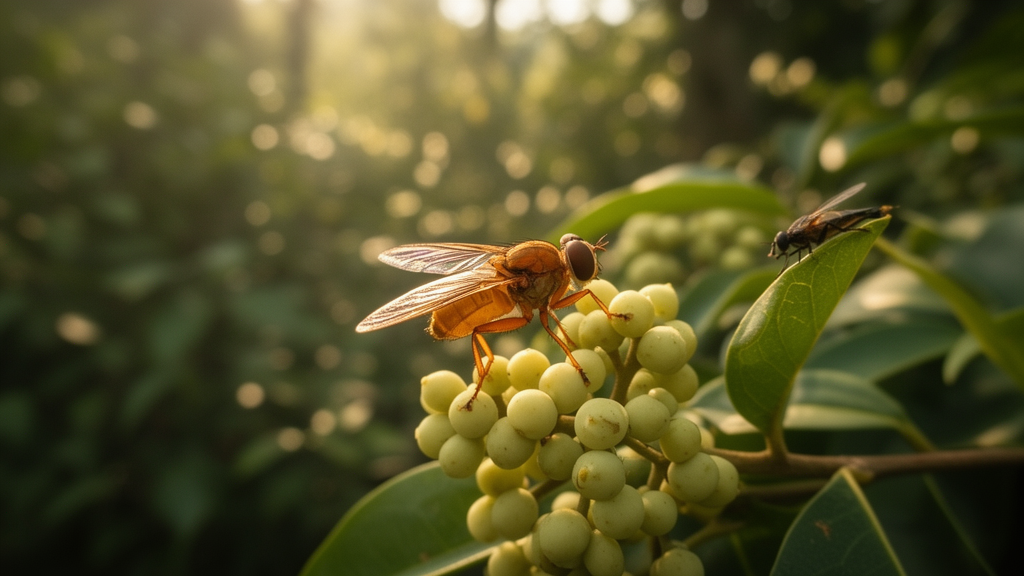
A taxonomic study of fruit flies in the genus Euphranta described two new species from India: Euphranta goniothalami and Euphranta undulata. Both are described from female specimens, and the study also presents an updated identification key for the 18 species of Euphranta then recorded in the country, comprising 16 previously known species and the two new taxa.
The paper places the work within the tribe Adramini of the subfamily Trypetinae in the family Tephritidae. Before these descriptions, the genus contained 112 species worldwide and was represented in India by 16 recorded species. The new species were distinguished using external morphology, wing pattern and female postabdominal structures, including the oviscape, aculeus, spermathecae and spicules on the eversible membrane.
The examined specimens were deposited in the National Insect Museum of the ICAR–National Bureau of Agricultural Insect Resources in Bengaluru, Karnataka, India. External structures were photographed with a Leica K3C camera attached to a Leica M205A stereozoom microscope. Postabdominal structures were imaged with a Nikon DS Fi-3 camera mounted on a Nikon Eclipse Ci phase-contrast microscope, and the resulting images were stacked using Combine ZP. The authors followed the terminology of White and colleagues and Cumming and Wood.
Euphranta goniothalami was described from a holotype and one paratype collected at Valara in Idukki district, Kerala, on 5 January 2025. The measured female body length was 5.73–5.90 mm, and the wing measured 5.51–5.67 mm long. Diagnostic features included a continuous subcostal band, a conical aculeus apex with a preapical flange, curved rod-shaped spermathecae densely covered with fine hairs, and blunt projections on the spicules at the distal end of the eversible membrane. The species differs from E. flavothoracica in these features and from E. laosica in its shorter oviscape and the stepped aculeus apex.
The authors reported that E. goniothalami was collected from infested fruits of Goniothalamus keralensis, a rare endemic plant in the Annonaceae found in the Western Ghats. They stated that fruit development was recorded from May to June, ripe fruits were observed from late August into early September, and the fruiting season ended by November. The fruits are aggregates of spindle-shaped berries that change from greenish to orange-red during maturation. The source also states that a high rate of seed feeding by the fly’s larvae was recorded in 2022 and 2023.
The observations for 2024 were more limited. The authors reported two larvae in 10 to 11 berries in an aggregate, with one larva present in a single fruit. Two larvae collected from attacked fruits on 19 November 2024 produced adults on 5 January 2025, an interval of 42–45 days. The egg, larval and pupal stages were not observed. These records are limited to the reported fruits and sampling occasions and do not establish a population-wide trend or a quantified effect on the host plant.
Euphranta undulata was described from a holotype and one paratype collected at Umiam in Ri-Bhoi district, Meghalaya, on 15 November 2023. The measured body length was 5.67–5.83 mm, and the wing was 5.18–5.54 mm long. The species resembles E. apicalis in general morphology and in having two transverse wing bands and a subapical fuscous patch, but the authors distinguished it by a narrower r-m crossband, an irregular proximal margin on the subapical patch and a broad aculeus tip with a wavy margin. Its name refers to that wavy aculeus margin.
The female genitalia of E. undulata included a 1.10-mm oviscape, a 0.8-mm eversible membrane with conical spicules at its distal end, a 0.31-mm aculeus and dark-brown, bulbous spermathecae with elongate stalks. The specimens had been collected in traps containing a liquid bait made with tender bamboo shoots and yeast. The study report does not provide a comparison of trap collections, abundance estimates or evidence that the bait was specific to E. undulata.
The principal limitation is the very small type series: one holotype and one paratype for each species. The paper provides detailed morphological descriptions and images of diagnostic structures, but its evidence does not establish broader geographic distributions, male morphology, life-history parameters across populations or the prevalence of either species beyond the reported collection records. The article’s findings are therefore a bounded taxonomic description of two newly named fruit-fly species and their differentiation from previously described Euphranta.
Subject of Research: Morphological description of two new species of the fruit-fly genus Euphranta from India
Article Title: Two new species of Euphranta Loew ( Diptera , Tephritidae , Trypetinae , Adramini ) from India
Article References: David, K. J., Hancock, D. L., Reshma, E. A., Jothish, P. S., Ningthoujam, K., Niladri, B. M., Abhishek, V., & Mahammed, N. R. N. (2025). Two new species of Euphranta Loew (Diptera, Tephritidae, Trypetinae, Adramini) from India. Deutsche Entomologische Zeitschrift, 72(2), 367-375. https://doi.org/10.3897/dez.72.165084
Image Credits: AI Generated
Keywords: Euphranta, fruit flies, Tephritidae, taxonomy, new species, India, Kerala, Meghalaya, morphology, identification key, species, Loew
Cite Scienmag News
Drew Townsend. (October 20, 2026). Taxonomic study describes two new Euphranta fruit fly species from India. Scienmag. https://scienmag.com/taxonomic-study-describes-two-new-euphranta-fruit-fly-species-from-india/
Drew Townsend. "Taxonomic study describes two new Euphranta fruit fly species from India." Scienmag, 20 October 2026, https://scienmag.com/taxonomic-study-describes-two-new-euphranta-fruit-fly-species-from-india/. Accessed 20 October 2026.
Drew Townsend. "Taxonomic study describes two new Euphranta fruit fly species from India." Scienmag. October 20, 2026. https://scienmag.com/taxonomic-study-describes-two-new-euphranta-fruit-fly-species-from-india/


