


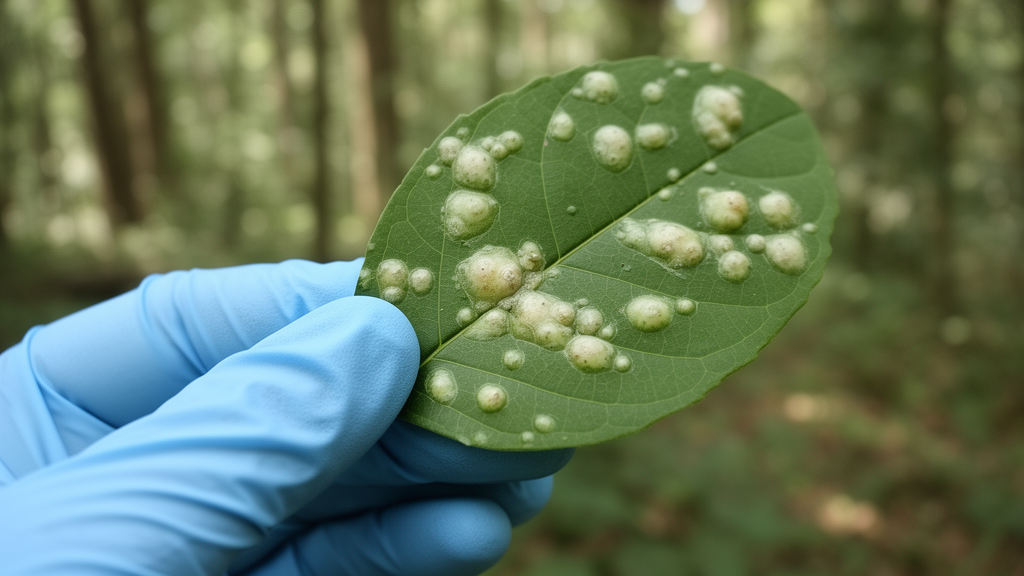
A field, culture and environmental-DNA study found Exobasidium in the phyllospheres of five broad-leaved tree species that are outside the genus’s known Ericales host associations. The researchers detected 12 phylogenetic lineages, isolated one of them into pure culture and formally described it as the new species Exobasidium phylloplanum, whose pathogenic phase has not been observed. The study combined ITS2 metabarcoding of whole leaves and dissected caterpillar guts with cultivation and phylogenetic analysis.
Leaf samples were collected in spring 2018 from a riparian floodplain forest in central Moravia, Czechia, where Ericales plants were absent. The analyzed trees were Alnus glutinosa, Carpinus betulus, Corylus avellana, Quercus petraea and Q. robur. The investigators also mined the GlobalFungi database for published environmental sequences to assess the occurrence of Exobasidium beyond known host plants.
After filtering, the researchers identified 75 Exobasidium amplicon sequence variants from leaves and insect guts, which clustered into 12 phylotypes. Seven grouped with described species that had publicly available DNA barcodes, including E. arescens, E. bisporum, E. camelliae, E. euryae, E. gracile, E. maculosum and E. miyabei. The other five had less than 94% similarity to sequenced species in the National Center for Biotechnology Information database, indicating possible undescribed or as-yet-unsequenced diversity.
This interpretation remains uncertain because many named Exobasidium species still lack public molecular data. Exobasidium communities differed significantly among host tree species in an analysis of similarity based on Jaccard and Morisita-Horn indices with 9,999 permutations. Quercus petraea had the highest measured alpha diversity, with a mean Shannon index of 0.50 and a mean Simpson index of 0.39, while Q. robur had the lowest values, at 0.32 and 0.17, respectively.
Principal component analysis also separated several tree-associated communities. Phylotype 9 accounted for more than 66% of Exobasidium reads on A. glutinosa and 62% on Q. robur, occurred in more than 30% of leaf samples from every analyzed tree and also dominated several caterpillar-gut communities. Overall, the gut datasets did not differ significantly from one another, and their phylotype proportions broadly reflected those in the corresponding tree phyllospheres.
Phylotype 9 was recovered in pure culture from two Tischeria ekebladella caterpillars and from healthy Tilia cordata leaves collected in Slovakia. All three isolates were genetically identical. Phylogenetic analysis placed them as a sister lineage to E. woronichinii and E. rhododendri.
The isolates differed from E. woronichinii by 3.9% of nucleotides in the ITS region and 1.8% in the LSU region, supporting their recognition as Exobasidium phylloplanum. Its name refers to the phylloplane, the leaf surface. The species produces filamentous colonies with fusiform blastoconidia measuring 8.2 ± 3.0 micrometres long and 1.8 ± 0.2 micrometres wide.
Physiological tests found growth from 6 to 25 °C, with optimal growth between 20 and 25 °C. Salinity of 16% or higher prevented growth. The isolates used all 16 tested carbon sources and grew on glucose without fermenting it.
In the GlobalFungi analysis, 17 of 40 examined Exobasidium species or phylotypes appeared in at least one environmental sample. E. phylloplanum was the most frequently detected lineage, occurring in 841 samples from 52 studies, mainly in European forests and in samples from plant shoots and soil. Its records were concentrated in temperate regions, with an absence in the otherwise well-surveyed boreal and Mediterranean areas.
Known parasites E. arescens, E. vaccinii and E. camelliae were also detected in environmental records, while some environmental phylotypes in the E. bisporum and E. miyabei clades occurred more frequently than the available reference sequences. The researchers could not establish that these environmental phylotypes represented the corresponding parasitic species in the sampled regions. They instead proposed that Exobasidium includes a continuum of life histories, ranging from predominantly parasitic species with short saprotrophic phases to lineages with longer environmental phases and possibly predominantly saprotrophic species.
The genome of E. phylloplanum strain CCF 7021 was assembled into five nuclear scaffolds totaling 17.7 megabases. The assembly had an N50 of 5.8 megabases, 95.5% BUSCO completeness and 7,463 annotated proteins. Comparative analyses found broadly similar numbers of carbohydrate-active enzyme genes and genes associated with pathogen–host interactions among E. phylloplanum and other Exobasidium species.
E. phylloplanum was distinguished by an expanded set of type I polyketide synthases, consistent with its production of red-brown gunacin pigments. The comparison did not identify a genomic feature that explained its apparently different lifestyle. A central limitation is that environmental DNA cannot by itself distinguish actively growing cells from dormant or wind-dispersed propagules.
Nevertheless, the non-random association of phylotypes with host trees, their recovery from healthy leaves and their isolation from insect guts support active surface colonization, although they do not prove a complete saprotrophic life cycle. It remains unresolved whether E. phylloplanum has an unrecognized pathogenic stage, a predominantly saprotrophic lifestyle or another form of ecological flexibility; the study establishes neither outcome. Infection experiments would be required to assess its parasitic potential.
Subject of Research: Environmental, cultural and genomic evidence for saprotrophic diversity in the fungal genus Exobasidium
Article Title: The saprotrophic dimension of Exobasidium ( Exobasidiales , Basidiomycota ): evidence for greater diversity and ecological flexibility than previously recognized
Article References: Veselská, T., Ježková, T., Ngubane, N. P., Wennrich, A., Kostovčík, M., Hařovská, D., Šigut, M., Pyszko, P., Bracewell, R., Drozd, P., Begerow, D., & Kolařík, M. (2026). The saprotrophic dimension of Exobasidium (Exobasidiales, Basidiomycota): evidence for greater diversity and ecological flexibility than previously recognized. IMA Fungus, 17, Article e180524. https://doi.org/10.3897/imafungus.17.180524
Image Credits: AI Generated
DOI: 10.3897/imafungus.17.180524
Keywords: Exobasidium, Exobasidium phylloplanum, saprotroph, environmental DNA, ITS2 metabarcoding, phyllosphere, fungal diversity, phylogenomics, caterpillar gut microbiome, Exobasidiales, saprotrophic, dimension
Cite Scienmag News
Roger Howard. (October 20, 2026). Research report: The saprotrophic dimension of Exobasidium ( Exobasidiales , Basidiomycota ): evidence for greater diversity and ecological flexibility than previously recognized. Scienmag. https://scienmag.com/research-report-the-saprotrophic-dimension-of-exobasidium-exobasidiales-basidiomycota-evidence-for-greater-diversity-and-ecological-flexibility-than-previously-recognized/
Roger Howard. "Research report: The saprotrophic dimension of Exobasidium ( Exobasidiales , Basidiomycota ): evidence for greater diversity and ecological flexibility than previously recognized." Scienmag, 20 October 2026, https://scienmag.com/research-report-the-saprotrophic-dimension-of-exobasidium-exobasidiales-basidiomycota-evidence-for-greater-diversity-and-ecological-flexibility-than-previously-recognized/. Accessed 20 October 2026.
Roger Howard. "Research report: The saprotrophic dimension of Exobasidium ( Exobasidiales , Basidiomycota ): evidence for greater diversity and ecological flexibility than previously recognized." Scienmag. October 20, 2026. https://scienmag.com/research-report-the-saprotrophic-dimension-of-exobasidium-exobasidiales-basidiomycota-evidence-for-greater-diversity-and-ecological-flexibility-than-previously-recognized/


