


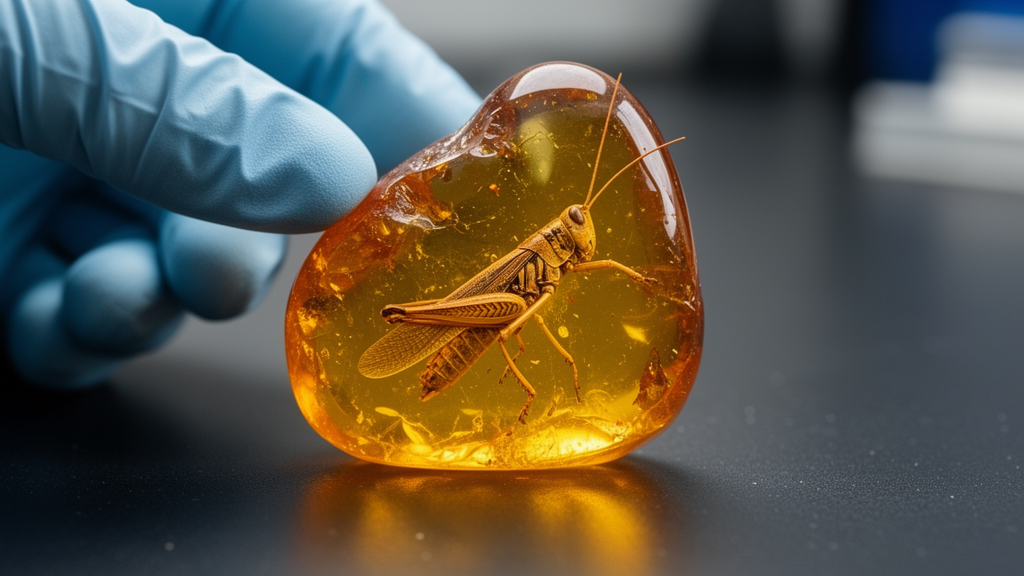
A taxonomic study of a single fossil insect preserved in Burmese amber describes a new genus and species, Burmeumastax lexiae , representing the first reported Cretaceous member of Eumastacoidea, a superfamily of short-horned grasshoppers. The almost completely preserved specimen is deposited in the amber collection of the Leibniz Institute for the Analysis of Biodiversity Change in Hamburg under accession number GPIH_07011. The study identifies B. lexiae from its preserved head, thorax, legs, abdomen and external genitalia.
The specimen is a small, brachypterous individual with a body length of 7.53 mm and a height of 1.03 mm immediately in front of the metathoracic leg. Its head measures 2.05 mm from the top of the capsule to the bottom of the mouthparts and 1.03 mm at its widest point. Large, ellipsoid eyes project laterally and occupy almost half the head height.
The antennae are absent apart from a 0.32 mm antennal bud, while the seven-segmented right maxillary palpus measures 0.87 mm. Researchers photographed the specimen with a Canon EOS 5Dsr camera fitted with a 65 mm lens and 2× magnification, using a stacked imaging system. Individual images were combined with Zerene Stacker and processed in Photoshop CS6, while interpretive drawings were prepared with GIMP and redrawn with artist pens.
The amber was recovered from a mining site near either Tanai or Hkamti in Myanmar, but its exact source remains unknown. Burmeumastax lexiae has a saddle-like pronotum with two distinct dorsal grooves, one smooth in front and one sharp behind. Short wing buds extending from beneath the posterior margin of the pronotum are about 0.42 mm long, indicating a brachypterous condition.
The metathoracic femur has a length-to-width ratio of 5.5. Fine hairs on the proximal half of its dorsal margin are replaced by small spines distally, and the metatibia bears spines that increase in size toward its distal end, although the tibia is not completely preserved. At the abdominal apex, the last tergite consists of five to seven separate plates arranged like a ring over the dorsal portion of the genitalia.
Only the dorsal, or middle, plate is setulose. The external genitalia include an elongate triangular supra-anal plate, a bulbous sub-genital plate with an apical central fold and lateral cercus-like lobes, and a slender cercus approximately 0.47 mm long. The sub-genital plate and cercus are also setulose.
These structures provided the first description of external genitalia for a fossil member of Eumastacoidea, according to the study. The fossil record for Eumastacoidea is sparse and usually consists of isolated fore- or hindwings. Before this description, the group included 13 valid fossil species from North America, Europe and Asia, and no member had been described from pre-Neogene amber.
Most fossils preserve only wings, while the Eocene species Eoerianthus eocaenicus , from Wyoming’s Green River Formation, was known from a specimen retaining most major body parts but lacking the abdominal apex. The new fossil therefore adds substantial anatomical information to a record dominated by incomplete wing specimens. Its family-level placement remains uncertain.
External and internal genitalia are important diagnostic references for eumastacoids, but the internal phallic complex is not preserved and other diagnostic characters are limited. The reduced wings also prevent direct comparison with most fossil genera. Burmeumastax can be compared with Eoerianthus and Paleomastacris : E. eocaenicus differs in body length, fully developed wings, pronotal structure and metafemoral spines, but its abdominal apex and external genitalia were not preserved, while P. ambarinus differs in its wingless condition, pronotum and supra-anal plate, and has external genitalia of a different shape.
The authors tentatively associate the new genus with Eumastacidae, observing that most fossil eumastacoids have been assigned to that family from wing-venation features. They acknowledge that the available anatomy cannot establish the assignment. The specimen may also be a nymph rather than an adult.
Its short wing buds and small body size support that interpretation, and its abdomen does not curve upward as it does in some male eumastacoids, although a straight abdomen in other living species means adulthood cannot be excluded. The discovery also has implications for the superfamily’s early distribution, but that interpretation is conditional. Burmese amber comes from the Burma Terrane, which separated from Gondwana during the Late Jurassic–Early Cretaceous and later formed part of an island arc in the Meso-Tethys at about 120 million years ago.
The terrane’s orthopteran fauna appears to have been strongly influenced by South American Gondwanan elements, including diverse Ripipterygidae and possible relationships between Burmese Elcanidae and insects from Brazil’s Crato Formation. If B. lexiae descended from ancestors in South American Gondwana before the terrane separated, Eumastacoidea would have been present there shortly after its DNA-based estimated origin around 180 million years ago. The fossil’s ancestry and precise amber locality, however, remain unresolved.
Subject of Research: Taxonomic description of a Cretaceous eumastacoid grasshopper from Burmese amber
Article Title: The first Cretaceous Eumastacoidea ( Orthoptera , Caelifera ) from Burmese amber
Article References: Husemann, M., Schall, O.-K. O., Uchida, K., & Kotthoff, U. (2025). The first Cretaceous Eumastacoidea (Orthoptera, Caelifera) from Burmese amber. Journal of Orthoptera Research, 34(1), 151-157. https://doi.org/10.3897/jor.34.134361
Image Credits: AI Generated
Keywords: Eumastacoidea, Burmese amber, Cretaceous fossil, grasshopper, Burmeumastax lexiae, taxonomic description, fossil genitalia, Myanmar, Orthoptera, paleontology, first, Cretaceous
Cite Scienmag News
Gavin Prescott. (October 20, 2026). New fossil grasshopper from Burmese amber reveals unusual Cretaceous anatomy. Scienmag. https://scienmag.com/new-fossil-grasshopper-from-burmese-amber-reveals-unusual-cretaceous-anatomy/
Gavin Prescott. "New fossil grasshopper from Burmese amber reveals unusual Cretaceous anatomy." Scienmag, 20 October 2026, https://scienmag.com/new-fossil-grasshopper-from-burmese-amber-reveals-unusual-cretaceous-anatomy/. Accessed 20 October 2026.
Gavin Prescott. "New fossil grasshopper from Burmese amber reveals unusual Cretaceous anatomy." Scienmag. October 20, 2026. https://scienmag.com/new-fossil-grasshopper-from-burmese-amber-reveals-unusual-cretaceous-anatomy/


