


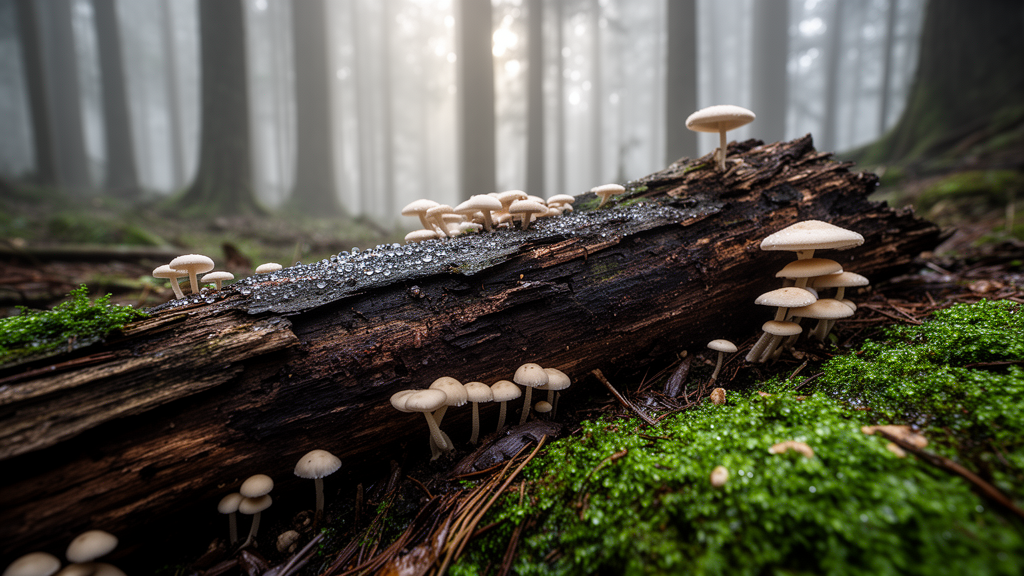
A taxonomic and phylogenetic study of the wood-inhabiting fungi Litschauerella and Tubulicium in East Asia describes three new species of Tubulicium and confirms that the two genera belong in different fungal orders. Analyses of combined internal transcribed spacer and 28S ribosomal DNA sequences, supported by microscopic examination of type and newly collected material, placed Litschauerella in Litschauerellaceae within Hymenochaetales and Tubulicium in Hydnodontaceae within Trechisporales. The study combined morphology with phylogenetic evidence to reassess the generic limits and relationships of two small, poorly known groups of corticioid fungi.
Investigators examined basidiomata, cystidia, basidia and basidiospores, and analyzed 57 sequences in the Hymenochaetales dataset and 67 in the Trechisporales dataset. Bayesian inference and maximum-likelihood analyses produced largely congruent trees, with branches considered well supported at posterior probabilities of at least 0.9 and bootstrap values of at least 70%. For microscopic work, free-hand sections were mounted in potassium hydroxide with phloxine and in Melzer’s reagent, and observations and measurements were made at magnifications up to 1,000 times.
DNA was extracted from dried specimens or mycelia cultivated on 2% malt extract agar. The investigators amplified the nuclear ribosomal DNA ITS1–5.8S–ITS2 region with ITS1F/ITS4B primers and the 28S region with LR0R/LR5 primers, using two overlapping ITS segments for aged specimens. Products were sequenced by the Sanger method.
The genera share thin, resupinate basidiomata with hispidulous hymenial surfaces, monomitic hyphal systems containing nodose-septate hyphae, projecting multi-rooted lyocystidia and slightly constricted, subclavate basidia. They are distinguished by cystidial structure, chemical reactions and basidiospore morphology. Litschauerella has lyocystidia encrusted with crystals and fibrous hyphae, a dextrinoid inner layer and globose to broadly ellipsoid spores.
Tubulicium has lyocystidia covered mainly with dendroidly branching hyphae, a weakly amyloid inner layer and navicular, fusiform or vermicular spores. Sequencing the type species Litschauerella abietis provided molecular confirmation of the genus’s previously uncertain placement. It grouped with L. gladiola and six operational taxonomic units of uncultured fungi in a monophyletic Litschauerella–Litschauerellaceae clade with 100% bootstrap support and a posterior probability of 1.
The clade represented an early-diverging lineage within Hymenochaetales. On this basis, the researchers recognized Litschauerellaceae as an independent family rather than a synonym of Hydnodontaceae. Tubulicium , including its type species T. vermiferum , formed a well-supported monophyletic clade within Trechisporales, with 99% bootstrap support and a posterior probability of 1.
It was placed in Hydnodontaceae as the sister group of the monotypic genus Membranohymenium . Each of the three newly described Tubulicium species occupied a distinct phylogenetic lineage. T. densum , described from Taiwan, clustered with an uncultured Basidiomycota sequence from orchid roots in China with 93% bootstrap support and a posterior probability of 1.
T. fusiforme , described from Yunnan, China, grouped with an uncultured sequence from healthy tea material in Japan with 96% bootstrap support and a posterior probability of 1. T. naviculisporum , also described from Taiwan, was represented by a single sequence and emerged as the sister lineage to T. bambusicola . The new species differ in their cystidial coverings and spores.
T. densum has dendroidly branching hyphae and columnar crystals on its lyocystidia, with narrowly fusiform to navicular, oily spores measuring (19–)20.5–26(–28.5) × (2.8–)3–3.5(–4.1) μm. T. fusiforme has polytetrahedral crystals and fusiform to slightly vermicular spores measuring (21.5–)23–26(–27.2) × (3.9–)4–4.4(–4.5) μm. T. naviculisporum has cylindrical hyphae on its cystidia and navicular to fusiform spores measuring (17–)18.5–22.5(–24.5) × (3–)3.2–3.8(–4.1) μm.
New observations also extended the documented distributions of several previously described taxa. Litschauerella abietis was recorded in Taiwan on gymnosperm and angiosperm branches, while L. hastata was reported from Vietnam’s Lam Dong Province on a rotting trunk in mossy forest. In Taiwan, T. bambusicola occurred on bamboo and once on Arenga engleri ; T. curvisporum occurred on tree fern; T. dussii was collected from tree fern and a rattan culm; and T. vermiferum grew on an angiosperm branch.
The analysis has bounded limitations. The phylogenetic datasets did not include every recognized species, and T. naviculisporum was represented by only one sequence. Similarity between environmental sequences and two new species suggested possible ecological associations, but sequence matches do not establish those relationships.
The authors also reported morphological plasticity and regional variants in the Litschauerella clematidis complex, which they said require further phylogenetic study to clarify species boundaries. Overall, the study established molecular support for the placement of Litschauerella , corroborated the existing placement of Tubulicium , expanded the known East Asian distributions of the genera and added three recognized species to Tubulicium .
Subject of Research: Taxonomy and phylogeny of East Asian Litschauerella and Tubulicium
Article Title: Taxonomy and phylogeny of Litschauerella ( Hymenochaetales ) and Tubulicium ( Trechisporales ) in East Asia: Three new species and six new records
Article References: Lin, Y.-C., & Chen, C.-C. (2026). Taxonomy and phylogeny of Litschauerella (Hymenochaetales) and Tubulicium (Trechisporales) in East Asia: Three new species and six new records. MycoKeys, 138, 249-279. https://doi.org/10.3897/mycokeys.138.203229
Image Credits: AI Generated
DOI: 10.3897/mycokeys.138.203229
Keywords: fungal taxonomy, Litschauerella, Tubulicium, Hymenochaetales, Trechisporales, molecular phylogeny, ITS sequences, 28S rDNA, wood-inhabiting fungi, Taxonomy, phylogeny, East
Cite Scienmag News
Roger Howard. (October 20, 2026). Morphology and phylogeny of East Asian Litschauerella and Tubulicium support placement in separate fungal orders. Scienmag. https://scienmag.com/morphology-and-phylogeny-of-east-asian-litschauerella-and-tubulicium-support-placement-in-separate-fungal-orders/
Roger Howard. "Morphology and phylogeny of East Asian Litschauerella and Tubulicium support placement in separate fungal orders." Scienmag, 20 October 2026, https://scienmag.com/morphology-and-phylogeny-of-east-asian-litschauerella-and-tubulicium-support-placement-in-separate-fungal-orders/. Accessed 20 October 2026.
Roger Howard. "Morphology and phylogeny of East Asian Litschauerella and Tubulicium support placement in separate fungal orders." Scienmag. October 20, 2026. https://scienmag.com/morphology-and-phylogeny-of-east-asian-litschauerella-and-tubulicium-support-placement-in-separate-fungal-orders/


