

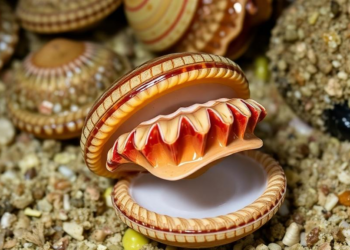
Deep-Sea Clams Use a Tiered Survival Strategy When Sulfide Supplies Falter
HKUST-led researchers used in situ transplant experiments at the Haima cold seep to show that a deep-sea clam and its ...
HKUST-led researchers used in situ transplant experiments at the Haima cold seep to show that a deep-sea clam and its ...

New research shows that in summertime, volatile chemical products and buildings, rather than vehicles, dominate urban air pollution emissions, a ...
Engineers at North Carolina State University have built a feather star-inspired soft robot that achieves full three-dimensional underwater maneuverability using ...
A three-decade survey of gutless marine worms reveals that their remarkably stable symbioses depend on a surprising willingness to acquire ...
Physicists at Johannes Gutenberg University Mainz have demonstrated that compact, room-temperature diamond magnetometers based on nitrogen vacancy centers can measure ...
Researchers at Tohoku University have revealed after three decades that the potassium channel AKT5, activated by phosphorylation, drives leaf stalk ...
Symbiotic ammonia-oxidizing archaea in marine sponges have been shown to consume amino acids as well as ammonia, revealing an unexpected ...
By measuring the strength of fossilized arm and leg bones, researchers found that Australopithecus combined tree-climbing with human-like walking, while ...
Two new Science Advances studies show that Enceladus's ice plumes naturally concentrate ocean chemicals, including potential biosignatures, and that methane-producing ...
A new analysis of Cassini data shows that slow freezing and fragmentation of ocean spray naturally sort and concentrate salts ...

Embark on a thrilling journey of discovery with Scienmag.com—your ultimate source for cutting-edge breakthroughs. Immerse yourself in a world where curiosity knows no limits and tomorrow’s possibilities become today’s reality!