Thursday, October 29, 2026
Science
No Result
View All Result
  • Login
  • HOME
  • SCIENCE NEWS
  • CONTACT US
  • HOME
  • SCIENCE NEWS
  • CONTACT US
No Result
View All Result
Scienmag
No Result
View All Result
Home Science News Earth Science

Climate change amplified Storm Boris floods more than its rainfall, models find

October 28, 2026
in Earth Science
Sloane Callahan
By Sloane Callahan Scienmag Editorial Profile - Climate Mitigation
Reading Time: 2 mins read
0
Climate change amplified Storm Boris floods more than its rainfall, models find

Climate change amplified Storm Boris floods more than its rainfall, models find

65
SHARES
587
VIEWS
Share on FacebookShare on Twitter
ADVERTISEMENT

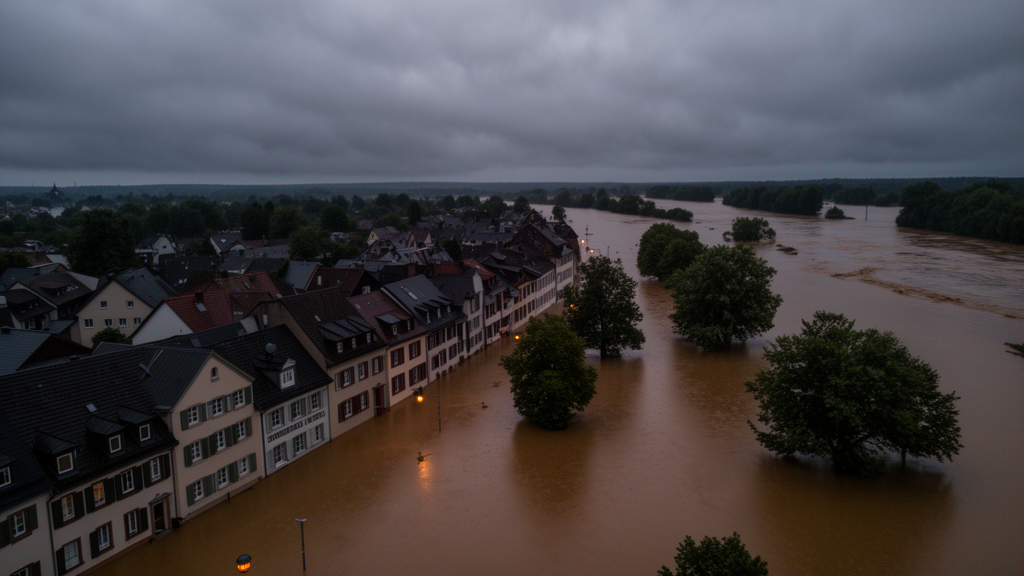
Flood peaks in central Europe from the calamitous 2024 Storm Boris would have been 14 to 22% lower without the influence of human-driven climate change, new models suggest. Precipitation, meanwhile, would have been 6 to 9% lower, according to the analysis published in Science Advances.

“Anthropogenic climate change substantially amplified the flooding associated with Storm Boris beyond what would be expected when studying precipitation intensification alone,” Peter Miersch and colleagues write.

Research shows that human-driven climate change has directly intensified extreme precipitation events. As such, it is likely that climate change has also contributed to intensifying floods, but the authors note that more studies must be done to define these relationships further.

Miersch and colleagues used 2024’s Storm Boris as a case study to examine the influence of anthropogenic climate change on precipitation and flooding in central Europe. The team drew on hydrological models, climate models and a storyline framework, an approach that reconstructs a narrative through data, to compare the event as it occurred with a counterfactual world without human-caused warming.

Using this combination of methods, they determined that precipitation from Storm Boris would have been 6 to 9% lower if there was no anthropogenic forcing. Meanwhile, flood peak magnitude would have been 14 to 22% lower.

Moreover, because of human-driven climate change, flood peaks increased by more than double the increase for event precipitation. This gap between the rainfall response and the flood response is the study’s central finding: the flooding associated with Storm Boris was amplified beyond what would be expected from precipitation intensification alone.

The study, published in Science Advances under the title “Evidence from 2024 Storm Boris indicates anthropogenic climate change amplifies floods more than extreme precipitation,” appeared on 28 October 2026. Its DOI is 10.1126/sciadv.aef7703.

The authors caution that further research is needed to define these relationships more precisely, and the results are specific to the Storm Boris case examined with the models and storyline framework used in the study.

Subject of Research: The influence of anthropogenic climate change on precipitation and flooding from Storm Boris in central Europe

Article Title: Without climate change, flood peaks in Europe from Storm Boris would have been as much as 22% lower, models suggest

Article References: Without climate change, flood peaks in Europe from Storm Boris would have been as much as 22% lower, models suggest. Original publication (Bibliographic details unavailable.)

Image Credits: AI Generated

DOI: Not provided

Keywords: Storm Boris, flooding, climate change, extreme precipitation, central Europe, hydrological modelling, storyline approach, flood peaks, Science Advances, attribution, Without, climate

Cite Scienmag News

Sloane Callahan. (October 28, 2026). Climate change amplified Storm Boris floods more than its rainfall, models find. Scienmag. https://scienmag.com/climate-change-amplified-storm-boris-floods-more-than-its-rainfall-models-find/

Sloane Callahan. "Climate change amplified Storm Boris floods more than its rainfall, models find." Scienmag, 28 October 2026, https://scienmag.com/climate-change-amplified-storm-boris-floods-more-than-its-rainfall-models-find/. Accessed 29 October 2026.

Sloane Callahan. "Climate change amplified Storm Boris floods more than its rainfall, models find." Scienmag. October 28, 2026. https://scienmag.com/climate-change-amplified-storm-boris-floods-more-than-its-rainfall-models-find/

Tags: anthropogenic forcing and flood severityattributionCentral Europeclimateclimate changeclimate change amplification of European floodsclimate change impact on floodingextreme precipitationflood peak reduction without climate changeflood peaksfloodinghuman-driven climate change and extreme weather eventshydrological and climate modeling for flood analysishydrological modellingimportance of further research on climate-flood relationshipsinfluence of climate change on precipitationmodeling flood scenarios with and without global warmingrole of climate change in flood risk assessmentScience AdvancesStorm BorisStorm Boris 2024storm event case study in central Europestoryline approachwithout
Share26Tweet16
Previous Post

New Green-Flowered Legume Species Discovered in Guangxi Forests of China

Next Post

Phase 3 Trials at Kidney Week 2026 Show New Promise for IgA Nephropathy Care

Related Posts

China’s Water Resilience and Green Development Are Rising Together, Study Finds
Earth Science

China’s Water Resilience and Green Development Are Rising Together, Study Finds

October 29, 2026
When Volcanoes Fall Quiet, Scientists Say It Is Time to Talk
Earth Science

When Volcanoes Fall Quiet, Scientists Say It Is Time to Talk

October 29, 2026
Farms shift toward the tropics and drylands as settlements expand
Earth Science

Farms shift toward the tropics and drylands as settlements expand

October 29, 2026
Soil Moisture at Startup Shifts Landfalling Typhoon Track Forecasts
Earth Science

Soil Moisture at Startup Shifts Landfalling Typhoon Track Forecasts

October 29, 2026
Warming seas push flood peaks hardest in small headwater streams, modeling study finds
Earth Science

Warming seas push flood peaks hardest in small headwater streams, modeling study finds

October 29, 2026
Magnetite nanoparticles pull lead from water in optimized batch adsorption study
Earth Science

Magnetite nanoparticles pull lead from water in optimized batch adsorption study

October 29, 2026
Next Post
Phase 3 Trials at Kidney Week 2026 Show New Promise for IgA Nephropathy Care

Phase 3 Trials at Kidney Week 2026 Show New Promise for IgA Nephropathy Care

  • Mothers who receive childcare support from maternal grandparents show more optimized

    Mothers who receive childcare support from maternal grandparents show more parental warmth, finds NTU Singapore study

    27656 shares
    Share 11059 Tweet 6912
  • University of Seville Breaks 120-Year-Old Mystery, Revises a Key Einstein Concept

    1061 shares
    Share 424 Tweet 265
  • Bee body mass, pathogens and local climate influence heat tolerance

    682 shares
    Share 273 Tweet 171
  • Researchers record first-ever images and data of a shark experiencing a boat strike

    546 shares
    Share 218 Tweet 137
  • Groundbreaking Clinical Trial Reveals Lubiprostone Enhances Kidney Function

    531 shares
    Share 212 Tweet 133
Science

Embark on a thrilling journey of discovery with Scienmag.com—your ultimate source for cutting-edge breakthroughs. Immerse yourself in a world where curiosity knows no limits and tomorrow’s possibilities become today’s reality!

RECENT NEWS

  • Research report: CLeaR: An adaptive continual learning framework for regression tasks
  • Most Tanzanian Clinicians Know a Little About AI but Few Actually Use It
  • China’s Water Resilience and Green Development Are Rising Together, Study Finds
  • Who Falls for Fake News? Large Italian Survey Points to Worldview and Topic

Categories

  • Agriculture
  • Anthropology
  • Archaeology
  • Athmospheric
  • Biology
  • Biotechnology
  • Blog
  • Bussines
  • Cancer
  • Chemistry
  • Climate
  • Earth Science
  • Editorial Policy
  • Marine
  • Mathematics
  • Medicine
  • Pediatry
  • Policy
  • Psychology & Psychiatry
  • Science Education
  • Science News
  • Social Science
  • Space
  • Technology and Engineering

Subscribe to Blog via Email

Enter your email address to subscribe to this blog and receive notifications of new posts by email.

Join 5,151 other subscribers

© 2025 Scienmag - Science Magazine

Welcome Back!

Login to your account below

Forgotten Password?

Retrieve your password

Please enter your username or email address to reset your password.

Log In
No Result
View All Result
  • HOME
  • SCIENCE NEWS
  • CONTACT US

© 2025 Scienmag - Science Magazine

Discover more from Science

Subscribe now to keep reading and get access to the full archive.

Continue reading