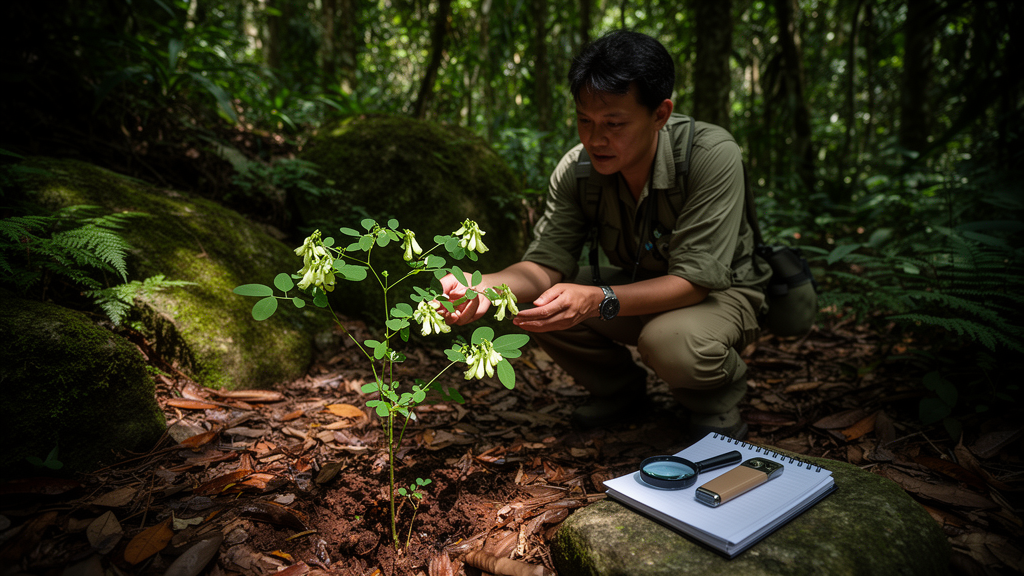
Botanists surveying the forests of Guangxi, China, have encountered an unusual shrubby legume that could not be matched to any known species, and they have now formally described it as Ormosia viridiflora, a new member of the Fabaceae. The species, collected in Rongan County, is distinguished by a striking combination of traits: a shrubby habit rather than the tall tree form typical of its relatives, light green flowers, a tubular calyx, pods with leathery valves and inconspicuous transverse septa, and, most unusually, just five fertile stamens. The description, published in the journal PhytoKeys, is based on specimens collected from the wild, including both fresh and dried material, and is accompanied by detailed photographs, scanning electron micrographs of leaf and pollen surfaces, and a comparative table against its closest morphological relatives.
The discovery emerged from a broader three-year effort to survey the distribution range of the genus Ormosia across China, including visits to the type localities of many species. That work has now yielded floral and fruit information for roughly half of the roughly 35 to 37 Chinese species of the genus. The new species was first collected in the field in 2019, with additional gatherings in 2026, and the formal type specimen was collected on 27 March 2026 at 706 meters elevation in Banlan Town, Rongan County. The holotype is deposited at the herbarium of IBK, with isotypes at HITBC, IBSC, KUN, and PE.
Ormosia is a genus of papilionoid legumes with a pantropical and subtropical distribution, comprising approximately 130 to 150 species of trees and shrubs. It belongs to one of the early-diverging groups within the subfamily Papilionoideae and is characterized by imparipinnate leaves, papilionaceous flowers usually with ten free stamens, and distinctive seeds with a hard, often red or black seed coat. In China the genus is represented predominantly in the southern provinces of Guangxi, Guangdong, Yunnan, and Hainan. The new species grows in thickets within evergreen mixed forests at elevations of 600 to 750 meters, on acidic mountain yellow soil, alongside plants such as Rhododendron latoucheae, Daphniphyllum oldhamii, and Pinus massoniana.
The diagnosis of the new species rests on a suite of characters that separate it from its two closest comparators, O. saxatilis and O. microphylla. Where those species are tall trees, O. viridiflora is a shrub of two to four meters. Its leaves carry five to eleven leaflets with caudate, or tail-tipped, apices, whereas the comparators bear eleven to twenty-three leaflets with acuminate apices. The new species’ leaflets are glabrous on the upper surface and subglabrous below, in contrast to the pubescent or densely hairy leaflets of its relatives. Its calyx is tubular rather than campanulate, its pods have leathery valves with inconspicuous transverse septa rather than woody, conspicuously septate valves, and the claw of its standard petal is pseudopeltate, with basal auricles sheathing the claw apex, a condition absent in both comparator species.
Perhaps the most eye-catching feature is the flower color and the stamen count. The petals are light green, a hue reflected in the species name viridiflora, which refers to the light green color of both the corolla and the calyx. The flowers lack obvious fragrance, while O. microphylla produces a strong scent at anthesis. Most notably, the species has five fertile stamens without staminodes, a condition that is rare in Asian Ormosia and also occurs in O. semicastrata, where flowers with five fertile stamens and no staminodes are common, though one to three staminodes may also appear. The authors note that this character may be homoplastic within the genus, and that in the new species no staminodes were observed in dissections from 2025 and 2026, although one photographic record shows a possible staminode of undetermined number.
The taxonomic history of Chinese Ormosia stretches back to Bentham’s early groupings and was formalized in Merrill and Chen’s 1943 treatment, which recognized 34 species and 15 series based largely on pod and seed morphology. Chang’s later revision recognized 35 species in three sections and six series, and the Flora of China treatment of 2010 accepted 35 species. However, these systems have relied heavily on a limited set of characters, particularly dry pod and seed features, which the authors say exhibit considerable homoplasy. Recent work has emphasized that floral morphology and fruit characters hold greater diagnostic value, with corolla shape, the ratio of calyx tooth length to tube length, pedicel length, and fruit characters providing essential criteria for species delimitation.
Molecular phylogenetics has also reshaped understanding of the genus. The most extensively sampled phylogeny to date, based on nuclear ITS and plastid markers from 82 species, recovered strong support for the monophyly of Ormosia and showed that all sampled Asian species fall into two comparably sized clades, one of which is sister to the clade containing all sampled New World species. Several widely distributed Chinese taxa, including O. emarginata and O. semicastrata, were recovered in different Old World clades despite their historical placement in the same infrageneric groups, underscoring that traditional morphology-based sections do not reflect evolutionary relationships. A robust phylogenetic framework at the genomic level is still needed before a stable infrageneric classification can be proposed.
The new species was identified through careful attention to features that have often been overlooked, particularly floral morphology at anthesis and the behavior of fruits as they dry. The authors compared fresh and dried fruits, controlling for the effects of drying on specimen appearance, and found that mature fresh pods of O. viridiflora and O. microphylla are both swollen, but those of the new species turn black and decrease in thickness by nearly one-quarter to one-third upon drying on the tree, whereas those of O. microphylla do not show this change; fruits of O. saxatilis remain flattened from maturity through complete drying. The three species share coincident flowering periods, glabrous transversely septate pods, and a red, hard, difficult-to-remove seed coat, a combination not known in other Asian congeners.
Micromorphology adds further documentation. Pollen grains are oblate-spheroidal, oblong in equatorial view, and three-lobed circular in polar view, tricolporate, measuring 23.5 to 26.5 by 21.5 to 24.0 micrometers, with fusiform colpi, transversely elongated endoapertures, and microreticulate exine. These features, together with the leaf indumentum, are consistent with the genus, though comparable pollen data for O. microphylla and O. saxatilis are lacking, so the pollen characters do not independently resolve the species’ affinities. The scanning electron microscopy also revealed rosette-like epicuticular wax crystals on the abaxial leaf surface, a feature the authors say is apparently previously unrecorded in Ormosia and may prove diagnostic for the new species.
Conservation prospects are grim. The species is known only from the type locality, where a single subpopulation has been recorded, and no additional populations have been found since the first collection in 2019. The extent of occurrence and area of occupancy remain unclear because comprehensive field surveys have not been carried out, but the species is evidently restricted to a single location, and the type locality sits at the edge of a plantation and is subject to direct human disturbance. The extremely narrow distribution and tiny population size imply a high risk of extinction, with an inferred continuing decline in habitat quality. Under IUCN criteria, the species meets thresholds for B1ab(iii)+2ab(iii), C2a(i), and D, with criterion D, fewer than 50 mature individuals, alone qualifying it as Critically Endangered. The authors recommend a tentative assessment of Critically Endangered, pending further field investigation, and stress that effective conservation measures are a priority. A phylogenetic analysis including O. saxatilis, O. microphylla, and O. semicastrata is planned to test the proposed relationships.
Subject of Research: Taxonomic description of a new legume species, Ormosia viridiflora, from Guangxi, China
Article Title: Ormosia viridiflora , a new species of Fabaceae from Guangxi, China
Article References: Zou, C., Lu, Z., Nong, S., & Liu, Y. (2026). Ormosia viridiflora, a new species of Fabaceae from Guangxi, China. PhytoKeys, 280, 239-248. https://doi.org/10.3897/phytokeys.280.214416
Image Credits: AI Generated
DOI: 10.3897/phytokeys.280.214416
Keywords: Ormosia viridiflora, Fabaceae, new species, Guangxi, China, taxonomy, legumes, Critically Endangered, IUCN Red List, plant morphology, pollen micromorphology, biodiversity
Cite Scienmag News
Margaret Porter. (October 28, 2026). New Green-Flowered Legume Species Discovered in Guangxi Forests of China. Scienmag. https://scienmag.com/new-green-flowered-legume-species-discovered-in-guangxi-forests-of-china/
Margaret Porter. "New Green-Flowered Legume Species Discovered in Guangxi Forests of China." Scienmag, 28 October 2026, https://scienmag.com/new-green-flowered-legume-species-discovered-in-guangxi-forests-of-china/. Accessed 28 October 2026.
Margaret Porter. "New Green-Flowered Legume Species Discovered in Guangxi Forests of China." Scienmag. October 28, 2026. https://scienmag.com/new-green-flowered-legume-species-discovered-in-guangxi-forests-of-china/