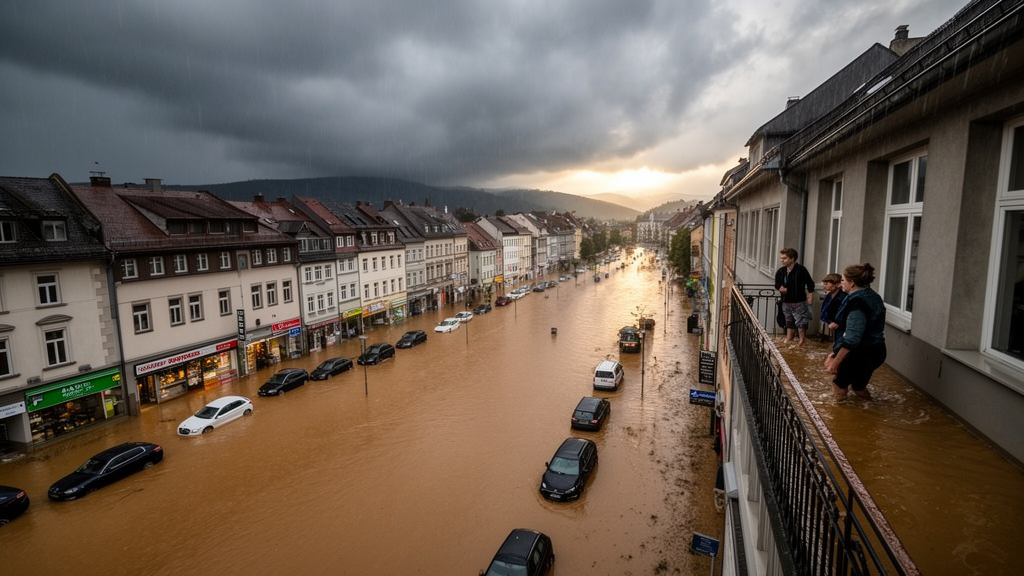
When Storm Boris swept across Central and Eastern Europe in September 2024, it delivered several hundred millimetres of rain within a few days in some areas, swelling rivers across Poland, Czechia, and Austria. Earlier attribution studies had already shown that global warming intensified the storm’s precipitation. Now a new study led by the Helmholtz Centre for Environmental Research (UFZ), published in Science Advances, reports that anthropogenic climate change amplified the resulting flood peaks considerably more than the precipitation itself, a finding that suggests flood risk assessments based solely on rainfall may underestimate the true change in flood hazard.
The research team went a step beyond conventional attribution analyses, which typically stop at the meteorological event and ask how much extreme precipitation has intensified. “In our study, we have taken this a step further. Using hydrological models, we investigated how changes in precipitation amounts caused by climate change affect the magnitude of flooding”, says lead author Peter Miersch from the UFZ. While it has long been known that an increase in precipitation does not translate proportionally into an increase in flood magnitude, the size of this effect for individual events, and the extent to which it can be attributed to human influence on the climate, had remained unclear.
To trace how rainfall in a catchment generates runoff and ultimately flooding, the researchers combined climate simulations with two different hydrological models. The differences between the world with and without human-caused warming were substantial. Without anthropogenic climate change, precipitation during Storm Boris would have been around 6 to 9 percent lower, depending on the climate model, but flood peaks would have been 14 to 22 percent lower on average.
The explanation lies in how catchments respond to additional rainfall once soils approach saturation. “The soil can initially absorb some of the rain during a heavy rainfall event. But eventually the soil becomes saturated, and every additional millimetre of rain flows directly into the river”, explains Miersch. Once the soil is saturated, additional rainfall produces a particularly sharp increase in runoff, which is why modest increases in precipitation can drive disproportionately large increases in flood peaks.
To test the robustness of the result, the team combined two different climate models with two hydrological models, one of which uses machine learning. Despite the different methodological approaches, the same basic pattern emerged in every combination: flood peaks increased considerably more than precipitation. This consistency across model pairings strengthens the conclusion that the amplification is a systematic feature of how catchments process extreme rainfall under a warmer climate, rather than an artefact of any single modelling choice.
The effect is especially relevant where flood protection measures are designed for specific flood thresholds. “If climate change increases extreme precipitation by 10%, it does not mean flooding will increase by only 10%. It could also be 20%. If flood levels exceed the thresholds for which flood protection measures are designed, extensive damage can occur very quickly”, says co-author Prof. Dr Jakob Zscheischler, a climate researcher at the UFZ and Professor of Data Analytics in Hydro Sciences at TUD Dresden University of Technology. Assessments of flood risk and flood protection that consider only changes in extreme precipitation may therefore underestimate the increase in flood hazard.
The researchers deliberately limited the scope of the study to isolate how much anthropogenic climate change altered this specific event under otherwise identical conditions. The study does not establish whether climate change makes weather patterns similar to those during Storm Boris more or less likely, and changes in land use or water management were not taken into account. Put simply, the researchers compared the same present-day landscape under different climatic conditions, isolating the climatic contribution to the flood outcome.
The results show that changes in flood hazards associated with climate change cannot be assessed solely on the basis of changes in precipitation. For a storm like Boris, which pushed numerous rivers over their banks and hit Poland, Czechia, and Austria particularly hard, that full-chain perspective revealed a flood signal substantially larger than the rain gauges alone would suggest.
Subject of Research: Attribution of amplified flood peaks relative to precipitation during Storm Boris 2024 using coupled climate and hydrological models
Article Title: Climate change amplifies flooding more than extreme precipitation
Article References: Climate change amplifies flooding more than extreme precipitation. Original publication (Bibliographic details unavailable.)
Image Credits: AI Generated
DOI: Not provided
Keywords: Storm Boris, flood attribution, extreme precipitation, flood peaks, hydrological modelling, climate change, runoff, soil saturation, Central Europe flooding, UFZ, Science Advances, flood risk
Cite Scienmag News
Sloane Callahan. (October 28, 2026). Climate change amplified Storm Boris floods far more than its rainfall. Scienmag. https://scienmag.com/climate-change-amplified-storm-boris-floods-far-more-than-its-rainfall/
Sloane Callahan. "Climate change amplified Storm Boris floods far more than its rainfall." Scienmag, 28 October 2026, https://scienmag.com/climate-change-amplified-storm-boris-floods-far-more-than-its-rainfall/. Accessed 29 October 2026.
Sloane Callahan. "Climate change amplified Storm Boris floods far more than its rainfall." Scienmag. October 28, 2026. https://scienmag.com/climate-change-amplified-storm-boris-floods-far-more-than-its-rainfall/