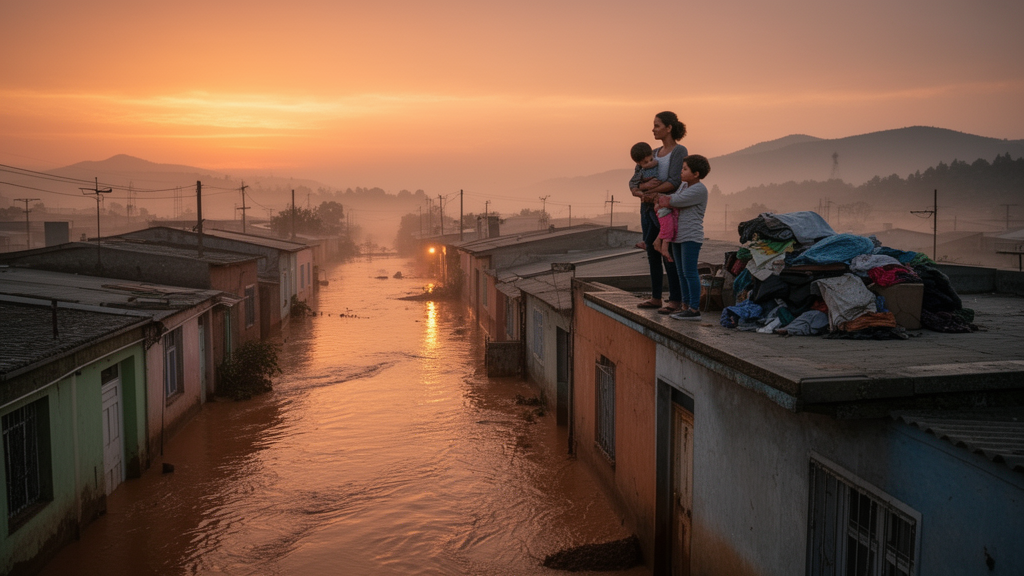
A dollar of disaster damage is never just a dollar. A global modelling study published in Nature Sustainability finds that across 132 countries, one dollar in asset damages from natural hazards causes well-being losses equivalent to a two-dollar uniform drop in national consumption. The analysis, built on household-level microsimulations, also shows that the poorest fifth of populations absorb only 9 per cent of asset damages but 33 per cent of the well-being losses, a disparity the authors attribute to differences in exposure, housing vulnerability, savings and the ability to borrow.
The study introduces a comprehensive accounting of what its authors call socio-economic resilience: the ability of a society to experience asset damages without a decline in well-being. Most disaster risk assessments stop at asset damages, treating a destroyed bridge and a destroyed home as interchangeable losses. This framework instead traces how damages propagate into household income losses, reconstruction costs and consumption cuts, and then converts those consumption losses into a well-being measure using an economic utility function with diminishing marginal utility, meaning that a lost dollar hurts a poor household far more than a rich one.
The modelling covers four hazard types: riverine and coastal floods, tropical cyclones with wind and storm surge treated separately, tsunamis and earthquakes. Modelled asset damages come from the Global Infrastructure Risk Model and Resilience Index, expressed as the share of a country’s capital stock destroyed at return periods ranging from 1-in-10 to 1-in-5,000 years. Protection levels, drawn from reported and modelled flood and storm surge defence standards, determine which events a country is assumed to withstand. Building vulnerability is estimated from a global inventory of 119 building structure types, mapped to fragile, medium and robust categories with vulnerability scores of 0.7, 0.3 and 0.1 respectively.
Households are represented in five income quintiles, each containing 20 per cent of the population. Their exposure relative to the national average is corrected using estimates of how many people at different poverty lines live in hazard-prone areas. Dwelling materials from roofs, walls and floors, reported in harmonized household surveys, yield a relative vulnerability score for each quintile. Where survey data are missing, the model applies the heuristic that the poorest people live in the most vulnerable buildings. Early warning system availability combines a government-reported indicator from the Hyogo Framework for Action with survey responses from the 2021 World Risk Poll on whether people actually received a warning before a past disaster.
The simulation then follows each affected household through recovery. Damages reduce labour income for directly affected households and diversified income, such as transfers and remittances, for everyone. Reconstruction is modelled as an exponential process whose speed households effectively choose: rebuilding quickly demands heavy immediate spending, while rebuilding slowly prolongs income losses. Liquid savings and borrowing capacity, estimated from Global Financial Inclusion survey data as the share of people who could raise one-twentieth of gross national income per capita in an emergency, offset consumption cuts. The authors note this measure excludes savings below that threshold, so their liquidity estimates are a lower bound.
Well-being losses are computed with a constant relative risk aversion utility function, with the elasticity of marginal utility set to 1.5 and a discount rate of 6 per cent, and are then translated into an equivalent national consumption loss for comparability. On this metric, the headline result emerges: globally, one dollar of damages translates into a two-dollar equivalent consumption drop. Because the conversion uses each country’s average consumption rather than a global benchmark, the measure captures inequality within countries but not differences in living standards between them.
The distributional findings are stark. The poorest populations incur 9 per cent of damages but 33 per cent of well-being losses. Low-income countries experience 72 per cent greater well-being losses per dollar of damages than high-income countries and need 92 per cent longer to recover. A statistical association in the data links resilience to wealth: a 10 per cent higher gross domestic product per capita is associated with a 1 percentage point increase in socio-economic resilience. The authors stress this is an association observed across countries, not a demonstration that growth alone causes resilience gains.
The framework also allows policy experiments. Post-disaster support is modelled as a one-time payout covering 40 per cent of reconstruction costs for the poorest affected quintile, and insurance as payouts covering 20 per cent of every affected household’s reconstruction cost, with aid costs assumed credit-financed and repaid far in the future. Early warning systems are modelled as reducing vulnerability by 20 per cent when fully functional, calibrated on analyses of past disasters, though the model excludes this benefit for tsunamis and earthquakes. The authors report that socio-economic and financial interventions can complement asset-focused policies such as protective infrastructure, and that targeting low-income populations usually yields higher well-being returns per dollar spent.
The study’s scope and limitations are explicit. It is a modelling exercise, not an observation of actual disasters, and it relies on modelled rather than observed damages, imputed data for countries missing survey coverage, and simplifying assumptions, including that all assets used by a household share the vulnerability of its dwelling and that capital ownership is equal across income quintiles. The authors also note that real borrowing costs include risk premiums that would raise losses further, especially in lower-income countries. Even so, the results offer a quantitative starting point for broadening disaster risk metrics beyond damaged assets toward the well-being of the people who live through them.
Subject of Research: Global modelling of well-being losses and socio-economic resilience to natural hazards across 132 countries
Article Title: Global socio-economic resilience to disasters
Article References: Middelanis, R., Jafino, B. A., Hill, R., Nguyen, M. C., & Hallegatte, S. (2026). Global socio-economic resilience to disasters. Nature Sustainability. https://doi.org/10.1038/s41893-026-01947-z
Image Credits: AI Generated
DOI: 10.1038/s41893-026-01947-z
Keywords: disaster risk, socio-economic resilience, well-being losses, natural hazards, income inequality, floods, tropical cyclones, earthquakes, early warning systems, recovery, consumption losses, Nature Sustainability
Cite Scienmag News
Sloane Callahan. (October 29, 2026). Disasters Cost Twice Their Damages in Well-Being, Global Analysis Finds. Scienmag. https://scienmag.com/disasters-cost-twice-their-damages-in-well-being-global-analysis-finds/
Sloane Callahan. "Disasters Cost Twice Their Damages in Well-Being, Global Analysis Finds." Scienmag, 29 October 2026, https://scienmag.com/disasters-cost-twice-their-damages-in-well-being-global-analysis-finds/. Accessed 4 November 2026.
Sloane Callahan. "Disasters Cost Twice Their Damages in Well-Being, Global Analysis Finds." Scienmag. October 29, 2026. https://scienmag.com/disasters-cost-twice-their-damages-in-well-being-global-analysis-finds/