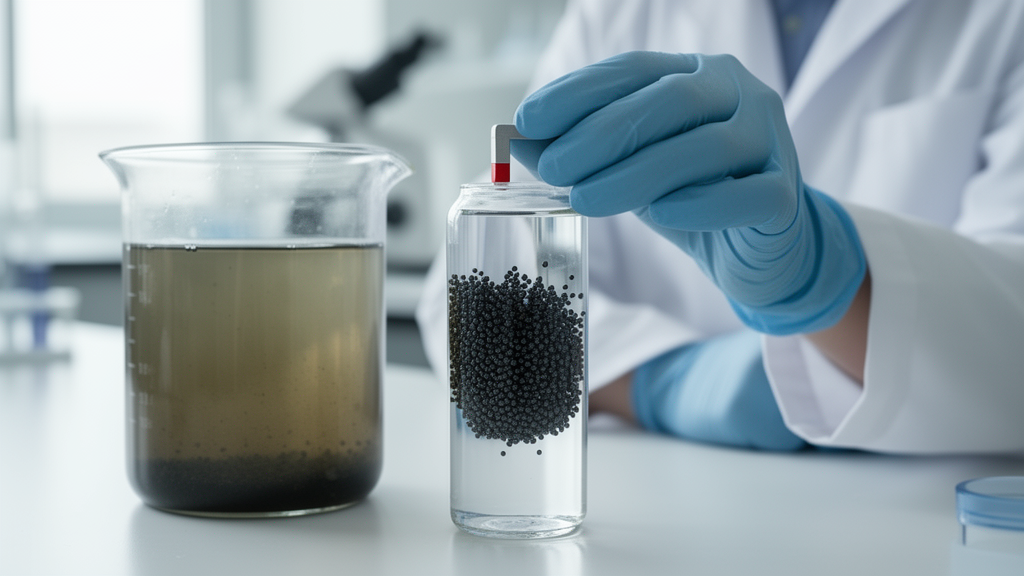
Lead contamination of water remains one of the most stubborn environmental problems worldwide, driven by the metal’s toxicity, its mobility in aquatic systems, and its capacity to bioaccumulate in living organisms. A new study from researchers at Peruvian institutions, published in Frontiers in Environmental Chemistry, set out to evaluate how effectively magnetite nanoparticles can remove lead ions, or Pb(II), from aqueous solutions, and to identify which operating conditions matter most for maximizing removal.
The research team, led by Carlos Enrique Espinoza-Quispe of the Universidad Nacional de Huancavelica with collaborators from several Peruvian universities and laboratories, took a quantitative experimental approach. Rather than testing one variable at a time, they used a full factorial 2³ design, meaning three factors were varied simultaneously at two levels each: solution pH, contact time, and adsorbent dosage. This factorial structure allowed the researchers to assess not only the individual effect of each factor but also how the factors interact with one another.
The resulting data were analyzed with descriptive and inferential statistics, including analysis of variance and regression models, using the SPSS and Orange software packages. This statistical framework let the team quantify precisely how much of the observed variation in lead removal could be attributed to each operating condition.
The results were clear on one central point: adsorbent dosage was the single most influential factor on removal efficiency, followed by pH and then contact time. The highest adsorption percentages were achieved under moderately alkaline conditions, with short contact times and higher amounts of magnetite nanoparticles.
Beyond the optimization experiments, the researchers fitted both Langmuir and Freundlich isotherm models to describe the adsorption equilibrium. The team reported a satisfactory fit to both models, which they interpreted as indicating the coexistence of monolayer adsorption mechanisms and surface heterogeneity on the magnetite nanoparticles. In other words, lead uptake appears to occur through more than one kind of binding environment on the particle surfaces.
The authors concluded that magnetite nanoparticles show outstanding adsorptive performance for Pb(II) removal in aqueous solutions, with high efficiencies achieved under controlled operational conditions. They emphasized that the process is strongly dependent on adsorbent dosage and system pH, while contact time contributes mainly to the stabilization of the adsorption equilibrium rather than to continued increases in removal once that balance is reached.
Several important caveats frame these findings. The work was carried out in laboratory batch systems using aqueous solutions prepared for the experiments, not in field trials on real contaminated water sources, which contain competing ions, natural organic matter, and other constituents that can affect adsorption performance. The study was also accepted for publication in April 2026, with the final formatted version still forthcoming at the time of this report, so detailed quantitative results such as maximum adsorption capacities and specific isotherm parameters will be available in the complete article.
By systematically identifying dosage and pH as the dominant controls and by characterizing the equilibrium behavior with two complementary isotherm models, the Peruvian team has provided a structured basis for future work scaling this approach toward practical water treatment applications.
Subject of Research: Optimization of lead ion adsorption from aqueous solutions using magnetite nanoparticles
Article Title: Adsorption of lead ions from aqueous solutions using magnetite nanoparticles: factorial optimization and isotherm analysis
Article References: Roque Alcarraz, M., Chanco-Gálvez, M. K., López-Alvarado, R. L., Tapia-Manrique, E. R., Laurente-Galarza, I. H., Rutti-Marin, J. M., & Yuli-Posadas, R. (2026). Adsorption of lead ions from aqueous solutions using magnetite nanoparticles: factorial optimization and isotherm analysis. Frontiers in Environmental Chemistry, 7, Article 1810395. https://doi.org/10.3389/fenvc.2026.1810395
Image Credits: AI Generated
DOI: 10.3389/fenvc.2026.1810395
Keywords: magnetite nanoparticles, lead removal, water treatment, adsorption, isotherm analysis, factorial design, heavy metals, water pollution, pH, batch experiments, lead, ions
Cite Scienmag News
Violet Maxwell. (October 29, 2026). Magnetite nanoparticles pull lead from water in optimized batch adsorption study. Scienmag. https://scienmag.com/magnetite-nanoparticles-pull-lead-from-water-in-optimized-batch-adsorption-study/
Violet Maxwell. "Magnetite nanoparticles pull lead from water in optimized batch adsorption study." Scienmag, 29 October 2026, https://scienmag.com/magnetite-nanoparticles-pull-lead-from-water-in-optimized-batch-adsorption-study/. Accessed 2 November 2026.
Violet Maxwell. "Magnetite nanoparticles pull lead from water in optimized batch adsorption study." Scienmag. October 29, 2026. https://scienmag.com/magnetite-nanoparticles-pull-lead-from-water-in-optimized-batch-adsorption-study/