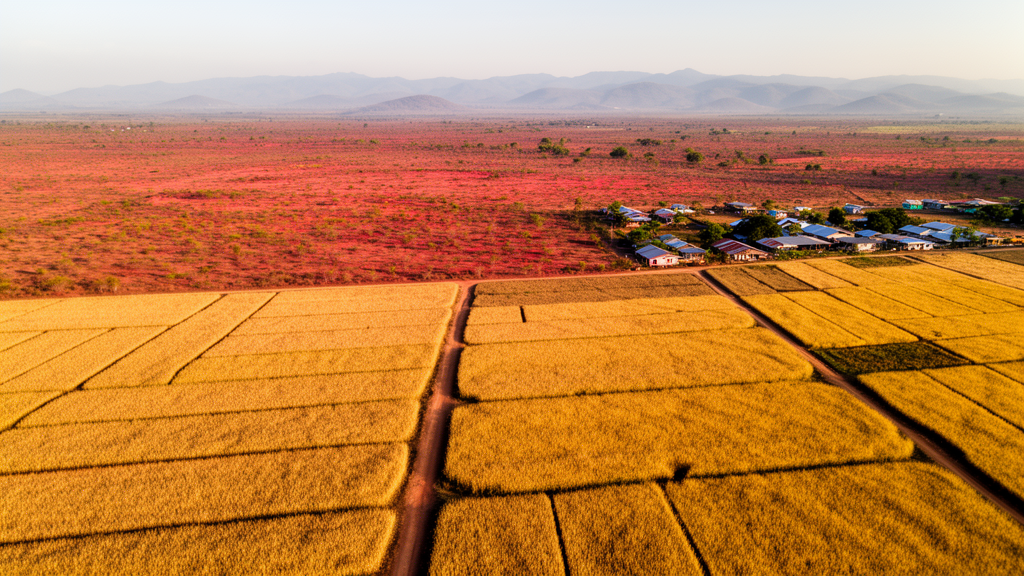
Arable land is being redistributed across the planet, moving away from the climatically favorable temperate regions of the Northern Hemisphere and toward the tropics and drylands, according to a study published in Nature Communications. The research links this shift to human settlement expansion, showing that where people live increasingly determines where crops can be grown.
The team combined a self-developed global arable land product with global human settlement layers, Köppen–Geiger climate classifications, and historical land-use reconstructions. This integration allowed them to track how cultivation and settlement have co-evolved across climate zones and to identify the patterns structuring global arable land dynamics, an integrated understanding of which the authors describe as previously limited.
A central finding is the disproportionate climatic co-location of arable land and human settlements. In much of the climatically favorable Northern Hemisphere, settlements and agriculture historically developed together, but this relationship has increasingly turned into competition. Settlement expansion is now displacing cultivation from temperate regions, and that displacement is contributing to the expansion of farming into adjacent arid zones.
Low-latitude tropical regions tell a different story. There, both settlements and agriculture continue to expand, doing so at the expense of natural landscapes. The study reports that this tropical expansion is partly driven by agricultural investment originating from the Northern Hemisphere, meaning pressure on land in one region can be transmitted to distant environments through economic activity.
Taken together, the authors interpret these contrasting trajectories as a broader redistribution of agricultural pressure from climatically favorable regions toward less-exploited tropical and arid environments. They connect this redistribution to a range of environmental consequences, including deforestation, biodiversity loss, groundwater depletion, and vegetation greening.
The findings carry practical implications. The authors argue that planning for future food production and settlement growth needs to account both for local competition between settlements and agriculture and for the wider redistribution of farming across the globe. Because the paper is being shared early as accepted, peer-reviewed research that remains subject to further edits before the final Version of Record, its detailed quantitative results may be refined in the published final version.
Subject of Research: Global redistribution of arable land toward the tropics and drylands under human settlement expansion
Article Title: Global arable land redistribution toward the tropics and drylands under human settlement expansion
Article References: Gao, L., Lu, X., Anderson, W., Lesk, C., Mazur, E., Stolle, F., Potapov, P., Tubiello, F. N., Fritz, S., Mao, J., You, L., & Ray, D. (2026). Global arable land redistribution toward the tropics and drylands under human settlement expansion. Nature Communications. https://doi.org/10.1038/s41467-026-79126-z
Image Credits: AI Generated
DOI: 10.1038/s41467-026-79126-z
Keywords: arable land, human settlement expansion, tropics, drylands, land-use change, deforestation, biodiversity loss, groundwater depletion, temperate regions, agricultural redistribution, Nature Communications, Global
Cite Scienmag News
Violet Maxwell. (October 29, 2026). Farms shift toward the tropics and drylands as settlements expand. Scienmag. https://scienmag.com/farms-shift-toward-the-tropics-and-drylands-as-settlements-expand/
Violet Maxwell. "Farms shift toward the tropics and drylands as settlements expand." Scienmag, 29 October 2026, https://scienmag.com/farms-shift-toward-the-tropics-and-drylands-as-settlements-expand/. Accessed 29 October 2026.
Violet Maxwell. "Farms shift toward the tropics and drylands as settlements expand." Scienmag. October 29, 2026. https://scienmag.com/farms-shift-toward-the-tropics-and-drylands-as-settlements-expand/