


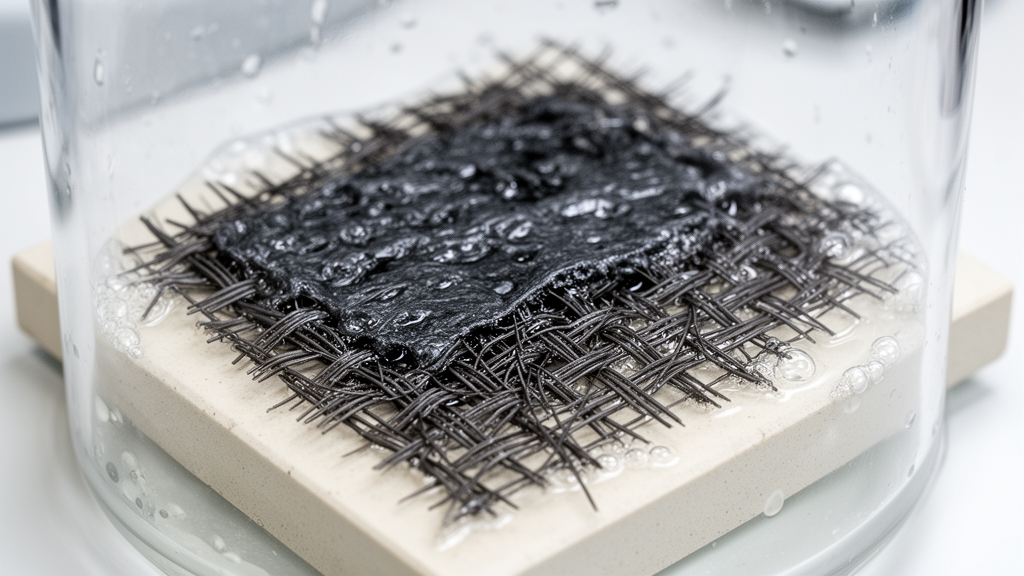
An experimental recycling technique developed by researchers at the University of Texas at Austin and Sandia National Laboratories deconstructs poly(dicyclopentadiene), or pDCPD, composites without generating the large amounts of waste associated with incineration. The process dissolves the durable, lightweight plastic in a solution containing an environmentally friendly solvent and a ruthenium-based catalyst, leaving a powder that can be reused in new plastics. Reinforcing fibers, including carbon and glass fibers, can also be isolated in pristine form for reuse. The peer-reviewed study, published in Science Advances, reports the deconstruction method but does not yet demonstrate a complete commercial recycling system or establish its industrial cost and scale.
The method emerged from an unexpected observation during work on a process intended to make pDCPD more durable. UT Austin graduate student Keldy Mason exposed the material to a solution containing a solvent and catalyst, expecting the treatment to strengthen it. Instead, the plastic broke down and dissolved. Corresponding author Zak Page, an associate professor of chemistry at UT Austin, said the result was surprising because pDCPD had long been considered too thermodynamically stable for the reaction to proceed in that direction. The researchers subsequently developed the deconstruction process around that behavior. UT Austin, Sandia National Laboratories and four study authors have applied for a U.S. patent related to the technology.
In the reported procedure, researchers placed an object made of pDCPD in the solvent-and-catalyst solution and stirred it for periods ranging from hours to days, depending on the size of the object. As the plastic deconstructed and dissolved, it left behind a powder that can be reused to make new plastics. Any carbon or glass fibers blended into the composite for reinforcement could also be separated and recovered without the degradation that occurs when the material is incinerated. The authors describe the approach as using less energy and producing less waste than incineration, which the source identifies as a common route for disposing of pDCPD products. The method may therefore help retain the strength, durability and low weight of pDCPD in applications such as vehicle bumpers, construction equipment and chemical storage tanks while making recovery of the material and its fibers more practical.
The experimental study focused specifically on pDCPD composites rather than demonstrating a universal solution for plastic recycling. Catalyst recovery remains a major unresolved question: the ruthenium catalyst must be recovered and reused if the overall process is to become more sustainable and affordable. The research establishes the chemical deconstruction of pDCPD and the recovery of reinforcing fibers, but it does not yet establish the full environmental performance, cost or scalability of an industrial recycling operation. The technique also cannot be treated as a general recycling method for all polymers. The source instead points to related advances at UT Austin involving more widely used plastics found in products such as water bottles and disposable bags and wrappers.
Co-first authors were Keldy Mason, Meghan Kiker and Zhenchuang Xu. Researchers from the University of Illinois Urbana-Champaign and the Massachusetts Institute of Technology also contributed. The research was primarily funded by the U.S. Department of Energy, with additional support from the Robert A. Welch Foundation, the Alfred P. Sloan Foundation and the Arnold and Mabel Beckman Foundation. The study was published in Science Advances on September 11, 2026, under the title “Direct Metathesis Deconstruction to Recycle Poly(dicyclopentadiene) Composites.”
Subject of Research: Experimental chemical recycling of poly(dicyclopentadiene) composites with fiber recovery
Article Title: New low-waste method breaks down tough-to-recycle plastics
Article References: New low-waste method breaks down tough-to-recycle plastics. Original publication (Bibliographic details unavailable.)
Image Credits: AI Generated
DOI: Not provided
Keywords: plastic recycling, poly(dicyclopentadiene), pDCPD, chemical deconstruction, ruthenium catalyst, fiber recovery, composite materials, circular plastics, Science Advances, low-waste, method, breaks
Cite Scienmag News
Bethany Barker. (October 26, 2026). Experimental method deconstructs pDCPD composites while preserving reinforcing fibers. Scienmag. https://scienmag.com/experimental-method-deconstructs-pdcpd-composites-while-preserving-reinforcing-fibers/
Bethany Barker. "Experimental method deconstructs pDCPD composites while preserving reinforcing fibers." Scienmag, 26 October 2026, https://scienmag.com/experimental-method-deconstructs-pdcpd-composites-while-preserving-reinforcing-fibers/. Accessed 26 October 2026.
Bethany Barker. "Experimental method deconstructs pDCPD composites while preserving reinforcing fibers." Scienmag. October 26, 2026. https://scienmag.com/experimental-method-deconstructs-pdcpd-composites-while-preserving-reinforcing-fibers/


