

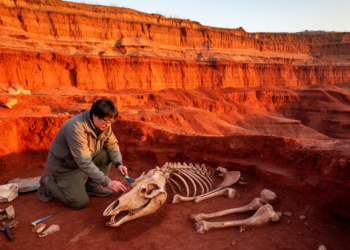
Taphonomy Reveals How China’s Hipparion Red Clay Preserved Neogene Mammal Communities
The first quantitative taphonomic study of China's Hipparion Red Clay shows that its fossil assemblages faithfully record ancient mammal communities, ...
The first quantitative taphonomic study of China's Hipparion Red Clay shows that its fossil assemblages faithfully record ancient mammal communities, ...

Deep beneath the waves of the world ocean, lanternfishes drift in enormous swarms, ... The significance of this new collection ...
A new study of fossil fish otoliths from the ancient Lake Pannon reveals a diverse and previously underappreciated endemic fish ...
A re-examination of roughly 450 fossil leaves and fruits from the abandoned Wolf clay pit in Graz-Andritz reconstructs the vegetation, ...
The first known partial skeleton of the extinct mustelid Leptarctus wortmani reveals a badger-like terrestrial generalist that occupied Miocene North ...
Deep in the bituminous mudstones of an abandoned Spanish sulphur mine, a slab of rock sat for decades with a ...
A tiny insect preserved in 16-million-year-old lake sediments in southern Germany is rewriting what scientists know about an often-overlooked group ...
Fossil teeth from Austria, France, Germany, and Italy reveal that the elusive Miocene shark genus Megalolamna once roamed European seas, ...
Researchers describe five extinct Solenopsis thief ant species from Miocene Dominican amber while exposing mislabeled copal specimens in museum collections.
A remarkably complete 18-million-year-old deer skeleton unearthed from a riverbank in central Japan is rewriting the opening chapter of deer ...

Embark on a thrilling journey of discovery with Scienmag.com—your ultimate source for cutting-edge breakthroughs. Immerse yourself in a world where curiosity knows no limits and tomorrow’s possibilities become today’s reality!