


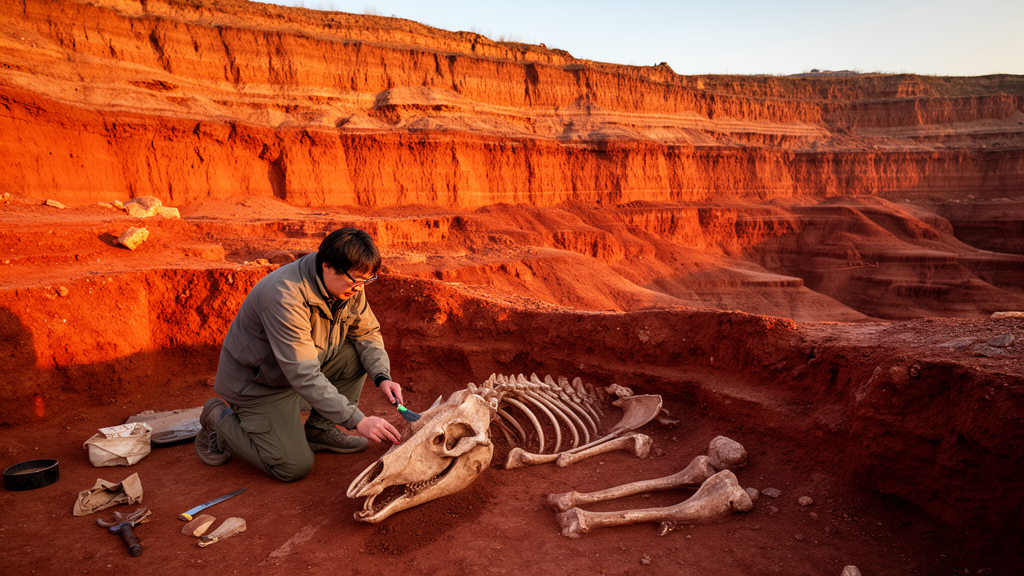
The Hipparion Red Clay of northern China is one of the most extensive archives of Neogene mammal life anywhere on Earth, preserving the three-toed horses, rhinoceroses, giraffids and bovids that roamed the region between roughly 7 and 3 million years ago. For over a century, palaeontologists have mined these red sediments for fossils that anchor biostratigraphic schemes across the Chinese Neogene. Yet a fundamental question has remained unanswered: do the fossil assemblages within the Red Clay faithfully record ancient living communities, or are they distorted by the very processes that buried them? A new quantitative study provides the first systematic answer, and the results are strikingly reassuring for palaeoecologists.
The research, published in the journal Fossil Record, presents the first quantitative taphonomic analysis of vertebrate assemblages from the Hipparion Red Clay, focusing on two fossil sites in the Loess Plateau of northern China. The team examined bone modification, skeletal completeness, mortality profiles and spatial distribution patterns to reconstruct how the assemblages formed. Their conclusion is that the Red Clay assemblages are largely autochthonous, meaning the animals died more or less where their remains were found, and were buried gradually by wind-blown dust rather than swept together by floods or concentrated by predators.
This finding matters because the Hipparion Red Clay spans vast areas of northern China and preserves fossils repeatedly through time. If taphonomic biases strongly shaped the assemblages, differences between sites might reflect preservation artifacts rather than genuine ecological or evolutionary change. The new study demonstrates that such biases are minimal, meaning that variations in faunal composition between horizons and regions can be interpreted as real signals of palaeoenvironmental and biochronological change rather than taphonomic noise.
The analysis focused on two key assemblages dominated by the three-toed horse Hipparion, alongside rhinocerotids, giraffids and bovids. Skeletal part representation showed that teeth and dense limb bones dominate the samples, a pattern consistent with gradual burial and minimal transport. Bone surfaces displayed limited abrasion, weathering or carnivore modification, further supporting the interpretation that carcasses were not exposed for long periods before burial. Mortality profiles revealed age structures typical of attritional death, where individuals of all ages die naturally over time, rather than the catastrophic profiles expected from mass death events or the selective profiles produced by predator accumulation.
The spatial distribution of fossils within the Red Clay also proved informative. Remains occur in diffuse, scattered concentrations rather than dense, channelized bone beds, consistent with animals dying on a stable landscape that was slowly dusted over. The fine-grained nature of the sediment, deposited grain by grain by wind, allowed carcasses to be buried in situ without the winnowing, sorting or reworking that characterizes fluvial deposits. This gentle burial regime preserved not only bones but also the delicate ecological context in which the animals lived and died.
Palaeontologists have long recognized that the Red Clay formed under semi-arid to sub-humid conditions, with dust derived from distant deserts and deposited across a vegetated landscape. The new taphonomic data refine this picture by showing that the landscape was stable enough for mammal communities to persist in place over extended periods. Grasslands and open woodlands supported diverse communities of horses, rhinoceroses, deer-like giraffids and antelope-like bovids, whose remains accumulated gradually as individuals died naturally and were slowly covered by dust.
The implications extend beyond the Neogene of China. Taphonomic analyses of aeolian deposits elsewhere have often been qualitative, leaving uncertainty about how faithfully such archives record ancient ecosystems. The new study provides a quantitative template for evaluating aeolian fossil assemblages, demonstrating that wind-blown sediments can preserve vertebrate communities with minimal bias. This has relevance for fossil sites in Central Asia, Africa and the Americas, where aeolian deposits also host important mammal faunas.
For palaeoecologists working on the Chinese Neogene, the study removes a major source of interpretive uncertainty. Faunal turnover within the Red Clay, including the decline of certain rhinoceros lineages and the diversification of grazing horses, can now be interpreted with confidence as genuine ecological change. The Red Clay’s role as a high-fidelity archive of late Miocene and Pliocene mammal evolution is thus strengthened, positioning it as a key reference for understanding how Eurasian ecosystems responded to late Neogene climatic cooling and aridification.
The research also highlights the value of revisiting classic fossil archives with modern analytical methods. The Hipparion Red Clay has been studied for generations, yet quantitative taphonomy had never been applied to its assemblages. By combining bone surface modification, skeletal completeness, mortality analysis and spatial statistics, the new work demonstrates how much interpretive power such approaches can unlock, even in deposits long considered well understood. As palaeontologists continue to confront global change questions through deep time, high-fidelity archives like the Red Clay will remain essential, and knowing exactly how their fossils formed is the first step toward reading them correctly.
Subject of Research: Taphonomy of the Hipparion Red Clay vertebrate assemblages, northern China
Article Title: Formation processes of Late Miocene Hipparion Red Clay vertebrate assemblages from northern China: taphonomic constraints on palaeoecological and biochronological interpretations
Article References: Martín-Perea, D. M., Wu, Y., Mielgo, C., Quan, Y., Li, C., Du, J., Jin, L., Guo, D., Deng, T., & Wang, S.-Q. (2026). Formation processes of Late Miocene Hipparion Red Clay vertebrate assemblages from northern China: taphonomic constraints on palaeoecological and biochronological interpretations. Fossil Record, 29(1), 211-226. https://doi.org/10.3897/fr.29.189157
Image Credits: AI Generated
DOI: 10.3897/fr.29.189157
Keywords: Formation, processes, Late, Miocene, Hipparion, Clay, vertebrate, assemblages, northern, China, taphonomic, constraints
Cite Scienmag News
Gavin Prescott. (October 17, 2026). Taphonomy Reveals How China’s Hipparion Red Clay Preserved Neogene Mammal Communities. Scienmag. https://scienmag.com/taphonomy-reveals-how-chinas-hipparion-red-clay-preserved-neogene-mammal-communities/
Gavin Prescott. "Taphonomy Reveals How China’s Hipparion Red Clay Preserved Neogene Mammal Communities." Scienmag, 17 October 2026, https://scienmag.com/taphonomy-reveals-how-chinas-hipparion-red-clay-preserved-neogene-mammal-communities/. Accessed 17 October 2026.
Gavin Prescott. "Taphonomy Reveals How China’s Hipparion Red Clay Preserved Neogene Mammal Communities." Scienmag. October 17, 2026. https://scienmag.com/taphonomy-reveals-how-chinas-hipparion-red-clay-preserved-neogene-mammal-communities/


