


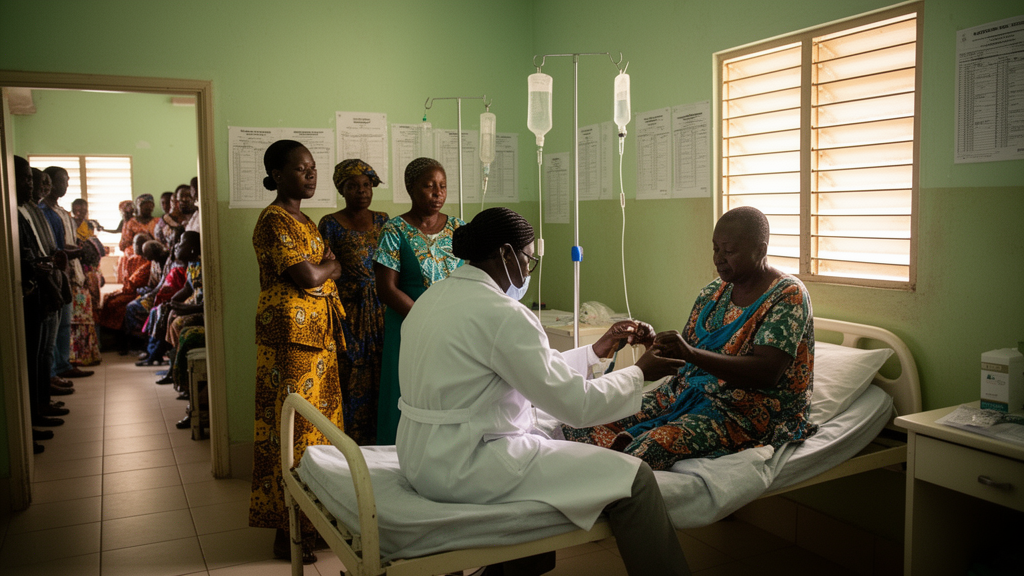
Nigeria is confronting a dual burden of HIV and cancer that researchers say remains largely invisible to policymakers, according to a comprehensive review of Nigerian studies published in Frontiers in Oncology. The review, led by investigators from the Plateau State Specialist Hospital, the University of Lagos, and Ahmadu Bello University, synthesized national HIV and cancer data from PubMed, Embase, and the Web of Science, along with reports from the National Agency for the Control of AIDS and the World Health Organization. It found that while antiretroviral therapy has dramatically reduced AIDS-defining cancers such as Kaposi sarcoma, non-AIDS-defining tumors are rising as people living with HIV survive longer, and the health system remains poorly equipped to detect or manage them.
Kaposi sarcoma, once the most common malignancy among Nigerians with HIV, has declined substantially with the scale-up of antiretroviral therapy. A national analysis of more than 2,000 patients across six geopolitical zones found that sarcoma incidence fell from 2.5 cases per 1,000 person-years in the pre-therapy era to 1.5 cases per 1,000 person-years after therapy became widely available. The review noted that sarcoma now accounts for a smaller share of malignancies among people with HIV, though it remains an important cause of cancer in this population, particularly in regions where therapy coverage is incomplete.
Cervical cancer, by contrast, remains poorly controlled. The review found that women with HIV face a substantially elevated risk of cervical cancer, driven by higher rates of human papillomavirus persistence and lower rates of screening. A national analysis of more than 1,500 women across six zones found that cervical cancer incidence among women with HIV was roughly three times higher than among women without HIV, and that fewer than one in five women with HIV had ever been screened for cervical cancer. The review noted that cervical cancer now accounts for a growing share of malignancies among Nigerian women with HIV, particularly in northern regions where screening coverage is lowest.
Non-AIDS-defining cancers are rising as people with HIV survive longer on therapy. The review found that malignancies such as liver cancer, lung cancer, and Hodgkin lymphoma now account for a growing share of cancers among Nigerians with HIV, driven by longer life expectancy, higher rates of viral hepatitis co-infection, and greater exposure to tobacco. A national analysis of more than 1,000 patients across six zones found that non-AIDS-defining cancers accounted for roughly one in three malignancies among people with HIV, up from one in five a decade earlier. The review noted that these tumors are often detected late, when curative treatment is no longer possible.
The health system remains poorly equipped to manage the HIV-cancer overlap. The review found that cancer registries cover only a fraction of the population, that pathology services are concentrated in urban centers, and that oncology services are largely separate from HIV care. A national analysis of more than 500 patients across six zones found that fewer than one in five people with HIV who developed cancer received coordinated care addressing both conditions. The review noted that this fragmentation is particularly acute in rural regions, where most Nigerians live and where both HIV and cancer services are scarcest.
The researchers called for coordinated action to address the HIV-cancer overlap. They recommended scaling up cervical cancer screening among women with HIV, integrating oncology services with HIV care, expanding cancer registries and pathology services, and strengthening surveillance of non-AIDS-defining cancers. They also called for greater investment in rural health services, where both HIV and cancer services are scarcest, and for research into the drivers of rising non-AIDS-defining cancers among people with HIV. The review noted that without such action, the HIV-cancer overlap will continue to grow as people with HIV survive longer, and the health system will remain poorly equipped to manage it.
The epidemiologic backdrop of this review is striking. Globally, the number of people living with HIV rose from 27.2 million in 2000 to 40.8 million in 2024, and Nigeria accounts for roughly 4.5 to 5.0 percent of that total, placing it fourth worldwide. Current national estimates suggest approximately 1.9 to 2.0 million Nigerians are living with the virus. Notably, an earlier figure of about 3.2 million was revised downward after the 2018 Nigeria HIV/AIDS Indicator and Impact Survey, a nationally representative household survey that reduced estimated prevalence from 2.8 percent to 1.4 percent. The authors emphasize that this revision reflects improved measurement rather than a genuine epidemiological decline, an important distinction for anyone interpreting trends in the country’s HIV burden over time.
As survival on antiretroviral therapy improves, the clinical picture among people living with HIV has shifted from acute opportunistic infections toward chronic, non-communicable conditions. The review attributes this transition to chronic immune activation, persistent low-level inflammation, viral co-infections, and behavioral risk factors. In the Nigerian setting, these forces interact in what the authors describe as a syndemic: endemic hepatitis B, elevated human herpesvirus 8 seroprevalence, and oncogenic human papillomavirus circulate in the same populations that face delayed HIV diagnosis, late initiation of therapy, and inconsistent adherence. Each of these infections is itself capable of driving malignancy, and immunosuppression amplifies their carcinogenic effects, which helps explain why cancer patterns among Nigerians with HIV differ from those seen in the general population.
The distinction between AIDS-defining and non-AIDS-defining malignancies underpins much of the review’s analysis. The three classic AIDS-defining cancers, Kaposi sarcoma, invasive cervical cancer, and non-Hodgkin lymphoma, remain the most common malignancies among Nigerians living with HIV, though their relative frequencies vary considerably by region. Beyond these, people living with HIV face elevated risks of Hodgkin lymphoma, anal cancer, liver cancer, lung cancer, oral cancer, and breast cancer compared with HIV-negative populations. The mechanisms behind these non-AIDS-defining tumors are more heterogeneous, involving prolonged survival on therapy, age-related accumulation of cancer risk, residual immune dysregulation even when viral suppression is achieved, and co-infections such as hepatitis B and C, which are particularly relevant to hepatocellular carcinoma in a country where hepatitis B is endemic.
One emerging pattern highlighted in the review is ocular surface squamous neoplasia, a tumor of the eye’s surface that has been increasingly recognized in African cohorts of people living with HIV and is strongly associated with human papillomavirus and ultraviolet exposure. Its inclusion alongside more familiar malignancies illustrates how the spectrum of HIV-associated cancer in Nigeria extends well beyond the traditional triad, and how local environmental and infectious exposures shape which tumors emerge as immune suppression recedes.
The evidence base itself carries important caveats. Of the seventy-three sources included in the review, the majority were hospital-based and retrospective studies, a design that captures only patients who reach tertiary facilities and can substantially overrepresent severe or late-stage disease. Because study designs and reported outcomes varied widely, the authors synthesized their findings narratively rather than pooling them statistically, which means the figures reported should be read as indicative patterns rather than precise national rates. This limitation is compounded by the state of cancer registration in Nigeria, where the National System of Cancer Registries and the National Institute for Cancer Research and Treatment are still developing, and where gaps in coverage, data quality, and coordination prevent reliable population-level estimates.
The structural constraints the review documents extend well beyond data collection. Pathology services, which are essential for confirming any cancer diagnosis, are concentrated in urban centers, leaving much of the rural population without timely histologic confirmation. Radiotherapy capacity is inadequate for the population’s needs, molecular diagnostics and immunohistochemistry remain scarce, and out-of-pocket treatment costs push many patients into delayed or abandoned care. Because HIV services and oncology services operate largely in parallel rather than in integration, a patient in HIV care who develops a suspicious lesion may face referral pathways that are slow, fragmented, or unaffordable, by which point curative options have narrowed.
The authors argue that antiretroviral therapy programs themselves represent an underused platform for cancer prevention and early detection. Since people living with HIV already maintain regular contact with treatment facilities, these visits could serve as entry points for cervical screening, hepatitis B and C testing, HPV vaccination eligibility assessment, and symptom screening for common malignancies. Such integration would address two problems simultaneously: the late-stage presentation that dominates the reviewed literature, and the weak linkage between HIV and cancer services that the authors identify as a central systemic failure.
Looking forward, the review points to digital and molecular innovations as potential force multipliers for a resource-constrained system. Telepathology could extend scarce diagnostic expertise to peripheral facilities, electronic record linkage between HIV programs and cancer registries could finally illuminate the true national burden, and molecular diagnostics could enable targeted therapies that are currently unavailable to most Nigerian patients. Whether these tools are deployed effectively will depend on sustained investment and policy attention, which the authors argue is overdue for a burden they characterize as major, growing, and persistently overlooked.
Subject of Research: Burden, patterns, and challenges of HIV-associated malignancies in Nigeria: a narrative review
Article Title: Burden, patterns, and challenges of HIV-associated malignancies in Nigeria: a narrative review
Article References: Silas, O., Nyam, C., Tsok, Y., Eshioramine, M., Nnaegbuna, N., Golit, W., Okunowo, A., Osuagwu, C., Offor, J., Achusi, I., Beneye, T., Isikhuemen, M., Ekanem, V., Ekpe, L., Odusolu, P., Akinjo, A., TAGCReC, Rasheed, F., Ayoade, F., … George, S. (2026). Burden, patterns, and challenges of HIV-associated malignancies in Nigeria: a narrative review. Frontiers in Oncology, 16, Article 1959750. https://doi.org/10.3389/fonc.2026.1959750
Image Credits: AI Generated
DOI: 10.3389/fonc.2026.1959750
Keywords: Burden, patterns, challenges, HIV-associated, malignancies, Nigeria, narrative, review, scientific research
Cite Scienmag News
Nathaniel Bowman. (October 17, 2026). HIV-associated cancers in Nigeria: a growing but overlooked cancer burden. Scienmag. https://scienmag.com/hiv-associated-cancers-in-nigeria-a-growing-but-overlooked-cancer-burden/
Nathaniel Bowman. "HIV-associated cancers in Nigeria: a growing but overlooked cancer burden." Scienmag, 17 October 2026, https://scienmag.com/hiv-associated-cancers-in-nigeria-a-growing-but-overlooked-cancer-burden/. Accessed 17 October 2026.
Nathaniel Bowman. "HIV-associated cancers in Nigeria: a growing but overlooked cancer burden." Scienmag. October 17, 2026. https://scienmag.com/hiv-associated-cancers-in-nigeria-a-growing-but-overlooked-cancer-burden/


