


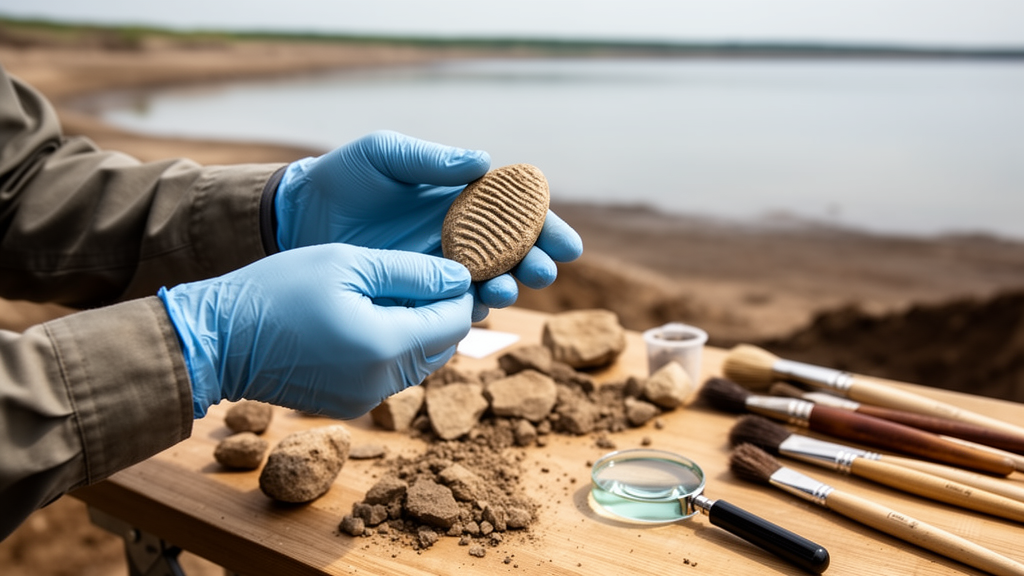
More than ten million years ago, the vast brackish expanse of Lake Pannon stretched across much of Central Europe, its waters covering what is now parts of Austria, Hungary, and surrounding countries. A new comprehensive study of fossil fish otoliths—tiny calcium carbonate structures found in the inner ears of fish—has revealed a surprisingly rich and complex fish fauna that once thrived in this ancient lake, challenging previous assumptions about its biodiversity and offering fresh insights into how endemic species evolve in isolated water bodies.
The research, published in a recent issue of a peer-reviewed paleontological journal, presents a detailed taxonomic revision of otolith-based fish remains from several key localities in the Vienna Basin and the Pannonian Basin. Led by paleontologist Werner Schwarzhans, the study describes numerous species across multiple fish families, including members of the Sciaenidae (drums and croakers), Moronidae (temperate basses), Gobiidae (gobies), and Clupeidae (herrings), among others. Many of these taxa were previously known only from fragmentary material or had been misidentified, and the new work establishes a much clearer picture of the lake’s fish communities during the late Miocene epoch.
Lake Pannon formed during the late Miocene as the Pannonian Basin, once connected to the Paratethys Sea, became progressively isolated. Over millions of years, the lake developed a suite of endemic species adapted to its brackish conditions. The otolith record now reveals that this endemism extended well beyond mollusks and crustaceans—the groups most commonly associated with the lake’s famous endemic fauna—to include a diverse array of fish species that evolved in isolation.
Among the most significant findings is the recognition of several new species of sciaenid fish, a family that today inhabits primarily marine and estuarine environments. The presence of multiple sciaenid species in Lake Pannon suggests that these fish successfully adapted to the lake’s reduced salinity and may have occupied different ecological niches within the water column. The study also documents the co-occurrence of multiple moronid species, providing evidence for niche partitioning among predatory fish in the ancient lake.
The gobies, represented by numerous otolith specimens, appear to have been among the most diverse components of the fish fauna. This pattern mirrors modern brackish-water ecosystems, where gobies often dominate in terms of species richness. The researchers identified several distinct gobiid morphotypes, suggesting that Lake Pannon supported a radiation of small benthic fish similar to what is observed in contemporary Caspian and Black Sea environments.
Otoliths, sometimes called ear stones, are among the most valuable microfossils for studying ancient fish faunas. These structures grow throughout a fish’s life and their shape is species-specific, making them excellent tools for taxonomic identification even when skeletal remains are absent. In lacustrine deposits, where complete fish fossils are rare, otoliths often provide the only reliable evidence of the fish community composition.
The study draws on material from multiple fossil sites spanning different time intervals within the lake’s history, allowing the researchers to track changes in fish diversity over millions of years. The results indicate that the fish fauna underwent significant turnover, with some lineages appearing, diversifying, and disappearing over the course of the lake’s existence. This pattern of sequential radiation and extinction mirrors what has been documented for the lake’s famous endemic mollusk radiation, suggesting that similar evolutionary forces shaped both groups.
The findings have implications for understanding how fish communities respond to long-term isolation in inland water bodies. Lake Pannon existed for approximately ten million years, providing an exceptional natural laboratory for studying speciation and adaptation in a closed or semi-closed basin. The otolith record suggests that fish lineages were capable of rapid diversification under these conditions, producing multiple endemic species within relatively short geological timeframes.
The research also highlights the importance of revisiting historical museum collections and previously described material with modern analytical methods. Many of the species described in the new study were based on specimens collected decades ago, some more than a century ago, and stored in institutional collections across Europe. By applying contemporary taxonomic standards and comparative approaches, the researchers were able to extract new information from old material, demonstrating the continuing scientific value of well-curated paleontological collections.
As climate change and human activity continue to threaten modern brackish and freshwater ecosystems, understanding how past endemic faunas evolved and eventually disappeared becomes increasingly relevant. The fossil record of Lake Pannon provides a long-term perspective on the dynamics of biodiversity in isolated aquatic environments, offering insights that may help inform conservation strategies for contemporary endemic species facing similar pressures in lakes and seas around the world.
The new review documents 29 otolith-based fish species from the Pannonian of the Vienna Basin and smaller samples from the Danubian and Pannonian basins in Hungary, distributed across 15 families ranging from the Clupeidae to the Sciaenidae. Four of these species are described as new to science, and four are left in open nomenclature because the available material does not permit confident identification. The new taxa include a new genus of cod-like fish, Pannonigadus, within the Gadidae, together with the new gadid species Gadiculus weinfurteri, the new eleotrid Eleotris pannonicus, and two new gobies, Ponticola planodorsalis and Toxopyge bradicae. This tally is notably lean compared with the spectacular adaptive radiation of mollusks that made Lake Pannon famous, and it points to a fundamental difference in how the two groups responded to life in the isolated lake.
Of the 29 species recognized, sixteen represent genuine lacustrine fishes that lived within Lake Pannon itself, while the remainder came from freshwater environments or were transported into the lake from surrounding freshwater habitats. Remarkably, half of the lake-dwelling fish species are endemic to Lake Pannon. This figure contrasts sharply with time-equivalent deposits of the restricted marine Eastern Paratethys, where 36 otolith-based species have been identified and almost all of them are endemic. The other half of the Lake Pannon fish fauna traces its roots to the restricted marine Middle Miocene Central Paratethys, the sea body that preceded the lake phase in the region. Unlike the mollusks, therefore, the fishes of Lake Pannon are characterized by relative evolutionary stasis, with species that endured for long stretches of geological time rather than undergoing rapid bursts of speciation.
The geographic and stratigraphic scope of the study reflects the complex history of the Vienna Basin, which formed the westernmost outlier of Lake Pannon and was connected eastward with the Danube Basin and, beyond it, the Pannonian Basin, forming a continuous water body. The basin stretches roughly 170 kilometers in a southwest to northeast direction across eastern Austria, the southern Czech Republic, and western Slovakia. Lake Pannon reached its maximum extent during the early middle Pannonian, a phase represented by the so-called Inzersdorf Tegel, when the fluvial deltas that had previously prograded into the basin were drowned and pushed beyond the present-day limits of the Vienna Basin. During later stages of the middle and late Pannonian, the water body retreated from the Vienna Basin, although it persisted into Pliocene times in the southeastern part of the Pannonian Basin.
As the lake withdrew, its initially poly- to mesohaline, so-called Caspi-brackish environment gave way to marginal brackish and ultimately freshwater marshland conditions. By the Pannonian H, represented at the classical locality of Eichkogel, Lake Pannon had fully retreated from the region, and the sediments there were deposited in freshwater paleoenvironments. The Paleo-Danube discharged into the lake east of the Leitha Mountains during this interval, and sediment tracts in the Vienna Basin became associated with that river system or with small freshwater lakes further to the west. This environmental trajectory helps explain the composition of the fish fauna: otoliths were recovered not only from brackish lake sediments and fluviatile deposits but also from freshwater lake deposits located away from Lake Pannon itself.
The study draws on material from a series of classic localities spanning the Pannonian stratigraphic sequence. Otoliths from Wiesen in the Eisenstadt-Sopron Sub-basin include material from the upper Sarmatian and a single specimen from the Pannonian C. The collection from Tinnye in the westernmost Pannonian Basin, obtained from the ornithopsis Zone of the Pannonian B, is the only assemblage studied from beyond the Vienna and Danube basins. Vösendorf and Inzersdorf, both classical localities of the Pannonian E, yielded rich collections, including material from the heritage of earlier researchers. Götzendorf and Stixneusiedl represent the Pannonian F, with Götzendorf slightly older than Stixneusiedl. The sciaenid otoliths described by Schubert in 1902 from Brunn am Gebirge had already been reviewed several times and were not re-examined in detail, although new findings from Vösendorf and Inzersdorf help clarify the status of certain problematic species that Schubert had established on the basis of non-optimal specimens.
Methodologically, the review follows otolith terminology established in the nineteenth century with later amendments, and applies specialized interpretive frameworks to the lapilli otoliths of cyprinid fishes. All specimens were studied with reflected-light microscopy, and photographs were taken at regular focus levels and digitally stacked to produce continuously focused images. Digital processing was restricted to enhancing contrast, balancing exposure, and retouching minor inconsistencies such as sand grains or incrustations, without altering otolith morphology. The studied specimens reside in the geological collections of the Natural History Museum in Vienna, the Paleontological Institute of the University of Vienna, and the Senckenberg Museum in Frankfurt am Main, with comparative material drawn from museums in Perth, Hamburg, and Copenhagen.
The freshwater component of the fauna is illustrated by finds from the Pannonian E of Inzersdorf, where remains attributable to carps and chubs occur alongside an enigmatic otolith tentatively compared with the polypterids, a primitive lineage of ray-finned fishes whose living representative Erpetoichthys calabaricus inhabits West African waters today. At Eichkogel, the freshwater assemblage includes umbrids, esocids, and percid fishes, consistent with the fully freshwater setting that prevailed after Lake Pannon had withdrawn from the Vienna Basin. Together, these assemblages trace the ecological transition from a brackish inland sea to riverine and lacustrine freshwater habitats, capturing in fossil form the final chapters of one of Europe’s most remarkable long-lived lake systems.
Subject of Research: Endemic fish evolution and diversity in the late Miocene Lake Pannon based on otolith fossils
Article Title: Fish-life in the Late Miocene Lake Pannon of the Vienna Basin – a review
Article References: Schwarzhans, W. (2025). Fish-life in the Late Miocene Lake Pannon of the Vienna Basin – a review. Annals of the Natural History Museum Vienna, 126, 81-109. https://doi.org/10.3897/anhmw.168691
Image Credits: AI Generated
DOI: 10.3897/anhmw.168691
Keywords: Lake Pannon, otoliths, Miocene, endemic fish, Pannonian Basin, paleontology, sciaenids, gobies, brackish water, Vienna Basin, speciation, Paratethys
Cite Scienmag News
Gavin Prescott. (October 17, 2026). Fossil Fish Ear Stones Reveal Hidden Diversity of Lake Pannon’s Ancient Waters. Scienmag. https://scienmag.com/fossil-fish-ear-stones-reveal-hidden-diversity-of-lake-pannons-ancient-waters/
Gavin Prescott. "Fossil Fish Ear Stones Reveal Hidden Diversity of Lake Pannon’s Ancient Waters." Scienmag, 17 October 2026, https://scienmag.com/fossil-fish-ear-stones-reveal-hidden-diversity-of-lake-pannons-ancient-waters/. Accessed 17 October 2026.
Gavin Prescott. "Fossil Fish Ear Stones Reveal Hidden Diversity of Lake Pannon’s Ancient Waters." Scienmag. October 17, 2026. https://scienmag.com/fossil-fish-ear-stones-reveal-hidden-diversity-of-lake-pannons-ancient-waters/


