


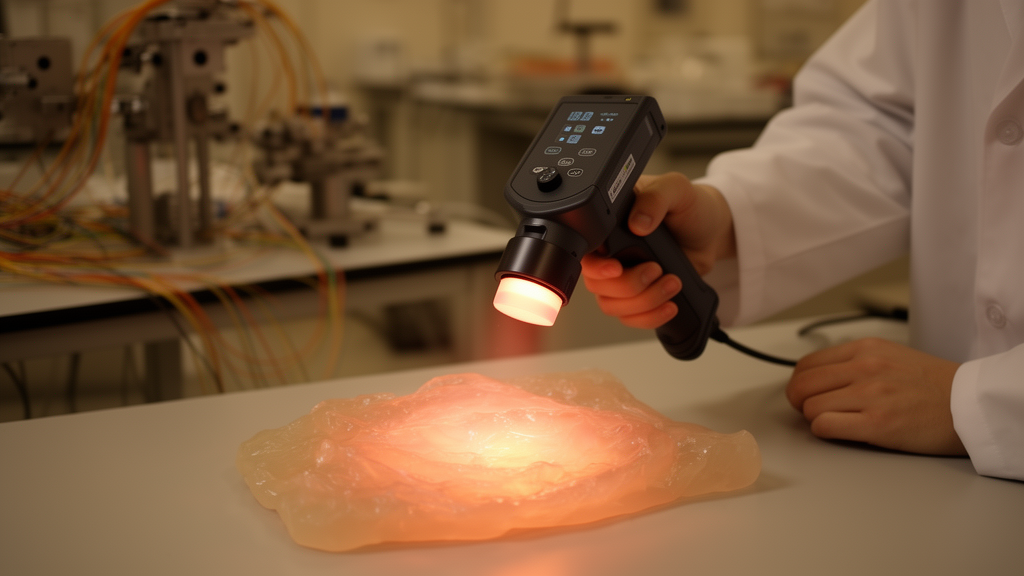
Diffusive optics for medical imaging is the theme of a special collection published in Frontiers in Photonics, edited by Ben Urban of Shimane University in Japan and António Miguel Morgado of the University of Coimbra in Portugal. The editorial, which appeared on 30 April 2026, gathers recent advances in a family of techniques that exploit the peculiar way near-infrared light travels through living tissue. Unlike X-rays or ultrasound, these methods use safe, non-ionizing radiation and portable instrumentation, yet they can quantify physiological parameters such as tissue oxygenation, blood flow, hydration, and metabolism. The collection showcases four studies spanning tissue hydration monitoring, lung assessment, retinal oxygenation measurement, and fluorescence-based ocular diagnostics, illustrating how optical measurements can reveal functional and biochemical changes within biological tissues.
The physical principle underlying diffusive optics is both a strength and a challenge. When near-infrared photons enter biological tissue, they undergo multiple scattering events off structures such as cell membranes, organelles, and collagen fibers. Rather than traveling in straight lines, the photons propagate diffusively, following random-walk trajectories through the medium. This behavior enables quantitative measurements of tissue absorption and scattering coefficients, which are related to physiological composition, structure, and function. Absorption features reveal chromophore concentrations such as oxygenated hemoglobin, deoxygenated hemoglobin, water, and lipids, while scattering reflects structural organization. Over the past decades, techniques including diffuse optical tomography, spatial frequency-domain imaging, time-resolved spectroscopy, and diffuse correlation spectroscopy have advanced rapidly, supporting applications in brain monitoring, breast imaging, wound assessment, and metabolic studies.
Despite these advances, important challenges remain. Light scattering complicates image reconstruction and leads to ill-posed inverse problems, meaning that small errors in measurement can produce large errors in reconstructed images. Spatial resolution and penetration depth also remain limited in highly scattering tissues. The Research Topic was organized to highlight methodological developments that improve quantitative accuracy, depth sensitivity, and clinical applicability, with contributions in structured illumination, time-resolved and frequency-domain techniques, and optical spectroscopy methods.
In their contribution, Livecchi and colleagues demonstrate the use of LED-based spatial frequency-domain imaging in the shortwave infrared spectral region for non-invasive assessment of tissue hydration. Spatial frequency-domain imaging is a powerful yet sometimes underrepresented technique for directly quantifying tissue optical properties. By projecting sinusoidal illumination patterns at multiple spatial frequencies and phase shifts, the method separates absorption and reduced scattering coefficients that are otherwise convolved in conventional diffuse reflectance measurements. The authors employ the technique in the shortwave infrared range, where absorption features of water and lipids are more pronounced and increasingly accessible due to recent advances in camera technology. Through experiments using tissue phantoms, ex vivo porcine skin undergoing desiccation, and in vivo human measurements during exercise, the study demonstrates that reduced scattering is highly sensitive to hydration changes. Such measurements may enable non-invasive monitoring of physiological processes including wound healing, edema formation, and skin hydration dynamics associated with exercise or thermoregulation.
In another contribution, Maffeis and colleagues investigate non-invasive lung monitoring using time-domain diffuse optical spectroscopy. This technique launches ultrashort light pulses into tissue and records photon arrival times after propagation. These time-of-flight measurements provide depth-sensitive information about tissue absorption and scattering properties, a key strength that enables probing of deeper structures than many other diffuse optical methods. Using Monte Carlo simulations and in vivo measurements, the authors study photon propagation through the chest wall to identify optimal probing conditions, an essential step toward a future goal of determining lung composition in terms of tissue constituents. Their results show that wavelength selection and measurement geometry influence sensitivity to lung expansion during breathing. Current lung imaging methods often rely on ionizing radiation or invasive procedures, so optical approaches may provide safer and more accessible monitoring. The work highlights both the promise and the challenges of applying diffuse optics to deep organs and may support future non-invasive monitoring of lung function and pulmonary physiology.
In another study, Parham and colleagues investigate diffuse reflectance spectroscopy for estimating retinal tissue oxygen saturation. Diffuse reflectance spectroscopy measures tissue absorption spectra related to hemoglobin oxygenation, but scattering variations, strong melanin absorption in the retinal pigment epithelium, and tissue geometry complicate interpretation of these spectra. To address this challenge, the authors apply principal component analysis to extract relevant spectral features. Principal component analysis identifies patterns in complex datasets and isolates spectral components associated with oxygenation. The method is evaluated using simulated datasets and retinal tissue phantoms, and results show that the approach can estimate oxygen saturation despite overlapping optical effects. Improved retinal oxygen measurements could support earlier detection and monitoring of diseases affecting ocular and systemic health, highlighting how data-driven analysis can improve quantitative parameter extraction in diffuse optical measurements.
In a further study, Herzog and Sick investigate fluorescence imaging of the anterior segment of the eye. The technique uses ultraviolet excitation to induce fluorescence from endogenous biomolecules in ocular tissues. The authors implement a two-color imaging system to distinguish spectral signals from different molecular sources, enabling detection of biochemical changes that may not appear in conventional reflectance-based imaging methods. Such molecular sensitivity may improve early detection of infections and other ocular diseases affecting the cornea. Experiments using ex vivo porcine eyes demonstrate visualization of fluorescence signals from tissue structures and bacterial contamination. Although not strictly a diffuse optical technique, the work illustrates how optical spectroscopy and imaging can complement diffusive optical methods, providing molecular contrast that may improve diagnostic capabilities in biomedical optics.
Together, the contributions highlight advances in instrumentation, modeling, and data analysis for diffusive optical measurements. The presented studies demonstrate applications including tissue hydration monitoring, lung assessment, retinal oxygenation measurement, and fluorescence-based ocular diagnostics. Future progress will depend on advances in optical instrumentation, computational modeling, and clinical translation. These developments may enable diffusive optical technologies to become routine tools for medical diagnostics and physiological monitoring, ultimately helping to improve patient outcomes, accessibility, and broader improvements in human health and wellbeing.
Subject of Research: Biophotonics
Article Title: Editorial: Diffusive optics for medical imaging
Article References: Urban, B., & Morgado, A. M. (2026). Editorial: Diffusive optics for medical imaging. Frontiers in Photonics, 7, Article 1842429. https://doi.org/10.3389/fphot.2026.1842429
Image Credits: AI Generated
DOI: 10.3389/fphot.2026.1842429
Keywords: diffusive optics, medical imaging, biophotonics, near-infrared spectroscopy, spatial frequency-domain imaging, time-domain diffuse optical spectroscopy, Frontiers in Photonics, Editorial, Diffusive, optics, medical, imaging
Cite Scienmag News
Ophelia Keating. (October 17, 2026). Diffusive optics for medical imaging. Scienmag. https://scienmag.com/diffusive-optics-for-medical-imaging/
Ophelia Keating. "Diffusive optics for medical imaging." Scienmag, 17 October 2026, https://scienmag.com/diffusive-optics-for-medical-imaging/. Accessed 17 October 2026.
Ophelia Keating. "Diffusive optics for medical imaging." Scienmag. October 17, 2026. https://scienmag.com/diffusive-optics-for-medical-imaging/


