


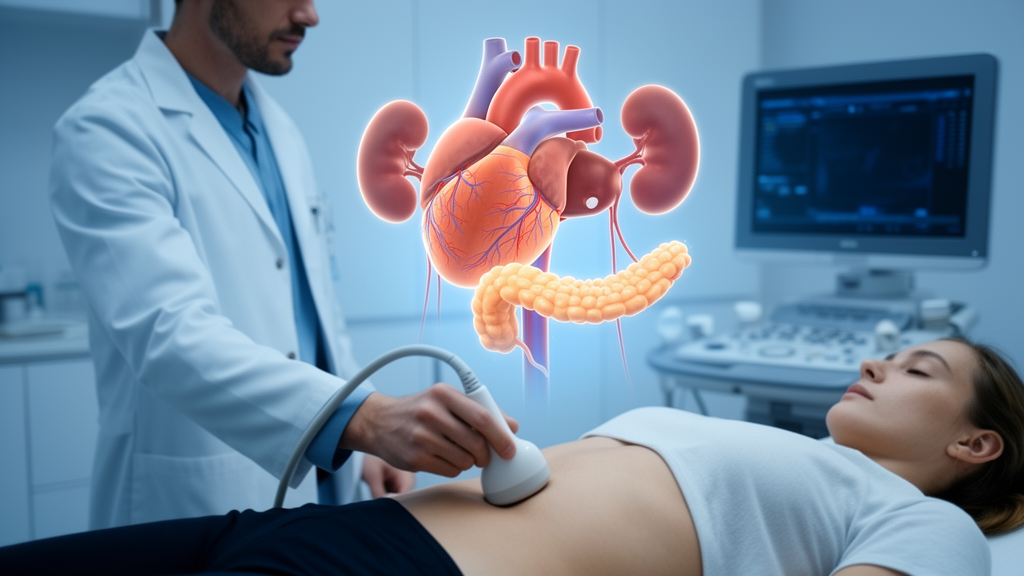
It sounds like the kind of claim that usually collapses under scrutiny: a single, radiation-free ultrasound examination that reads out the molecular state of the liver, heart, blood vessels, and kidneys in one sitting. Yet a new narrative mini review, published in Acta Biochimica Polonica by Marcin L. Kutek and Jacek M. Witkowski of the Medical University of Gdańsk, argues that this is no longer science fiction but an evidence-based proposition awaiting prospective validation. The review, which synthesizes a decade of PubMed literature from 2015 to 2026, maps each ultrasonographic parameter onto the molecular milieu of cardio-renal-metabolic syndrome (CRMS)—the pathological interplay of visceral adiposity, insulin resistance, chronic kidney disease, and cardiovascular disease that, according to the American Heart Association’s 2023 staging framework, affects over 90% of US adults across its four-stage spectrum.
The molecular logic underlying CRMS begins in dysfunctional visceral adipose tissue. When subcutaneous fat reaches its storage capacity, lipids overflow into ectopic depots—visceral, hepatic, epicardial, and pancreatic—where they acquire pro-inflammatory secretory profiles. Serum leptin, resistin, and visfatin rise while protective adipokines such as adiponectin and omentin fall, promoting insulin resistance, atherogenesis, and sympathetic activation. The adiponectin/leptin ratio, below 0.5 indicating severe cardiometabolic risk and above 1.0 considered normal, tracks this dysfunction. Meanwhile, macrophage-driven inflammation elevates IL-6, TNF-α, and CRP, with co-occurring CRP and IL-6 elevation conferring a 5.1-fold increased risk of developing type 2 diabetes. NLRP3 inflammasome activation by metabolic danger signals drives IL-1β maturation, exacerbating atherosclerosis and renal fibrosis, while monocyte subsets shift toward pro-inflammatory phenotypes and CD8+ T cell activation correlates with fasting glucose.
The liver provides the most extensively validated ultrasound window into this process. Using transient elastography (FibroScan), the controlled attenuation parameter (CAP) quantifies hepatic fat content with pooled cutoffs of approximately 268 dB/m for S ≥ 1, 288 dB/m for S ≥ 2, and 313 dB/m for S ≥ 3 steatosis across large individual patient data meta-analyses. CAP correlates directly with insulin resistance: patients with HOMA-IR above 2.5 carry a 3.21-fold risk of elevated CAP, while HOMA-IR independently correlates with both CAP (r = 0.36) and B-mode steatosis grade (r = 0.44). Liver steatosis additionally correlates with CRP concentrations (r = 0.233) and FGF-21 (r = 0.313), linking ultrasound-detectable fat accumulation to the systemic inflammatory and endocrine milieu. Liver stiffness measurement correlates independently with HOMA-IR (r = 0.275) and fasting insulin (r = 0.270) regardless of BMI and transaminases, confirming that hepatic stiffening reflects insulin-driven portal inflammation rather than merely the mechanical consequence of fat deposition. Elastography thresholds of 8.2–13.6 kPa stage fibrosis in MASLD, though transient elastography may overestimate stiffness in active hepatic inflammation—a condition prevalent in CRMS—whereas 2D-SWE isolates the elastic component and is less confounded.
Epicardial adipose tissue (EAT) represents perhaps the most striking example of ultrasound as a molecular transducer. This fat depot differs from others by having direct anatomical continuity with the myocardium and coronary vessels, exerting vasocrine and paracrine effects via shared microcirculation. Measured as the echo-free space on the right ventricular free wall at end-systole by transthoracic echocardiography, EAT thickness correlates with circulating IL-17A (r = 0.308), hs-CRP (r = 0.666), and HOMA-IR (r = 0.567–0.580). Proposed risk thresholds range from 4.7 mm for metabolic syndrome (sensitivity 77.5%, specificity 87.5%) to 7.5–9.5 mm for high cardiometabolic risk stratified by sex. A systematic review and meta-analysis confirmed that EAT volume and thickness are significantly greater in patients with metabolic syndrome independently of conventional risk markers, and EAT thickness constitutes an independent predictor of left ventricular diastolic dysfunction after adjusting for BMI and waist circumference. Remarkably, GLP-1 receptor agonists reduce EAT thickness by approximately 7%–8% independently of weight loss, and SGLT-2 inhibitors reduce EAT to an even greater extent than either GLP-1 agonists or exercise interventions, making EAT an attractive target for both diagnosis and therapeutic monitoring.
The vascular compartment adds carotid intima-media thickness (cIMT), measured at the far wall of the common carotid artery according to Mannheim Consensus Guidelines. Values exceeding 0.9 mm indicate asymptomatic organ damage. In patients with type 2 diabetes and CKD, cIMT above 0.86 mm independently predicts all-cause mortality (HR 2.9) and cardiovascular events (HR 2.04) after adjustment for eGFR and albuminuria. Among hemodialysis patients, a per-unit increase carries a relative risk of 1.08 for all-cause and 1.29 for cardiovascular mortality. cIMT correlates strongly with osteopontin, an inhibitor of vascular calcification, and a four-year longitudinal study demonstrated that progressive eGFR decline in CKD stage 4 directly parallels progressive cIMT expansion from 1.13 to 1.25 mm, establishing cIMT as a dynamic imaging marker of the renal-vascular axis crucial to CRMS pathophysiology. The presence of a carotid plaque—defined as focal intimal protrusion exceeding 0.5 mm or a thickness above 1.5 mm—is more predictive of CKD progression and cardiovascular events than common carotid artery IMT alone.
The kidneys offer a rich multiparametric landscape. The renal resistive index (RRI), obtained by pulsed-wave Doppler at interlobar arteries, with a validated threshold of ≥0.70 predicts abnormal renal vascular resistance and has been found to predict both cardiovascular mortality and CKD progression among diabetic, heart failure, and hypertensive populations. A per 0.1-unit increment predicts five-year renal disease progression and long-term mortality in non-proteinuric CKD patients. In populations at risk of CRMS, those suffering from diabetes present higher mean RRI (0.72) than non-diabetic controls (0.65), and the development of microalbuminuria is preceded by an elevated RRI above 0.70. Renal cortical echogenicity, when assessed by the Brenbridge grading system, demonstrates higher specificity (96%) and positive predictive value (75%) for CKD staging than RRI, though limited by poor inter-observer reproducibility. Perirenal adipose tissue, measured by B-mode ultrasound, exerts deleterious paracrine effects through TNF-α, IL-6, leptin, and renin-angiotensin-aldosterone system activation, and was shown to predict CKD in type 2 diabetes patients (HR 1.67 per SD increment) as well as negatively correlate with eGFR among all adiposity indices (r = −0.29 to −0.43, AUC 0.686), thus mechanistically linking ectopic lipotoxicity with parenchymal fibrosis.
Renal shear wave elastography distinguishes fibrotic from non-fibrotic parenchyma with a cortical stiffness cutoff of 4.05 kPa when compared with kidney biopsy, achieving 93.1% sensitivity. Across mild, moderate, and severe fibrosis grades, pooled AUROC values of 0.87, 0.78, and 0.86 respectively have been reported. Renal stiffness inversely correlates with eGFR (r = −0.329 to −0.65) across diabetic nephropathy, nephrosclerosis, and glomerulonephritis etiologies. When applied in patients with metabolic syndrome, multiparametric ultrasound phenotyping yields five nephropathy patterns relevant to CRMS: diabetic (thinned parenchyma, RI > 0.7), ischemic-atherosclerotic (reduced kidney size, RI > 0.8, flow velocities < 25 cm/s), hypertensive (elevated RI and preserved morphology), gout-associated (hyperechoic inclusions, hilly cortical margins, SWE 8.7–10.0 kPa), and the circular pyramids pattern (hypoechoic perimedullary rings), each linked to a distinct molecular axis. In biopsy-validated phenotyping in diabetic CKD, RI was shown to discriminate pure metabolic from vascular nephropathy (p = 0.02). Another important phenotype, post-COVID-19 nephropathy—driven by endothelial injury and microvascular thrombosis—was shown to be detectable by ultrasound: SWE stiffness reaching 10 ± 1.7 kPa in severe and 7.2 ± 1.5 kPa in moderate post-COVID renal injury versus 4.2 ± 1.2 kPa in controls, with concomitant RRI > 0.75, cortical thinning, and hyperechoic inclusions.
The cross-compartmental correlations are where the review’s argument becomes most compelling. EAT thickness at the posterior cardiac recess correlates with omental (r = 0.46) and perirenal fat (r = 0.58), tracking together across advancing metabolic syndrome severity alongside HOMA-IR. The strongest replicated ultrasound-to-molecular correlation is between renal cortical echogenicity and serum creatinine/eGFR (r = 0.84–0.91). In the hepatic compartment, the attenuation coefficient in combination with ALT and INR can predict the presence of metabolic dysfunction-associated steatohepatitis with an AUC of 0.85. Combining liver stiffness measurement with FIB-4 improves fibrosis detection AUC from 0.83 to 0.92 compared with either parameter alone. Carotid plaque grey-scale median correlates with circulating MMP-9, MMP-3, and TIMP-1, reflecting extracellular matrix remodeling, and a low grey-scale median value combined with elevated MMP-9 was shown to predict major adverse cardiovascular events. When combined, the carotid imaging finding, NT-proBNP, hs-cTnI, and hs-CRP can stratify a three-year cardiovascular risk with an eight-fold gradient between highest and lowest scoring patients. The integration of cIMT into a composite vascular age model improved ten-year stroke and CVD risk prediction by 18% over the Framingham Risk Score.
Emerging techniques push the frontier further. Contrast-enhanced ultrasound (CEUS), using intravascular microbubbles, allows real-time quantification of renal cortical microperfusion. The renal cortical perfusion index is significantly lower in CKD patients than in healthy controls (1618 vs. 3176 arbitrary units; p = 0.034) and correlates with eGFR (r = 0.54), while mean transit time is prolonged in CKD (3.6 s) compared to healthy individuals (1.8 s; p < 0.001), reflecting capillary rarefaction that precedes conventional laboratory deterioration. Superb microvascular imaging (SMI) and related modalities detect low-velocity capillary flow without contrast agents. The SMI vascular index correlates with eGFR (r = 0.56) and biopsy-confirmed fibrosis across CKD stages 2–5, outperforming conventional color Doppler. In the cardiorenal context directly relevant to CRMS, the SMI-derived intra-renal perfusion index predicts congestion resolution and composite cardiovascular endpoints in acute decompensated heart failure independently of creatinine (AUC 0.73), capturing the hemodynamic-microvascular interface that underlies the cardiorenal phenotype of CRMS stage 3–4.
Two critical gaps remain before such a protocol can be adopted. No published study has directly associated specific ultrasound parameter values with the AHA/ACC CRMS stages 0 through 4 in a prospective cohort, and no study has evaluated a unified pan-organ ultrasound protocol across carotid, cardiac, hepatic, and renal compartments simultaneously. Nonetheless, the feasibility of point-of-care ultrasonography is well established: general practitioners can achieve competence in focused ultrasound examinations after two to thirty-one hours of structured hands-on training, and after a five-step course, family physicians were able to detect carotid atherosclerosis with 96.3% sensitivity and 90.0% specificity compared to vascular specialists. POCUS carotid assessment reclassified 39% of patients from high to remarkably high cardiovascular risk, directly altering therapeutic management. AI-assisted image analysis represents a promising tool to simplify CRMS ultrasound assessment, with deep learning models applied to renal ultrasonography already demonstrating accuracy for CKD staging and fibrosis quantification comparable to expert sonographers. The authors propose a precision medicine framework that would link each ultrasound parameter to its molecular axis—hepatic CAP and LSM to HOMA-IR and adipokine dysregulation; EAT thickness to IL-17A and hs-CRP; cIMT to osteopontin and eGFR trajectory; renal RI and renal SWE to tubular injury biomarkers (NGAL, KIM-1) and cystatin C; and perirenal adipose tissue to leptin and TNF-α—enabling non-invasive patient stratification by the dominant pathophysiological pathway rather than by organ alone. Translating this framework into clinical practice will require prospective cohort studies mapping specific ultrasound and biochemical parameter values to AHA/ACC CKM stages 0–4, outcome-based validation of the multiparametric protocol against hard endpoints, and standardization of acquisition protocols across equipment platforms.
Subject of Research: Multiparametric ultrasound for cardio-renal-metabolic syndrome
Article Title: Beyond biochemistry: multiparametric ultrasound parameters and their molecular correlates in cardio-renal-metabolic syndrome
Article References: Kutek, M. L., & Witkowski, J. M. (2026). Beyond biochemistry: multiparametric ultrasound parameters and their molecular correlates in cardio-renal-metabolic syndrome. Acta Biochimica Polonica, 73, Article 16873. https://doi.org/10.3389/abp.2026.16873
Image Credits: AI Generated
Keywords: Beyond, biochemistry, multiparametric, ultrasound, parameters, molecular, correlates, cardio-renal-metabolic, syndrome, scientific research
Cite Scienmag News
Jerry Hayes. (October 17, 2026). One scan, five organs: ultrasound emerges as a molecular window into cardio-renal-metabolic syndrome. Scienmag. https://scienmag.com/one-scan-five-organs-ultrasound-emerges-as-a-molecular-window-into-cardio-renal-metabolic-syndrome/
Jerry Hayes. "One scan, five organs: ultrasound emerges as a molecular window into cardio-renal-metabolic syndrome." Scienmag, 17 October 2026, https://scienmag.com/one-scan-five-organs-ultrasound-emerges-as-a-molecular-window-into-cardio-renal-metabolic-syndrome/. Accessed 17 October 2026.
Jerry Hayes. "One scan, five organs: ultrasound emerges as a molecular window into cardio-renal-metabolic syndrome." Scienmag. October 17, 2026. https://scienmag.com/one-scan-five-organs-ultrasound-emerges-as-a-molecular-window-into-cardio-renal-metabolic-syndrome/


