


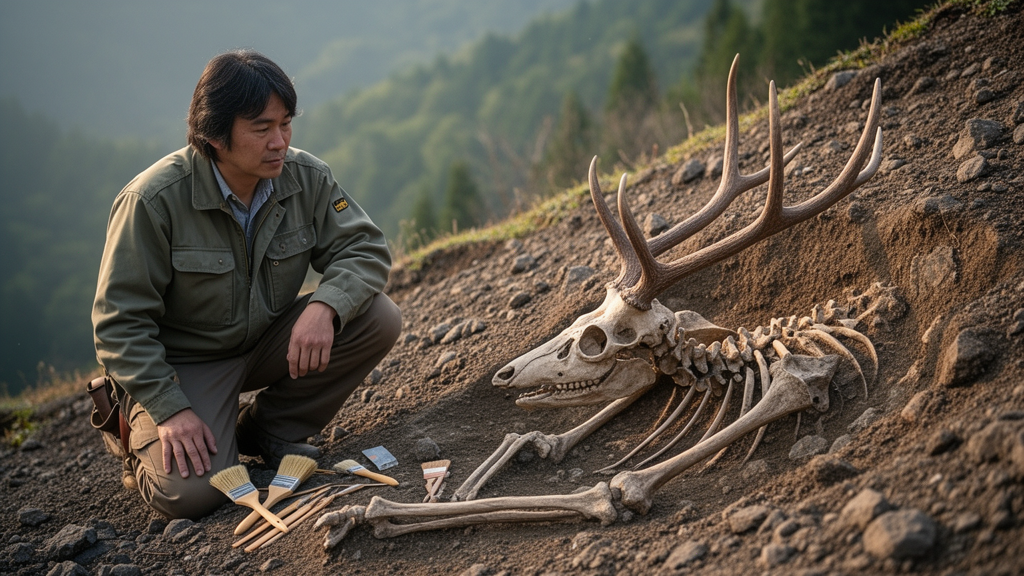
A remarkably complete 18-million-year-old deer skeleton unearthed from a riverbank in central Japan is rewriting the opening chapter of deer evolution. Described in the Swiss Journal of Palaeontology, the fossil belongs to a new species, Procervulus mizunami, and represents the oldest known skeleton of a stem cervid — an early deer lineage that branched off before the family containing all living species had fully formed. The discovery provides the first hard evidence that one of the earliest antlered deer had already crossed Eurasia and reached East Asia by roughly 18 million years ago, far earlier than the fragmentary Asian record had ever suggested.
The specimen was found in 2019 by Mr. Tatsuya Kaede in the uppermost part of the Togari Member of the Akeyo Formation, part of the Miocene Mizunami Group in Gifu Prefecture. It comprises an associated cranium with both frontal appendages, upper and lower dentition, and an extensive postcranial skeleton including scapula, humerus, radius, ulna, fused metacarpals, femur, tibiae, tarsal bones, fused metatarsals, phalanges, vertebrae and rib fragments. The holotype, catalogued as MFM 18008, is now housed at the Mizunami Fossil Museum. Such completeness is extraordinary for early Miocene deer: until now, the only articulated stem cervid skeleton with antlers known to science came from roughly 17-million-year-old deposits in Germany.
Dating the fossil relied on an unusually rigorous stratigraphic framework. The Togari Member is primarily tuffaceous sandstone intercalated with key tuff beds, and absolute ages from the uppermost Akeyo Formation were determined by fission-track dating (15.8 ± 1.8 Ma) and U-Pb dating of zircon crystals (18.8–16.6 Ma, mean 17.8 ± 0.4 Ma). Strontium isotope analysis of molluscan fossils from the same locality constrains deposition to around 18.3–17.9 Ma. The skeletal fossils were collected from a shell bed directly below a distinctive Felaniella bed, whose abundant cool-water bivalves are linked to the global cooling event Miocene Isotope Stage 1b at approximately 17.8 Ma. Together, these lines of evidence place the deer at roughly 18 million years ago, in the early Burdigalian stage of the Early Miocene.
Technically, the new species is diagnosed by a suite of anatomical characters. Its frontal appendages are short and dichotomous, meaning each antler forks once into two prongs diverging at an acute angle of 75–80 degrees. Critically, the antlers lack a burr — the prominent circular structure at the base of modern antlers — as well as any basal thickening or accessory structures such as the longitudinal sculpturing seen in the contemporary genus Heteroprox or the coronet-like boundary of Acteocemas. The pedicle, the bony stalk from which the antler arises, is nearly cylindrical and straight with a shallow medial groove, and is proportionally shorter than in any other known species of Procervulus. The upper molars bear a distinct internal postprotocrista, a neocrista shared with basal stem cervids from Europe. The metacarpal is much shorter than the metatarsal, with a greatest-length ratio of approximately 0.7 — a limb proportion intermediate between living tragulids, the tiny mouse-deer-like ruminants, and modern cervids.
Micro-CT scanning at 100 kV and 100 μA with a voxel size of 66.8 μm revealed internal bone microstructure within the frontal appendages. Although permineralisation limited the clarity of sectional images, the scans barely reveal internal trabecular bone in the pedicle and a faint distinction between external dense cortical bone and internal trabecular bone in the distal end of the posterior tine. If confirmed, this differentiated tissue pattern would be consistent with a relatively advanced stage of antler development, differing from the predominantly primary trabecular structure observed during early ossification. This interpretation is supported by the eruption of the third molars and the complete fusion of all postcranial epiphyses, indicating the individual was not a juvenile.
The ontogenetic question matters because antlers change size and proportion during growth. Pedicles become shorter and more rounded in fully mature individuals of some extinct deer, as in living cervids, so the unusually short pedicles of the Japanese specimen might conceivably reflect old age. However, the tooth wear of MFM 18008 — assessed through the wear stage of the third molars — is substantially less advanced than that of the long-pedicles holotype of Procervulus dichotomus, suggesting an intermediate-aged adult rather than a senescent one. The authors therefore accept the short, robust pedicles as a genuine diagnostic feature of the species rather than an artefact of developmental stage.
Comparative anatomy places the new species firmly within Procervulus, the earliest known antlered deer genus, characterised by dichotomous antlers and recovered as the sister taxon to the clade comprising all other stem and crown cervids except lagomerycines. In pedicle diameter and tooth size, P. mizunami resembles P. dichotomus, but differs in having a proportionally wider antler base and a shorter pedicle. It is larger than the smallest species, P. praelucidus, in dental dimensions and pedicle diameter, and unlike P. ginsburgi it lacks an additional third fork on the antler base. The sabre-shaped upper canines, elongated and weakly curved as in living muntjacs, and the selenodont, low-crowned cheek teeth all match the primitive cervid condition. The simple, bullet-shaped second lower premolar, short mesiodistally with a non-distally extended mesolingual conid, may represent a primitive state distinguishing it from Middle Miocene relatives.
The biogeographic implications are the most striking part of the story. Basal cervids bearing dichotomous antlers are well documented from the Lower Miocene of Europe, but had never previously been recorded from contemporaneous Asian localities. The Shanwangian biota of China, rich in beautifully preserved skeletons, is dominated entirely by lagomerycines such as Lagomeryx, Ligeromeryx and Stephanocemas — deer-like ruminants with trichotomous to palmated antlers — and completely lacks procervulines. Mongolia’s Early Miocene cervid record consists solely of lagomerycines as well. The Japanese discovery therefore demonstrates that procervulines and lagomerycines had already dispersed widely throughout Eurasia by the early Burdigalian, mirroring the two-cervid faunal composition seen in contemporaneous Europe, where Procervulus coexisted with Ligeromeryx.
The timing of this dispersal may connect to one of the most famous mammalian migrations in Earth history. The proboscidean Gomphotherium spread from Africa to East Asia between 20 and 19 million years ago, and the same dispersal corridors should have served various terrestrial mammals. If the earliest cervids moved during this window, the appearance of P. mizunami by 18 million years ago suggests that procervulines were more widely distributed in Asia than the fossil record currently shows. Alternatively, the species may represent a relic lineage that survived on the Palaeo-Japanese Arc after its close relatives disappeared from continental Asia — a pattern of discontinuous distribution known in both extinct and living Japanese mammals. The arc began separating from the Asian continent around 18 million years ago, and this progressive isolation may have promoted the distinctive short frontal appendages that set the Japanese species apart.
Reconstructed from the skeleton using 3D modelling that restored dorsoventral compression of the neurocranium and filled deficient parts with details from the German P. dichotomus specimen, the living animal had a head-and-body length of 80–90 centimetres and a shoulder height of 50 centimetres — comparable to a modern roe deer. Its limb proportions, with metacarpals intermediate in relative length between tragulids and cervids, hint at a body plan more primitive than any living deer. Fragmentary lower cheek teeth from the roughly 19-million-year-old Koura Formation in Shimane Prefecture exhibit cervid plesiomorphy and molar sizes similar to P. mizunami; if they belong to or are closely related to the new species, the Asian cervid record would extend even deeper into the Early Miocene. Either way, the Mizunami skeleton stands as a vivid reminder that the evolutionary story of deer — like so many others — was written across an entire continent, not in a single European cradle.
Subject of Research: Oldest known skeleton of a stem cervid ( Artiodactyla , Cervidae ) from the Lower Miocene of Japan and implications for the initial dispersal of stem cervids
Article Title: Oldest known skeleton of a stem cervid ( Artiodactyla , Cervidae ) from the Lower Miocene of Japan and implications for the initial dispersal of stem cervids
Article References: Nishioka, Y., & Ando, Y. (2026). Oldest known skeleton of a stem cervid (Artiodactyla, Cervidae) from the Lower Miocene of Japan and implications for the initial dispersal of stem cervids. Swiss Journal of Palaeontology, 145, 1011-1039. https://doi.org/10.3897/sjp.145.199515
Image Credits: AI Generated
Keywords: Oldest, known, skeleton, stem, cervid, Artiodactyla, Cervidae, Lower, Miocene, Japan, implications, initial
Cite Scienmag News
Gavin Prescott. (October 15, 2026). Oldest Known Deer Skeleton With Dichotomous Antlers Found in Japan Rewrites Early Cervid Dispersal. Scienmag. https://scienmag.com/oldest-known-deer-skeleton-with-dichotomous-antlers-found-in-japan-rewrites-early-cervid-dispersal/
Gavin Prescott. "Oldest Known Deer Skeleton With Dichotomous Antlers Found in Japan Rewrites Early Cervid Dispersal." Scienmag, 15 October 2026, https://scienmag.com/oldest-known-deer-skeleton-with-dichotomous-antlers-found-in-japan-rewrites-early-cervid-dispersal/. Accessed 15 October 2026.
Gavin Prescott. "Oldest Known Deer Skeleton With Dichotomous Antlers Found in Japan Rewrites Early Cervid Dispersal." Scienmag. October 15, 2026. https://scienmag.com/oldest-known-deer-skeleton-with-dichotomous-antlers-found-in-japan-rewrites-early-cervid-dispersal/


