


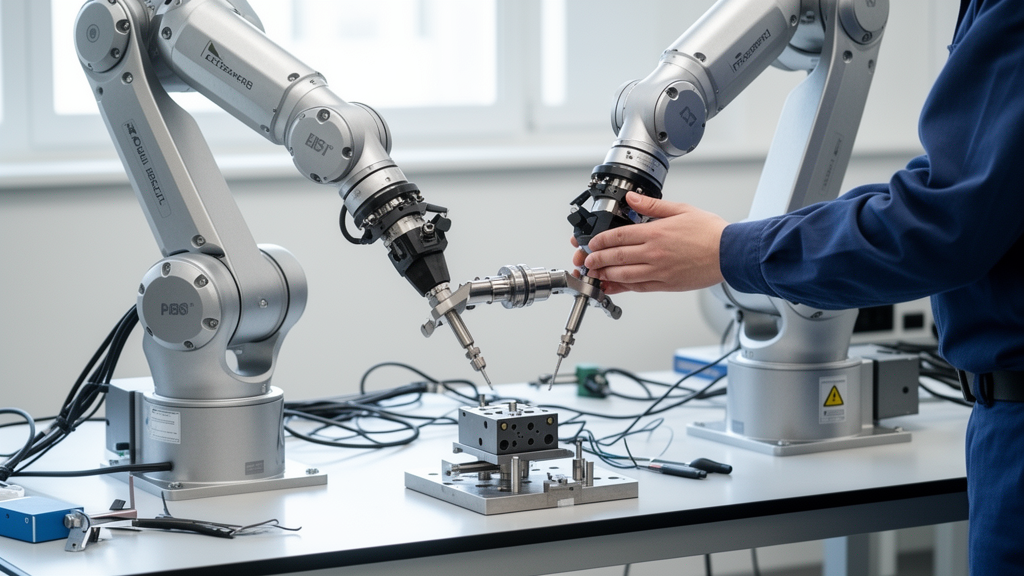
A controlled human study found that making two robot arms more strongly coupled during kinesthetic teaching shortened a bimanual pick-and-place task by about 22%, while producing higher interaction forces and lower perceived workload. The finding applies to a rigid box manipulated by two collaborative arms and does not establish that stronger coupling will deliver the same benefits for deformable objects, asymmetric tasks or robots learning autonomous behavior from the demonstrations.
Researchers at the University of Ljubljana and the Jožef Stefan Institute tested how the stiffness linking two KUKA LBR iiwa arms affected the process of teaching the robot to move a box. Fifteen volunteers, including 11 men and four women with an average age of 23.8 years, physically guided both robot end-effectors through repeated demonstrations. Robot experience ranged from none among some participants to master’s-level study among others. The researchers used a randomized within-subject design, so each person experienced four controller configurations, while the order of those configurations was assigned randomly.
The four settings ranged from fully independent arms to strong bimanual coupling. In the OFF condition, relative stiffness was zero, allowing the two arms to move independently. LOW used translational relative stiffness of 15 newtons per meter and orientational stiffness of 4 newton-meters per radian. MID increased those values to 70 N/m and 10 N m/rad, while HIGH used 200 N/m and 25 N m/rad. Absolute impedance was kept low so that the controller primarily governed the relationship between the arms rather than their position in the workspace. Damping was tuned separately for relative and absolute motion, and a nullspace task kept each seven-axis arm away from its joint limits.
Participants grasped opposite sides of a rigid 50.5-centimeter-long box, crossed a six-centimeter-high obstacle and placed the box at one of two marked targets. The controller maintained a fixed relative pose between the arms throughout the demonstration, including the initial grasp and final placement. Its reference was deliberately 10 centimeters narrower than the box, creating a baseline compression that made the arms continuously resist separation once both end-effectors were in contact. This design meant that stronger coupling would mechanically increase the load, so the investigators also separated the controller’s commanded wrench from the residual difference between measured and commanded forces.
The clearest objective benefit appeared in task time. Mean transport time was 22.9 seconds with independent arms, 19.4 seconds at LOW, 20.0 seconds at MID and 17.8 seconds at HIGH. A Friedman test identified a significant overall effect of controller setting, with a moderate effect size. Bonferroni-corrected post-hoc comparisons showed a significant difference between OFF and HIGH, corresponding to an approximately 22.3% reduction in mean cycle time and a large rank-biserial effect. The intermediate conditions did not produce a strictly monotonic time pattern, which means the results support a clear advantage for HIGH over OFF rather than demonstrating that every incremental increase in stiffness improves performance.
Final placement accuracy did not differ significantly among the four settings. Mean planar positioning errors were 16.9 millimeters for OFF, 16.8 millimeters for LOW, 16.1 millimeters for MID and 16.8 millimeters for HIGH. A repeated-measures analysis of variance found no significant condition effect, and none of the pairwise comparisons met the statistical-significance threshold. The investigators suggested that participants deliberately slowed their movements before release, allowing them to compensate for coordination differences during the fine-positioning phase. The null result therefore should not be read as proof that coupling cannot affect precision; the task design may simply have masked such an effect.
Interaction forces moved in the opposite direction from perceived effort. The sum of force magnitude across the two end-effectors increased monotonically as relative stiffness rose, with significant differences between every pair of settings in data from 14 participants whose force recordings were complete. The commanded controller wrench accounted for a growing share of measured variation, with median R-squared values of 0.01, 0.09 and 0.37 for LOW, MID and HIGH. Yet the residual force also grew, with medians of 1.3, 2.1, 3.6 and 6.0 newtons from OFF through HIGH. Because that residual includes operator actions as well as unmodeled actuation effects, it cannot be assigned solely to the human. Even so, its continued increase shows that the controller’s designed-in pretension does not fully explain the force pattern.
Participants nevertheless reported less workload under stronger coupling. Raw NASA-TLX scores showed lower perceived demands with higher stiffness, with significant differences between OFF and LOW, OFF with MID, and OFF with HIGH. Most subscales followed the same general improvement, although differences among the higher settings were not significant. The apparent contradiction between greater measured force and less perceived effort is consistent with a redistribution of control: at LOW, operators had to maintain fine relative coordination themselves, whereas stronger coupling let them concentrate on moving the assembly toward each target. Some participants nevertheless preferred MID over HIGH, indicating that the practical benefit of additional stiffness may plateau, reverse or vary between individuals. The study tested only a limited force range, so this pattern should not be extrapolated to substantially stronger coupling.
The experiment also had important boundaries. It examined demonstration performance rather than the autonomous behavior a robot might later learn, so it did not compare the training value of trajectories collected under each setting. There was no dedicated practice period, and the small, demographically homogeneous sample of 15 meant that intra-session learning and fatigue may not have been fully balanced despite randomization. Camera placement introduced noise into placement measurements, while fixed controller gains could not accommodate individual preferences. The findings also apply directly only to a symmetric task with a rigid object whose effective grip-point relationship remained constant. Tasks involving changing relative orientation, deformable material or different roles for the two arms could work against a strong fixed constraint and require separate testing.
For the tested pick-and-place operation, the results identify controller coupling as more than a low-level engineering parameter: it shaped how quickly people could teach a bimanual robot, how much force the interaction produced and how demanding the process felt. HIGH coupling offered the strongest contrast with fully independent operation, reducing mean task time and perceived workload without a statistically detectable change in final placement error. The results do not show that all coordination is better than independence, nor that stronger is always better. They instead support tailoring relative stiffness to the task and the demonstrator, with future work needed to test adaptive gains, broader manipulation tasks, larger and more diverse groups, and the quality of robot policies learned from the resulting demonstrations.
Subject of Research: Effects of relative stiffness on bimanual kinesthetic robot teaching
Article Title: Effectiveness of bimanual kinesthetic teaching through different controller settings
Article References: Avsec, O., Ude, A., Mihelj, M., & Gams, A. (2026). Effectiveness of bimanual kinesthetic teaching through different controller settings. Frontiers in Neurorobotics, 20, Article 1960197. https://doi.org/10.3389/fnbot.2026.1960197
Image Credits: AI Generated
DOI: 10.3389/fnbot.2026.1960197
Keywords: bimanual robotics, kinesthetic teaching, impedance control, human-robot interaction, robot learning by demonstration, dual-arm manipulation, collaborative robots, task performance, perceived workload, Effectiveness, bimanual, kinesthetic
Cite Scienmag News
Denise Maddox. (October 21, 2026). Stiffer coupling speeds bimanual robot teaching without improving placement accuracy. Scienmag. https://scienmag.com/stiffer-coupling-speeds-bimanual-robot-teaching-without-improving-placement-accuracy/
Denise Maddox. "Stiffer coupling speeds bimanual robot teaching without improving placement accuracy." Scienmag, 21 October 2026, https://scienmag.com/stiffer-coupling-speeds-bimanual-robot-teaching-without-improving-placement-accuracy/. Accessed 21 October 2026.
Denise Maddox. "Stiffer coupling speeds bimanual robot teaching without improving placement accuracy." Scienmag. October 21, 2026. https://scienmag.com/stiffer-coupling-speeds-bimanual-robot-teaching-without-improving-placement-accuracy/


