


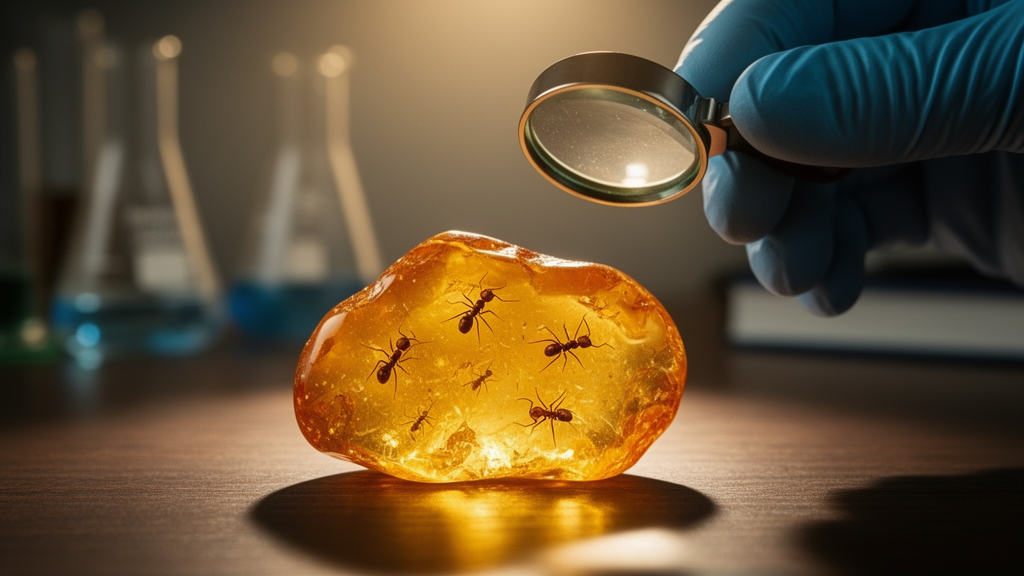
Deep inside golden lumps of Dominican amber, tiny workers of a genus best known today for its invasive fire ants have been waiting for roughly sixteen million years. A new study in the journal Fossil Record formally describes five extinct species of Solenopsis, the genus that contains the notorious Tropical Fire Ant and Red Imported Fire Ant, and in doing so delivers the first thief ant species ever named from fossil resin. The work also carries an uncomfortable warning for paleontology: several specimens in celebrated museum collections, long assumed to be ancient amber, turned out to be far younger copal or even recent resin.
Solenopsis is a taxonomically notorious genus. With more than 180 living species described, most of its members are externally so uniform that telling them apart requires scrutiny of fine details such as sculpturing on the head, the width of the postpetiole, the length of the antennal scape, or the presence of teeth on the front edge of the clypeus, the plate above the mouthparts. The genus is informally divided into fire ants, thief ants, and parasitic ants, but only the fire ant group appears to be a natural, evolutionarily coherent cluster. Thief ants, the tiny relatives that sneak into the nests of larger ants to steal food, remain poorly resolved, and most of the known diversity is concentrated in the Neotropics, where systematic study has historically been thickest.
The fossil record of Solenopsis has until now been surprisingly thin and geographically lopsided. All previously named fossil species come from the Palaearctic, preserved as compression imprints in Oligocene deposits of France and Germany and in Miocene shales of the Crimean Peninsula. Those descriptions, some dating back to the 1890s, have never been revised and are based on impressions of variable quality. From amber, the genus was entirely unknown until Edward O. Wilson mentioned specimens from Dominican amber in his 1985 study of West Indian ant biogeography, noting three morphotypes that were never formally described. A further report from coeval Mexican amber at Simojovel also remained unnamed. The new study finally gives these ants taxonomic footing.
The research team examined material from four repositories: the Museum of Comparative Zoology at Harvard University, the American Museum of Natural History in New York, the Museo Nacional de Historia Natural in Santo Domingo, and the Geological Department and Museum of the University of Rennes in France. Dominican amber, famed for its exceptional preservation of insects, plants, and even vertebrates, formed in a single sedimentary basin during the late Lower Miocene to early Middle Miocene, with the best current dating placing the deposits at approximately sixteen million years ago. The amber occurs mainly in the La Toca Formation of the Cordillera Septentrional in northern Hispaniola, with smaller quantities from the Yanigua Formation in the east.
Before describing anything, however, the authors had to confront a problem that has been quietly corroding confidence in amber collections worldwide. A specimen labeled as Eocene Baltic amber at Harvard was recently revealed to be subfossil resin, most likely East African copal, only after it had been published as the first army ant from that deposit. Whether the result of historical misidentification or outright forgery, dubious material has evidently entered numerous collections. The team therefore subjected every candidate specimen to physical testing before allowing it to anchor a new species name.
The testing combined two complementary approaches. The first was disarmingly simple: a drop of 75 percent ethanol applied to the specimen surface for two seconds, then dabbed away with a cotton ball. Resin polymerizes as it matures, so subfossil and recent resins remain soluble in ethanol while fully fossilized amber does not. If cotton fibers stuck to the surface or the surface turned tacky, the specimen failed the test. All three reference copal pieces from the Dominican Republic and Colombia reacted strongly. Among the sixteen collection specimens tested, three showed the telltale fibers or tackiness, including two specimens in the Harvard collection that had been labeled as Dominican amber.
The second assay used Raman spectroscopy, firing a 785-nanometer excitation laser at the specimens and measuring the intensity ratio between peaks near 1646 and 1450 wavenumbers, a ratio previously linked to resin maturation. Ratios above one had been suggested to indicate copal, while ratios below one supposedly indicated amber. But the reference measurements revealed a surprise: Dominican copal itself yielded strict ratios between 0.80 and 0.83 and peak ratios between 0.91 and 1.04, well below the traditional cutoff. The authors concluded that a simple ratio below one is not a valid criterion for distinguishing Dominican amber from Dominican copal, and they excluded all ethanol-reactive specimens plus one commercially derived specimen from Rennes, regardless of spectral values. Their formal descriptions rest only on material whose provenance and properties are consistent with genuine fossil resin.
With provenance secured, the team named five new species of minor workers. Solenopsis lamellata, from the northern mines of Santiago Province, is the standout: it bears a spine-like lamella on the posterior margin of the propodeum, a feature unknown in any other Solenopsis species and possibly tied to an unusual posterior narrowing of the thorax. Solenopsis pilonaria, named by students of the Universidad Autónoma de Santo Domingo after the pilón, the wooden mortar used to crush chocolate, is the only species with extralateral clypeal teeth and five mandibular teeth, and it shares affinities with the modern molesta species complex. Solenopsis merengue, honoring the national music and dance of the Dominican Republic, is the only species with a scape longer than two-thirds of head length and resembles the living brevicornis complex.
The remaining two species round out a picture of surprising Miocene diversity. Solenopsis viralata, whose name playfully references the street dogs of the Dominican Republic, shows affinities with the molesta subgroup and is the only species in which the dorsal margin of the propodeum is visibly shorter than the declivitous margin. Solenopsis picapica, named after the beloved Dominican rice dish Locrio de pica pica made with canned sardines, is known from a holotype and three paratypes sharing a single amber piece with a small termite and an Azteca ant worker, and it combines traits of both the molesta and pygmaea species complexes. Four of the type specimens were also imaged with micro-computed tomography at the Okinawa Institute of Science and Technology and the American Museum of Natural History, producing three-dimensional renderings of anatomy that light microscopy alone could not resolve.
Beyond the five new species, the study’s most consequential message may be methodological. The ethanol assay and Raman spectroscopy together exposed multiple instances of mislabeled material, including specimens in a historical collection examined by one of the twentieth century’s most famous ant biologists. Because copal can be chemically treated to defeat ethanol testing, and because some forgeries are plastics that do not react at all, the authors argue that no single test is sufficient and that spectroscopic ratios must be calibrated against regionally specific reference materials. As amber-inclusion taxonomy continues to underwrite claims about insect evolution and biogeography, the Solenopsis thief ants of Hispaniola stand as both a scientific prize and a cautionary tale: before a fossil can rewrite history, it must first prove that it is genuinely old.
Subject of Research: Fossil thief ants of the genus Solenopsis preserved in Dominican amber and the verification of amber provenance using ethanol assays and Raman spectroscopy
Article Title: Solenopsis ( Hymenoptera , Formicidae ) thief ants in Dominican amber and putative subfossil resin
Article References: Bouju, V., Chény, C., Gotzek, D., Perrichot, V., Fernandez, F., Barden, P., & Fiorentino, G. (2026). Solenopsis (Hymenoptera, Formicidae) thief ants in Dominican amber and putative subfossil resin. Fossil Record, 29(2), 499-517. https://doi.org/10.3897/fr.29.181268
Image Credits: AI Generated
DOI: 10.3897/fr.29.181268
Keywords: Solenopsis, thief ants, Dominican amber, fossil ants, Miocene, copal, Raman spectroscopy, paleontology, Formicidae, new species, Hispaniola, amber provenance
Cite Scienmag News
Gavin Prescott. (October 16, 2026). Five Extinct Thief Ant Species Emerge From 16-Million-Year-Old Dominican Amber. Scienmag. https://scienmag.com/five-extinct-thief-ant-species-emerge-from-16-million-year-old-dominican-amber/
Gavin Prescott. "Five Extinct Thief Ant Species Emerge From 16-Million-Year-Old Dominican Amber." Scienmag, 16 October 2026, https://scienmag.com/five-extinct-thief-ant-species-emerge-from-16-million-year-old-dominican-amber/. Accessed 16 October 2026.
Gavin Prescott. "Five Extinct Thief Ant Species Emerge From 16-Million-Year-Old Dominican Amber." Scienmag. October 16, 2026. https://scienmag.com/five-extinct-thief-ant-species-emerge-from-16-million-year-old-dominican-amber/


