


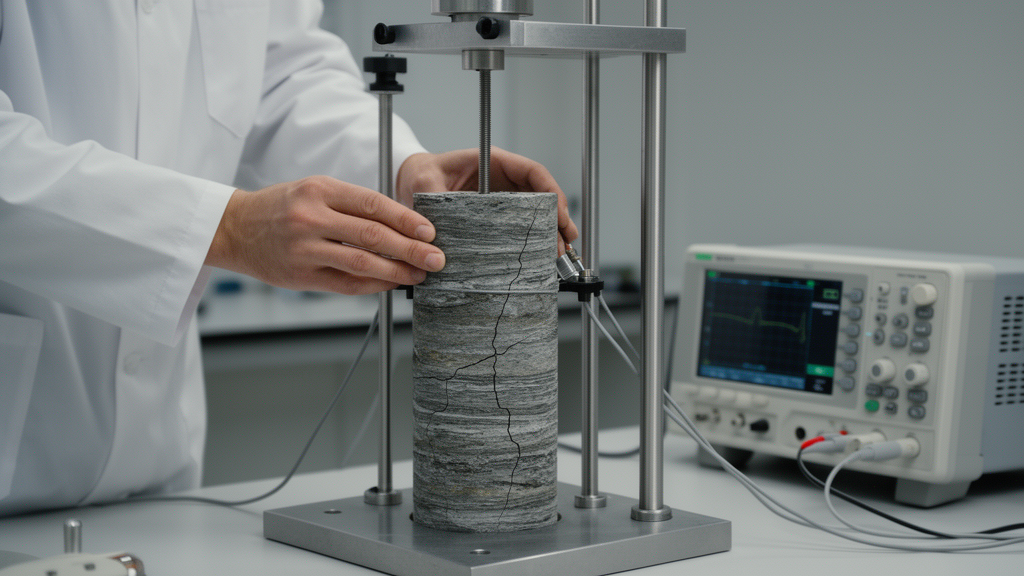
Deep beneath the Jura Mountains of Switzerland, in a laboratory carved into 200-million-year-old seafloor mud turned to stone, scientists have been eavesdropping on the slow-motion collapse and recovery of a faulted rock mass. At the Mont Terri Underground Rock Laboratory, a team monitoring the Progressive Failure experiment has shown that the scattered, echoing tails of seismic waves—so-called coda waves—can track both the drying and the rewetting of Opalinus Clay with a sensitivity that conventional first-arrival seismic measurements simply cannot match. The results, published in the Swiss Journal of Geosciences, offer a template for watching damage evolve in real time around tunnels, boreholes, and potentially nuclear waste repositories.
The experiment centered on a single, deliberately provocative act: in October 2020, researchers drilled a borehole roughly 12.9 meters long and 0.6 meters wide straight through the laboratory’s Main Fault, a zone of scaly, sheared clay that runs subparallel to the bedding of the Opalinus Clay host rock. The borehole was left unsupported and continuously ventilated for 21 months, then allowed to resaturate from July 2022 onward. That sequence—drying followed by rewetting—is precisely the kind of perturbation that stresses clay-rich rocks, and the team wanted to know whether faint seismic echoes could reveal the damage accumulating in the rock mass around the hole.
To listen, the researchers deployed 12 acoustic emission sensors and 12 ultrasonic transmitters distributed across four parallel monitoring boreholes, arranged in two observation planes hovering 0.1 and 0.7 meters above the test borehole. The instruments, pneumatically clamped inside open borehole casings and coupled to the rock with resin, fired ultrasonic shots every night when the laboratory was quiet, stacking each signal 1024 times to squeeze clean waveforms out of the noise. From March 2022 to January 2024, this network produced an almost continuous time-lapse record of the rock’s acoustic personality.
The first finding concerns the direct P waves, the fastest signals that travel straight from transmitter to receiver. These arrivals remained largely unchanged over the entire observation period, but their measured velocities painted a detailed portrait of the rock’s initial condition. Opalinus Clay is strongly anisotropic: waves traveling parallel to bedding reached up to 4.5 kilometers per second, consistent with intact shale, while paths crossing the bedding at steeper angles dropped below 2 kilometers per second in places. Velocities above 3 kilometers per second appeared almost exclusively in the upper observation plane, suggesting that the rock between tectonic shear surfaces there had suffered little damage, whereas the lower plane, closer to the experimental borehole, showed the 2 to 3 kilometers per second signature of more pronounced fracturing.
The real drama unfolded in the coda—the long, reverberating tail of each seismic signal, built from waves that have bounced and scattered off countless heterogeneities in the rock. Because the sources and sensors stayed fixed and tightly coupled, any change in the coda could be attributed to changes in the rock itself. Using the stretching method, which compares each new waveform against a reference trace stretched in time, the team quantified relative velocity changes and waveform similarity month by month. In 2021, during active ventilation, the coda showed a rapid velocity jump in the first 20 days, followed by a steady, nearly linear increase that persisted until November.
When ventilation of the test borehole ended on 22 July 2022, the character of the signal changed again. Velocities kept climbing but at a slower rate, and around March 2023—coinciding with the inferred full resaturation of the rock mass—the increase plateaued, with most source-receiver pairs showing no further change. The researchers thus identified three distinct phases: the end of ventilation, the resaturation period, and a final stabilization. Crucially, all three effects were far more pronounced in the lower plane, the one nearest the experimental borehole, with the strongest changes concentrated at depths of roughly 8 to 10 meters where the Main Fault crosses the monitoring array.
To turn these pairwise measurements into a picture of the rock volume, the team applied a probabilistic tomographic inversion built on sensitivity kernels that describe where coda waves actually sample the medium. The resulting three-dimensional models revealed that velocity changes during both the ventilation and resaturation phases were strongest near the test borehole, extending from the Main Fault into the adjacent footwall, where the strongest changes reached a radial extent of at least 1.5 meters above the borehole. During ventilation, localized velocity decreases on the order of 15 meters per second marked damage zones; during resaturation, increases exceeding 45 meters per second dominated the same region.
The interpretation weaves together several competing hydromechanical processes. During drilling, a damage zone with breakouts formed around the borehole, and ventilation then drove desaturation, spawning thousands of desiccation cracks—a photogrammetric survey counted roughly 5,500 cracks with a cumulative trace length of 128 meters at the November 2020 peak. As drying continued, mechanical closure of these cracks through rock compaction competed with crack opening driven by shrinkage, and the team attributes the steady 2021 velocity increase largely to this compaction, aided by desaturation effects known from laboratory experiments on Opalinus Clay samples.
The resaturation phase delivered the study’s most counterintuitive result. Renewed deformation—growing breakouts and increased slip along pre-existing faults—might be expected to lower seismic velocities by damaging the rock further. Instead, coda velocities rose. The explanation lies in the peculiar physics of water-swelling clays: as saturation increases, Opalinus Clay swells, closing void space and raising effective confining pressure, which boosts shear-wave velocity while leaving P waves nearly untouched. Because coda waves in weakly scattering clay rocks are dominated by shear-wave contributions, they registered the swelling and compaction loudly, while the near-absence of waveform decorrelation indicated that new damage contributed little by comparison. Freshly sheared surfaces in the fault zone and footwall, prone to swelling as water flowed along fractures, were likely the hotspots of this velocity gain.
Beyond its value for understanding one Swiss fault zone, the study makes a broader case: coda wave interferometry, with its exquisite sensitivity to subtle changes in saturation and structure, could be scaled up to monitor damage evolution and transient water content in clay formations at engineering scale. For projects planning to entomb radioactive waste in claystone, or to tunnel through water-sensitive shales, the ability to hear a rock mass dry out, crack, slip, and swell again—without touching it—may prove one of the quietest yet most consequential tools in the geotechnical toolkit.
Subject of Research: Coda wave interferometry for monitoring damage and saturation evolution in faulted Opalinus Clay
Article Title: Coda wave interferometry to monitor the evolution of rock mass damage and saturation in Opalinus Clay: a study at the Mont Terri Underground Laboratory
Article References: Obermann, A., & Ziegler, M. (2026). Coda wave interferometry to monitor the evolution of rock mass damage and saturation in Opalinus Clay: a study at the Mont Terri Underground Laboratory. Swiss Journal of Geosciences, 119, 49-59. https://doi.org/10.3897/sjg.119.182811
Image Credits: AI Generated
Keywords: coda wave interferometry, Opalinus Clay, Mont Terri, seismic monitoring, rock damage, resaturation, desiccation cracks, fault slip, borehole stability, geomechanics, nuclear waste repositories, time-lapse seismology
Cite Scienmag News
Iris Watkins. (October 16, 2026). Echoes in the Clay: Coda Waves Reveal Hidden Damage and Drying in Opalinus Shale. Scienmag. https://scienmag.com/echoes-in-the-clay-coda-waves-reveal-hidden-damage-and-drying-in-opalinus-shale/
Iris Watkins. "Echoes in the Clay: Coda Waves Reveal Hidden Damage and Drying in Opalinus Shale." Scienmag, 16 October 2026, https://scienmag.com/echoes-in-the-clay-coda-waves-reveal-hidden-damage-and-drying-in-opalinus-shale/. Accessed 16 October 2026.
Iris Watkins. "Echoes in the Clay: Coda Waves Reveal Hidden Damage and Drying in Opalinus Shale." Scienmag. October 16, 2026. https://scienmag.com/echoes-in-the-clay-coda-waves-reveal-hidden-damage-and-drying-in-opalinus-shale/


