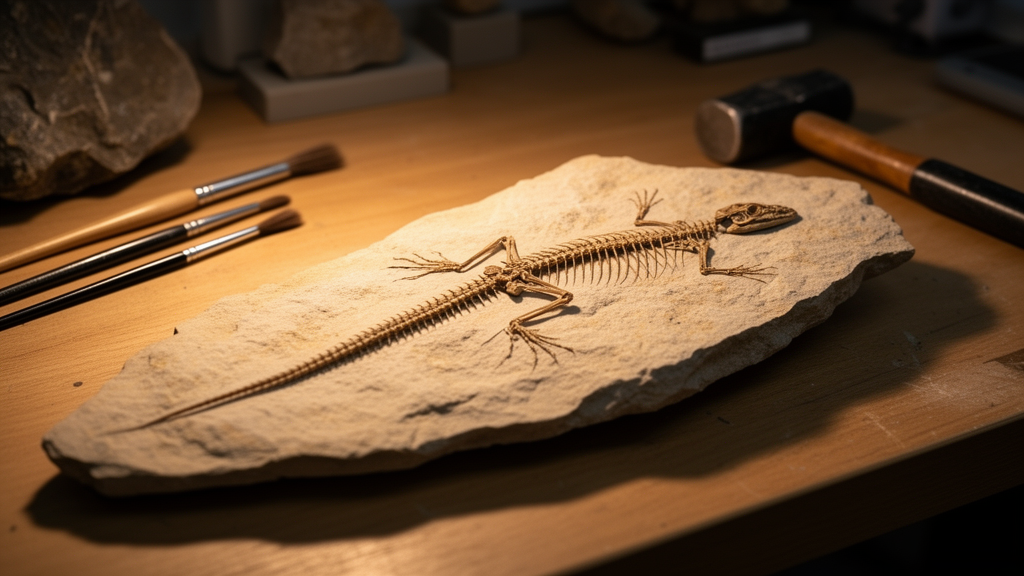
Deep in the bituminous mudstones of an abandoned Spanish sulphur mine, a slab of rock sat for decades with a secret pressed between its laminations. When researchers at the Museo Nacional de Ciencias Naturales in Madrid finally subjected the slab, catalogued as MNCN 63766, to high-resolution X-ray microtomography, the scans revealed something no one had documented at this famous fossil site before: the partial skeleton of a legless lizard belonging to the glass lizard genus Pseudopus. The discovery, published in the journal Fossil Record, marks the first anguid record from the Late Miocene Konservat-Lagerstätte of Libros in Teruel, Spain, and it is forcing palaeontologists to redraw their picture of the ecosystems that surrounded this ancient palaeolake roughly eight million years ago.
The fossil site of Libros, also known historically as Minas de Libros, La azufrera or La zofrera, ranks among the most prominent Lagerstätten of the entire Miocene epoch. Lagerstätten are fossil deposits so exceptional in their preservation that they capture soft tissues, delicate bones and even behavioural traces that normally vanish from the rock record. At Libros, mining operations running from the late eighteenth to the mid-nineteenth century extracted gypsum-rich materials with sulphur occurrences from the sedimentary infill of the Teruel Basin, which was deposited over Triassic evaporites and Cretaceous carbonates. Fossils uncovered during those mining activities were never properly documented; instead, they were purchased from mine workers and the local population, leaving the exact stratigraphic origin of most specimens, including the new anguid slab, frustratingly uncertain.
Scientific investigation of the site began in earnest only in 1920, when Navás published studies revealing a substantial number of well-preserved ranid frogs, salamandrids, snakes and wading birds. Subsequent work added insects, arachnids, dragonfly larvae, leaves of Salix denticulata and the fossil bird Thiornis sociata. The exceptional preservation at Libros has enabled the conservation of bird tracheae, gastropods ingested by frogs, the eyes of amphibian larvae and, in some cases, feathers. A single fossil beaver has been securely identified from the site. Yet until now, no member of the family Anguidae, the group that includes modern glass lizards and slow worms, had ever been reported from these lacustrine sediments.
The new specimen presents a formidable technical challenge. The fossil remains are mostly embedded and partially articulated within a fragile slab of bituminous mudstone measuring 41 by 22 centimetres, a lithology whose thin laminations facilitate fracture along its layers. Preliminary observations indicated the presence of cranial elements, vertebrae, ribs and osteoderms, but their millimetric size and accumulation in a dense mass of poorly distinguishable remains hindered detailed identification through direct examination. To overcome this limitation, the research team designed a custom support to protect the slab during handling and performed three micro-CT scans using a Nikon XT H-160 scanner, which operates at a maximum energy of about 160 kilovolts and offers a maximum resolution of 3 micrometres. Each scan covered a section of the slab with a maximum length of 12 centimetres, and the resulting two-dimensional images were segmented and rendered into three-dimensional models using the open-source software 3D Slicer.
The micro-CT scans revealed a partially articulated skeleton in which only vertebrae and some osteoderms remain in anatomical connection. Most of the remains are damaged and distributed in a mass of bones that is difficult to describe upon naked-eye examination. Among the identifiable elements are an anterior fragment of a nasal bone, dozens of vertebrae, eleven ribs and hundreds of osteoderms. Two best-preserved trunk vertebrae and one caudal vertebra, along with the dermal sculpturing pattern of the osteoderms, suggest attribution to the genus Pseudopus within the subfamily Anguinae. Based on the disposition of the bones along the slab, the living specimen would have had a minimum total length of 50 centimetres, and given that the tail of a glass lizard can extend to twice its body length, this individual could plausibly have reached approximately one metre in total length.
Taxonomic identification of the Libros material required careful comparison with both extinct and extant taxa. The researchers examined modern specimens of Pseudopus apodus, Anguis fragilis and Ophisaurus ventralis from herpetological collections in Madrid and Torino, alongside a broad array of fossil anguines. The ventral surface of the centrum in the dorsal vertebrae is flat, a characteristic trait shared by amphisbaenians, Varanidae, Helodermatidae and Anguidae. However, the absence or strong reduction of the neural spine in amphisbaenians rules out that group, while differences in osteoderm morphology exclude Helodermatidae and differences in vertebral robustness and condyle shape exclude Varanidae. The vertebrae of MNCN 63766 are not as robust as those of limbed lizards, and the elongation of the body combined with the large number of vertebrae is associated with limb loss or reduction in squamates. These characters, together with the disposition of osteoderms along the body, point to a close affinity with the family Anguidae.
Distinguishing Pseudopus from related genera such as Anguis and Ophisaurus rested on subtle vertebral features. Compared with Anguis, the Libros specimen shows less curved inner margins of the postzygapophyses, straight and oblique rather than parallel subcentral ridges, a lower length-to-width ratio of the dorsal vertebra and a narrow, long rather than wide, short neural spine on the caudal vertebrae. Compared with Ophisaurus, the subcentral ridges of the dorsal vertebra are straight rather than concave, the condyle and cotyle are larger and less flattened, and the postzygapophyses of the caudal vertebrae expand more laterally than posteriorly. After discarding all previously mentioned anguid candidates, the researchers carefully identified MNCN 63766 as cf. Pseudopus, a designation reflecting strong affinity but incomplete preservation that prevents definitive species-level assignment.
Taphonomic analysis of the specimen offers a vivid reconstruction of what happened after death. The distribution of skeletal elements along the slab shows distinct patterns of articulation and dispersal. In the upper and middle sections, vertebrae remain in anatomical connection and are associated with numerous osteoderms. In contrast, the central portion of the slab, corresponding to a coiled region of the body, contains no articulated vertebrae; instead, the remains are disarticulated and redistributed. The lower section holds a concentration of displaced elements including ribs, osteoderms and occasional dorsal vertebrae. This pattern is consistent with the rupture of the abdominal region due to the accumulation of gases, which may have caused an explosion of the visceral cavity, a process previously simulated in reptiles and mammals from other fossil sites. Notably, none of the bone surface modifications associated with trampling, abrasion or digestion are visible on the specimen, suggesting the animal was buried rapidly in a low-energy aquatic environment without post-depositional transport.
The palaeobiogeographic implications of this find are considerable. The Miocene to Pliocene fossil record of Pseudopus shows a wide distribution across Eurasia, with a particularly broad geographic range during the Miocene in Central Europe and western Asia, where species such as P. laurillardi, P. pannonicus, P. ahnikoviensis and P. confertus have been documented. This pattern is consistent with previously proposed links between the expansion of Pseudopus and warm climatic intervals such as the Miocene Climatic Optimum. Following that interval, a reduction in the number of records and a more restricted geographic distribution can be observed, particularly towards the Late Miocene. The Iberian Peninsula represents the westernmost extent of the genus in Eurasia, and the Libros specimen adds to a growing list of eastern Spanish localities documenting its presence during the Miocene. Its position, both geographically and chronologically, is consistent with the persistence of the genus in south-western Europe during the Late Miocene, even during intervals of increasing aridity towards the end of that epoch.
Perhaps the most transformative contribution of the discovery lies in what it reveals about the palaeoenvironment of the Libros palaeolake. Almost all taxa previously found at the site, including amphibians, semi-aquatic mammals and wading birds, are tied to aquatic environments. The presence of Pseudopus, which is typically associated with open or semi-open habitats linked to riparian shrublands rather than densely forested environments, is consistent with the existence of exposed, vegetated margins surrounding the waterbody. The co-occurrence of Salix and Pseudopus may suggest a more open environment or riparian shrubland rather than a closed forest. Beavers, which preferentially exploit trees with smaller diameters and soft, flexible wood such as Salix, may have acted as ecosystem engineers, promoting the formation of shallow waterbodies through dam-building activities. These processes increase habitat heterogeneity, enhance organic matter accumulation and support the development of riparian vegetation, conditions generally favourable for amphibian reproduction and larval development. Taken together with the associated faunal and floral assemblages, the presence of Pseudopus suggests that the Libros site was dominated by an open riparian woodland surrounding a temporary waterbody, a setting more consistent with shallow wetland environments or marginal zones within a larger lacustrine system than with the classical deep lacustrine systems exemplified by Messel. The greater abundance of semi-aquatic specimens relative to terrestrial ones could reflect either an ecological signal or a taphonomic bias favouring organisms inhabiting areas close to the water, a pattern also documented at Messel and Camp dels Ninots. In this revised framework, the formation and abandonment of beaver-influenced wetlands may have promoted habitat succession towards more open and riparian landscapes, potentially creating suitable ecological conditions for taxa such as Pseudopus in shallow or marginal areas of the lake system rather than in its deeper, central zones. The discovery of a glass lizard pressed into ancient lake mud thus does more than add a name to a species list; it opens a window onto the terrestrial transition from wetland to open, forested landscape that defined the Late Miocene of the Iberian Peninsula.
Subject of Research: Paleontology
Article Title: First anguid record ( Anguidae , Squamata ) from the Late Miocene Konservat-Lagerstätte Libros (Teruel, Spain) and its palaeoenvironmental implications
Article References: Linares-Martín, A., Přikryl, T., Villa, A., Delfino, M., Gómez De Soler, B., & Blain, H.-A. (2026). First anguid record (Anguidae, Squamata) from the Late Miocene Konservat-Lagerstätte Libros (Teruel, Spain) and its palaeoenvironmental implications. Fossil Record, 29(1), 411-428. https://doi.org/10.3897/fr.29.183059
Image Credits: AI Generated
DOI: 10.3897/fr.29.183059
Keywords: paleontology, fossils, lizards, micro-CT, Miocene, Spain, Lagerstätte, Pseudopus, First, anguid, record, Anguidae
Cite Scienmag News
Gavin Prescott. (October 16, 2026). Glass Lizard Hidden in Spanish Mine Slab Rewrites Miocene Ecosystem Map. Scienmag. https://scienmag.com/glass-lizard-hidden-in-spanish-mine-slab-rewrites-miocene-ecosystem-map/
Gavin Prescott. "Glass Lizard Hidden in Spanish Mine Slab Rewrites Miocene Ecosystem Map." Scienmag, 16 October 2026, https://scienmag.com/glass-lizard-hidden-in-spanish-mine-slab-rewrites-miocene-ecosystem-map/. Accessed 16 October 2026.
Gavin Prescott. "Glass Lizard Hidden in Spanish Mine Slab Rewrites Miocene Ecosystem Map." Scienmag. October 16, 2026. https://scienmag.com/glass-lizard-hidden-in-spanish-mine-slab-rewrites-miocene-ecosystem-map/