Tuesday, October 20, 2026
Science
No Result
View All Result
  • Login
  • HOME
  • SCIENCE NEWS
  • CONTACT US
  • HOME
  • SCIENCE NEWS
  • CONTACT US
No Result
View All Result
Scienmag
No Result
View All Result
Home Science News Biology

SWAP70 promotes liver cancer growth through CPT1A-dependent fatty acid oxidation

October 20, 2026
in Biology
Nathaniel Bowman
By Nathaniel Bowman Scienmag Editorial Profile - Precision Oncology
Reading Time: 3 mins read
0
SWAP70 promotes liver cancer growth through CPT1A-dependent fatty acid oxidation

SWAP70 promotes liver cancer growth through CPT1A-dependent fatty acid oxidation

65
SHARES
587
VIEWS
Share on FacebookShare on Twitter
ADVERTISEMENT

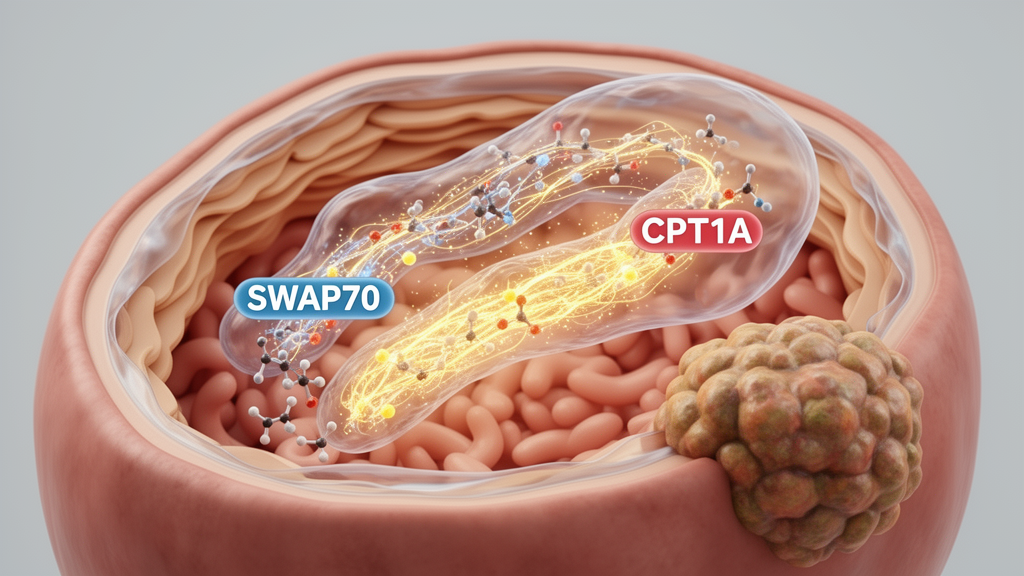
A study combining analysis of human liver-tumor samples, experiments with hepatocellular carcinoma (HCC) cells and mouse models found that switch-associated protein 70 (SWAP70) promotes tumor-cell proliferation and tumor growth by increasing carnitine palmitoyltransferase 1A (CPT1A)-mediated fatty acid β-oxidation under glucose deficiency. SWAP70 expression was significantly elevated in HCC tissues, particularly in advanced tumors, and was associated with poor overall survival. The research identifies a metabolic pathway that may contribute to HCC development, but it does not establish a treatment for patients.

The researchers first evaluated SWAP70 expression and its relationship to clinical outcomes using bioinformatics analysis and immunohistochemistry on clinical tissue microarrays. SWAP70 is a multidomain protein that binds and bundles F-actin and has roles in multiple cellular functions. The tissue analysis showed that SWAP70 was upregulated in HCC, especially in advanced disease, and that high expression correlated with poorer overall survival. These observations associate SWAP70 with tumor severity and prognosis in the analyzed samples; they do not by themselves show that SWAP70 causes the clinical outcomes in patients.

Functional studies then examined the effects of SWAP70 in HCC cells and animals. SWAP70 promoted proliferation in cultured cells and increased tumor growth in vivo. To investigate the mechanism behind these effects, the research team used multi-omics analysis. The analysis linked SWAP70 activity to increased mitochondrial fatty acid β-oxidation through upregulation of CPT1A, which the study identifies as a rate-limiting enzyme in this pathway. When CPT1A was silenced, the proliferative effect mediated by SWAP70 was abolished, supporting CPT1A’s role as a downstream component of the SWAP70-associated growth effect.

The study also identified a regulatory mechanism that connects glucose deficiency with SWAP70 expression. Under conditions of glucose deficiency, AMP-activated protein kinase (AMPK) was activated. This activation suppressed the expression of hepatocyte nuclear factor 4 alpha (HNF4A), which acts as a transcriptional repressor of SWAP70. With HNF4A-mediated repression reduced, SWAP70 expression increased, enhancing CPT1A-mediated fatty acid β-oxidation and supporting HCC-cell proliferation. The experimental sequence therefore links glucose deficiency to AMPK activation, lower HNF4A expression, higher SWAP70 expression and increased CPT1A-dependent fatty acid oxidation.

The investigators assessed the possible therapeutic relevance of the pathway in a mouse model of HCC induced with diethylnitrosamine and carbon tetrachloride. Silencing SWAP70 delayed tumor progression in this model. That result supports SWAP70 as a contributor to HCC development in the experimental system and suggests that suppressing it may warrant further investigation. The evidence presented is preclinical: the work includes tissue analysis, cell experiments and mouse models, and it does not demonstrate the safety or efficacy of SWAP70-directed treatment in people. The supplied article is an early accepted version that remains subject to further editing, so the findings should be regarded as an experimental description of the SWAP70–HNF4A–CPT1A pathway rather than a validated human therapeutic strategy.

Subject of Research: SWAP70 regulation of fatty acid metabolism and proliferation in hepatocellular carcinoma

Article Title: SWAP70 promotes hepatocellular carcinoma proliferation by enhancing CPT1A-mediated fatty acid β-oxidation under glucose deficiency

Article References: He, J., Wang, Y., & Zhang, D. (2026). SWAP70 promotes hepatocellular carcinoma proliferation by enhancing CPT1A-mediated fatty acid β-oxidation under glucose deficiency. Cellular and Molecular Life Sciences. https://doi.org/10.1007/s00018-026-06490-w

Image Credits: AI Generated

DOI: 10.1007/s00018-026-06490-w

Keywords: hepatocellular carcinoma, SWAP70, CPT1A, fatty acid β-oxidation, glucose deficiency, AMPK, HNF4A, tumor metabolism, liver cancer, mouse models, promotes, hepatocellular

Cite Scienmag News

Nathaniel Bowman. (October 20, 2026). SWAP70 promotes liver cancer growth through CPT1A-dependent fatty acid oxidation. Scienmag. https://scienmag.com/swap70-promotes-liver-cancer-growth-through-cpt1a-dependent-fatty-acid-oxidation/
Nathaniel Bowman. "SWAP70 promotes liver cancer growth through CPT1A-dependent fatty acid oxidation." Scienmag, 20 October 2026, https://scienmag.com/swap70-promotes-liver-cancer-growth-through-cpt1a-dependent-fatty-acid-oxidation/. Accessed 20 October 2026.

Nathaniel Bowman. "SWAP70 promotes liver cancer growth through CPT1A-dependent fatty acid oxidation." Scienmag. October 20, 2026. https://scienmag.com/swap70-promotes-liver-cancer-growth-through-cpt1a-dependent-fatty-acid-oxidation/
Tags: AMPKbioinformatics analysis of HCC markersbiomarker analysis of SWAP70 in liver cancercellular mechanisms of tumor proliferationCPT1ACPT1A-dependent fatty acid oxidation in cancerfatty acid β-oxidationglucose deficiencyglucose deficiency and cancer metabolismhepatocellularhepatocellular carcinomaHNF4Aimmunohistochemistry in tumor tissue analysisliver cancerliver cancer progressionmetabolic pathways in liver tumor growthmouse modelsmouse models of liver cancerprognostic significance of SWAP70 expressionPromotesrole of fatty acid metabolism in HCCSWAP70SWAP70 protein function in hepatocellular carcinomatherapeutic targets intumor metabolism
Share26Tweet16
Previous Post

Machine learning links immune-cell measures to resected lung cancer prognosis

Next Post

Betaine solvent extracts more than 99% of copper from waste circuit boards

Related Posts

Baicalin partly eases APEC-induced ileal injury in broiler chickens
Biology

Baicalin partly eases APEC-induced ileal injury in broiler chickens

October 20, 2026
Single case links deep intronic MFSD8 variant to CLN7 disease
Biology

Single case links deep intronic MFSD8 variant to CLN7 disease

October 20, 2026
Cell studies link TONSL recognition of histone H3.1 to DNA repair
Biology

Cell studies link TONSL recognition of histone H3.1 to DNA repair

October 20, 2026
Integrative study reveals eight new endemic freshwater shrimp species on Hainan
Biology

Integrative study reveals eight new endemic freshwater shrimp species on Hainan

October 20, 2026
Aflatoxin M1 in Milk and Aflatoxin B1 in Animal Feed in Bangladesh: A Systematic Review, Meta-Analysis and Literature-Based Dietary Risk Assessment
Biology

Aflatoxin M1 in Milk and Aflatoxin B1 in Animal Feed in Bangladesh: A Systematic Review, Meta-Analysis and Literature-Based Dietary Risk Assessment

October 20, 2026
DNA taxonomy reveals high species diversity in African Metastenasellus
Biology

DNA taxonomy reveals high species diversity in African Metastenasellus

October 20, 2026
Next Post
Betaine solvent extracts more than 99% of copper from waste circuit boards

Betaine solvent extracts more than 99% of copper from waste circuit boards

  • Mothers who receive childcare support from maternal grandparents show more optimized

    Mothers who receive childcare support from maternal grandparents show more parental warmth, finds NTU Singapore study

    27656 shares
    Share 11059 Tweet 6912
  • University of Seville Breaks 120-Year-Old Mystery, Revises a Key Einstein Concept

    1061 shares
    Share 424 Tweet 265
  • Bee body mass, pathogens and local climate influence heat tolerance

    682 shares
    Share 273 Tweet 171
  • Researchers record first-ever images and data of a shark experiencing a boat strike

    546 shares
    Share 218 Tweet 137
  • Groundbreaking Clinical Trial Reveals Lubiprostone Enhances Kidney Function

    531 shares
    Share 212 Tweet 133
Science

Embark on a thrilling journey of discovery with Scienmag.com—your ultimate source for cutting-edge breakthroughs. Immerse yourself in a world where curiosity knows no limits and tomorrow’s possibilities become today’s reality!

RECENT NEWS

  • Corporate Network Positions Shape Innovation in Chinese Cities
  • Indonesian rural banks: governance links technology to sustainable performance
  • Research report: Physicians’ use of a digital tool with information views to support chart review of complex patient cases
  • Baicalin partly eases APEC-induced ileal injury in broiler chickens

Categories

  • Agriculture
  • Anthropology
  • Archaeology
  • Athmospheric
  • Biology
  • Biotechnology
  • Blog
  • Bussines
  • Cancer
  • Chemistry
  • Climate
  • Earth Science
  • Editorial Policy
  • Marine
  • Mathematics
  • Medicine
  • Pediatry
  • Policy
  • Psychology & Psychiatry
  • Science Education
  • Science News
  • Social Science
  • Space
  • Technology and Engineering

Subscribe to Blog via Email

Enter your email address to subscribe to this blog and receive notifications of new posts by email.

Join 5,149 other subscribers

© 2025 Scienmag - Science Magazine

Welcome Back!

Login to your account below

Forgotten Password?

Retrieve your password

Please enter your username or email address to reset your password.

Log In
No Result
View All Result
  • HOME
  • SCIENCE NEWS
  • CONTACT US

© 2025 Scienmag - Science Magazine

Discover more from Science

Subscribe now to keep reading and get access to the full archive.

Continue reading