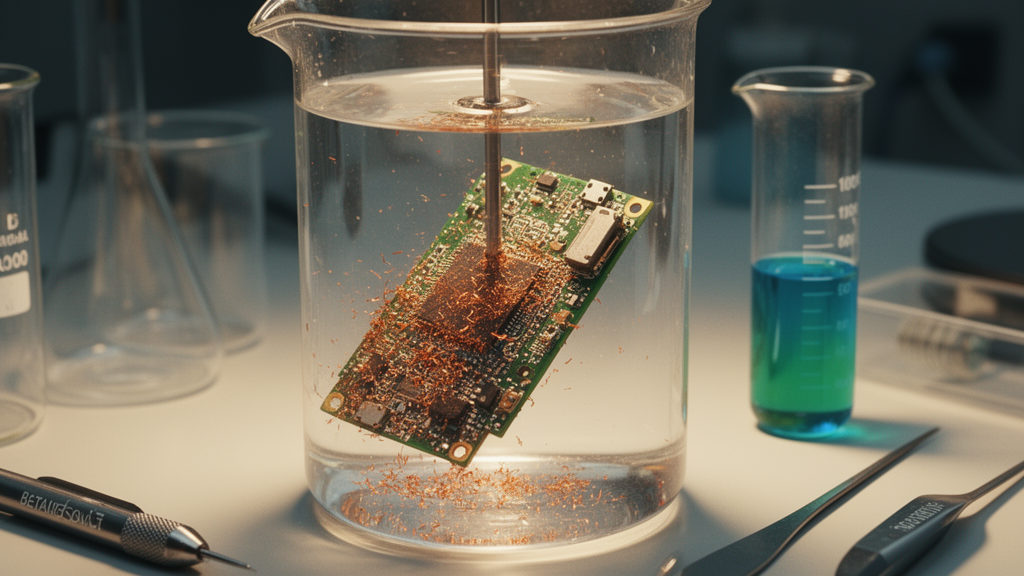
A betaine-based natural deep eutectic solvent can extract more than 99% of copper and lead from waste printed circuit boards under laboratory conditions, according to a new study of metal leaching from discarded computer hardware. The formulation containing betaine and ethane-1,2-diol, abbreviated BET:ETD, also removed 97.8% of iron and 95.4% of aluminium when operated at 75 °C for six hours with hydrogen peroxide. Tin recovery reached 90.5%, while titanium was less completely extracted at 73.9%. The work provides evidence that a tunable, largely bio-derived solvent system can attack the metal-rich fraction of printed circuit boards while leaving much of the underlying polymer and glass-fibre framework intact.
Waste printed circuit boards are an important but difficult component of electronic waste. They contain copper, aluminium, iron, tin, lead, nickel, zinc and smaller quantities of precious metals, along with polymers, ceramics and reinforcing glass fibres. The Global E-waste Monitor 2024 reported that the world generated approximately 62 million metric tonnes of electronic waste in 2022, and the authors note that a United Nations University projection puts the total near 74.7 million metric tonnes by 2030. Printed circuit boards account for an estimated 3–5% of that mass. Their concentrated metal content offers a potential source of recovered materials, but the intimate mixture of metals, resins and refractory components makes separation difficult.
Conventional recycling routes include physical separation, pyrometallurgy, hydrometallurgy and biometallurgy. Physical methods can separate metallic and non-metallic fractions, while thermal routes can recover metals but may consume considerable energy, release hazardous gases and lose valuable material. Bioleaching offers milder operating conditions, yet its practical adoption is constrained by slow kinetics and an incomplete understanding of operating parameters. Hydrometallurgical leaching can be effective, but many established systems depend on volatile, strongly acidic or toxic reagents, including cyanide and thiosulphate. The new study was designed to test whether a less aggressive family of solvents could provide high extraction without requiring mineral acids as the main lixiviant.
The researchers prepared three natural deep eutectic solvents, or NADES, by combining betaine, which served as the hydrogen-bond acceptor, with one of three related diols serving as the hydrogen-bond donor: ethane-1,2-diol, propane-1,2-diol or butane-1,2-diol. Each formulation also included deionised water, producing a 1:3:1 betaine-to-diol-to-water molar ratio. Mixtures were agitated at 500 rpm and 70 °C until they became transparent, single-phase liquids. Fourier transform infrared spectroscopy showed shifts and broadening in the hydroxyl and carboxylate bands that were consistent with new intermolecular hydrogen bonding between betaine and the diols, while the retention of characteristic chemical-group bands indicated that the components remained chemically intact during preparation.
Thermal and rheological measurements revealed practical differences among the three liquids. Thermogravimetric analysis showed broad, overlapping mass-loss processes, with pronounced maximum mass-loss rates above approximately 240 °C for every formulation. These DTG peaks are rates of maximum mass loss rather than absolute decomposition thresholds, and measurable mass loss also occurred at lower temperatures, including a region below 150 °C that may include removal of water and other volatile species. At 20 °C, all three liquids displayed Newtonian flow over shear rates of 1–100 s⁻¹. The ethane-1,2-diol formulation had the lowest viscosity at 50.1 mPa·s, compared with 86.9 mPa·s for the propane-1,2-diol formulation and 96.7 mPa·s for the butane-1,2-diol formulation.
That viscosity gradient tracked directly with metal extraction. In comparative tests at 55 °C for four hours, with a solid-to-liquid ratio of 1:20 and stirring at 500 rpm, BET:ETD produced the highest recovery for every target metal. Copper extraction was 62.5% with BET:ETD, compared with 60.1% for BET:PPD and 53.8% for BET:BTD. Lead recovery followed the same order at 65.4%, 61.2% and 56.5%, while tin declined from 58.8% to 51.6% and 42.5%. The authors interpret the pattern as evidence that transport properties were more influential here than any potential coordination advantage of the longer-chain diols: the less viscous short-chain formulation wetted the heterogeneous solid more readily and supported faster movement of dissolved species away from reactive surfaces.
The study then compared three oxidants in the BET:ETD system at a concentration of 1.0 M, holding temperature at 55 °C, leaching time at four hours, stirring at 500 rpm and the solid-to-liquid ratio at 1:20. Hydrogen peroxide produced the highest value for all six metals: 75.2% for copper, 70.8% for aluminium, 72.2% for iron, 69.4% for tin, 80.1% for lead and 46.6% for titanium. Potassium permanganate gave intermediate recoveries, while iodine produced the lowest. The reported order was hydrogen peroxide greater than potassium permanganate greater than iodine. The results establish an advantage for hydrogen peroxide within this experimental system, although the study examined oxidant type at one concentration rather than comparing a complete matrix of concentrations and operating conditions.
Contact time and temperature then drove extraction sharply upward. Over one to six hours at 55 °C with 1.0 M hydrogen peroxide, copper recovery increased from 41.4% to 92.3%, aluminium from 37.6% to 86.7%, iron from 43.2% to 90.4%, tin from 33.7% to 84.1%, lead from 48.3% to 95.6% and titanium from 18.5% to 61.8%. In the six-hour temperature series, copper extraction rose from 53.4% at 25 °C to 98.7% at 65 °C and 99.3% at 75 °C. Lead reached 99.2% at 65 °C and 99.5% at 75 °C. At 85 °C, however, efficiencies declined: copper fell to 96.4%, iron to 93.3% and lead to 97.7%. The authors associated this downturn with faster hydrogen peroxide decomposition, reduced oxygen solubility and possible changes in dissolution or precipitation behaviour at high temperature.
Mechanistic analysis indicated that no single mechanism fully described the process. The researchers fitted time-series data for the six metals to shrinking-core models representing either interfacial chemical reaction or internal diffusion through an evolving product layer. Both models produced strong linear relationships with correlation coefficients approaching one, so regression alone could not distinguish the controlling step. Arrhenius analysis produced apparent activation energies of 21.3–23.5 kJ mol⁻¹ for the chemical-reaction model and 35.7–38.8 kJ mol⁻¹ for the diffusion model. Because neither set matched the conventional ranges expected for purely reaction-controlled or purely diffusion-controlled extraction, the authors interpreted leaching as mixed control in which surface reactions and internal diffusion operate concurrently. This conclusion is an interpretation of the fitted models and activation energies, rather than direct observation of each elementary reaction step.
Microscopy and spectroscopy showed that the solvent did something more complex than simply dissolve the whole board. Scanning electron micrographs showed that the initially compact, heterogeneous surface became porous and irregular after leaching, exposing rod-like glass-fibre bundles that remained behind. X-ray diffraction showed that reflections for copper, iron and lead were no longer detectable, aluminium peaks were strongly diminished and tin peaks remained relatively pronounced, consistent with its lower recovery. Infrared signals associated with residual organic and ceramic fractions persisted, indicating that polymeric and inorganic framework components largely survived. The findings are nevertheless laboratory results based on ground boards from discarded desktop computers, processed after removal of bulky attachments, chemical stripping of the solder mask and reduction to particles below 300 micrometres. The study did not test a continuous industrial reactor, reagent recycling, long-term solvent stability or the economics of full-scale operation, leaving those questions for subsequent process development.
Subject of Research: Laboratory development of a betaine-based natural deep eutectic solvent for extracting metals from waste printed circuit boards
Article Title: Development of efficient betaine-based natural deep eutectic solvents for metal leaching from waste printed circuit boards
Article References: Oke, E. A., & Potgieter, J. H. (2026). Development of efficient betaine-based natural deep eutectic solvents for metal leaching from waste printed circuit boards. Environmental Science and Pollution Research. https://doi.org/10.1007/s11356-026-38292-9
Image Credits: AI Generated
DOI: 10.1007/s11356-026-38292-9
Keywords: betaine, natural deep eutectic solvents, metal leaching, printed circuit boards, electronic waste, hydrometallurgy, hydrogen peroxide, urban mining, solvent chemistry, Development, efficient, betaine-based
Cite Scienmag News
Violet Maxwell. (October 20, 2026). Betaine solvent extracts more than 99% of copper from waste circuit boards. Scienmag. https://scienmag.com/betaine-solvent-extracts-more-than-99-of-copper-from-waste-circuit-boards/
Violet Maxwell. "Betaine solvent extracts more than 99% of copper from waste circuit boards." Scienmag, 20 October 2026, https://scienmag.com/betaine-solvent-extracts-more-than-99-of-copper-from-waste-circuit-boards/. Accessed 20 October 2026.
Violet Maxwell. "Betaine solvent extracts more than 99% of copper from waste circuit boards." Scienmag. October 20, 2026. https://scienmag.com/betaine-solvent-extracts-more-than-99-of-copper-from-waste-circuit-boards/