


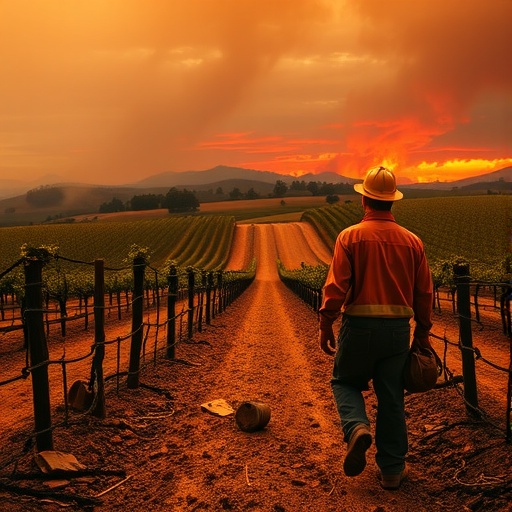
Amidst the iconic rolling vineyards of Sonoma County, a region synonymous with California’s prestigious wine industry, new research from UC Berkeley casts an urgent spotlight on a pressing public health and labor concern. A comprehensive survey reveals that approximately three-quarters of agricultural workers in this area have faced wildfire exposure in their line of duty since 2017, igniting complex questions about occupational safety protocols and emergency response measures.
Agricultural laborers, the backbone of Sonoma’s viticulture and livestock industries, have frequently found themselves laboring under hazardous wildfire conditions. The data gathered from over a thousand workers uncovers unsettling health repercussions: nearly half reported acute symptoms such as headaches and sore throats after working amidst wildfire smoke. These findings underscore the overlooked human cost endured behind the production of beloved California wines and agricultural products.
Compounding the issue, the survey sheds light on systemic vulnerabilities within agricultural labor communities. Half of those surveyed lacked health insurance coverage, and many continued to work while sick out of acute economic necessity. The specter of wage loss, coupled with fears of job insecurity, compelled workers to prioritize financial survival over health, revealing a critical gap in labor protections and disaster preparedness for this vital workforce segment.
The introduction of the Agricultural Access Verification Card Program, colloquially known as the “Ag Pass,” was intended by Sonoma County authorities as a solution to enable agricultural workers to maintain operations during wildfire-induced evacuations. However, a policy white paper accompanying the study raises concerns that this program may inadvertently coerce workers into choosing between their safety and their livelihood, as it pressures them to remain active in perilous environments during disasters.
The study represents a merger of public health scholarship and human rights advocacy, brought forth by researchers at UC Berkeley’s School of Public Health and Human Rights Center. Published in the peer-reviewed Journal of Agromedicine, the research represents one of the most detailed investigations of farmworker experiences during wildfire events within the region, drawing upon community-engaged research principles to ensure authenticity and inclusivity in data gathering.
Sonoma County’s agricultural sector has faced escalating operational hazards with the intensification of wildfire season and climate volatility. In 2020 alone, approximately 25% of the region’s wine grape harvest was left unpicked due to destruction from wildfires and compounding challenges such as the COVID-19 pandemic. These environmental and economic stressors have created a volatile context in which farmworkers are particularly susceptible to exploitation and health risks.
Historically, the lack of clear evacuation policies for agricultural operations during wildfires exacerbated these vulnerabilities. Prior to legislative intervention in 2021, there was no statewide mandate for consistent emergency access for livestock and crop management across California counties, leaving many workplaces unmanaged during crises. Sonoma County’s subsequent expansion of the Ag Pass program to include all full-time agricultural workers marked a critical policy shift but raised questions about its implementation and the health implications for pass-holders.
From a methodological standpoint, the research team adopted a community-engaged approach to circumvent barriers of distrust common among marginalized labor populations. Collaboration with local farmworker advocacy organizations proved indispensable, with outreach strategies extending beyond traditional recruitment to include churches, clinics, and trusted community hubs. The result was a robust dataset encompassing over 1,000 participants, thus providing a statistically significant representation of farmworker experiences.
One compelling qualitative insight from the research highlighted a pervasive fear among workers of losing income or employment if they refrained from working during wildfire events, even when health was compromised. This economic imperative sharply delineates the tension between occupational hazard exposure and the necessity to fulfill basic living expenses, signaling critical policy gaps that must be addressed to safeguard worker welfare.
The study further illuminated skepticism and mistrust toward the institutions responsible for administering the Ag Pass program, particularly law enforcement agencies such as the sheriff’s office. Many respondents expressed unease with the biometric data collection protocols required for participation, indicating privacy concerns and a preference for informational outreach through community organizations or local health clinics. These trust deficits complicate efforts to implement effective and equitable emergency access programs.
In response, the research team advocates for policy enhancements that integrate public health perspectives into wildfire emergency management decisions, moving beyond exclusive reliance on security agencies for program activation. They recommend the development of transparent data protection policies to safeguard worker information and emphasize the importance of multilingual communication strategies that respect linguistic diversity, including Indigenous languages, fostering broader awareness and acceptance among farmworker populations.
At the state policy level, the researchers call for robust economic safety nets and enforceable workplace health regulations tailored to wildfire contexts. Ensuring that farmworkers have access to wage protections and healthcare resources during disasters would alleviate the untenable choice many face between health and economic survival. Additionally, mandated enforcement of occupational safety standards during periods of poor air quality is essential to mitigate long-term health consequences for this vulnerable workforce.
Ultimately, the UC Berkeley study situates agricultural laborers at the intersection of climate change, public health, and labor rights. As wildfires become more frequent and intense under changing climate conditions, the resilience of California’s agricultural industry depends not only on environmental and economic adaptation but crucially on the protection and empowerment of its most indispensable human resource—farmworkers. Without inclusive and health-centered policies, wildfire disasters risk perpetuating cycles of harm, inequity, and exploitation against those who cultivate the land.
The findings of this research urge policymakers, public health experts, and community advocates to rethink wildfire response frameworks, prioritizing health equity and labor justice in disaster readiness. By centering farmworker voices and incorporating scientific rigor into program design, Sonoma County—and the broader state—can pioneer more just and resilient agricultural systems in an era defined by unprecedented environmental challenges.
News Publication Date: 20-Oct-2025
Web References:
- Journal of Agromedicine Publication
- Human Rights Center White Paper
- Sonoma County Agricultural Access Program
References:
Hyland, C., & Gordon, L. (2025). Evaluation of “Agricultural Pass” Program and Farmworkers’ Experiences Working During Wildfires in Sonoma County, California. Journal of Agromedicine. https://doi.org/10.1080/1059924X.2025.2569371
Cite Scienmag News
Alan Morgan. (October 20, 2025). Survey Reveals Widespread Wildfire Exposure Among Wine Country Agricultural Workers. Scienmag. https://scienmag.com/survey-reveals-widespread-wildfire-exposure-among-wine-country-agricultural-workers/
Alan Morgan. "Survey Reveals Widespread Wildfire Exposure Among Wine Country Agricultural Workers." Scienmag, 20 October 2025, https://scienmag.com/survey-reveals-widespread-wildfire-exposure-among-wine-country-agricultural-workers/. Accessed 4 September 2026.
Alan Morgan. "Survey Reveals Widespread Wildfire Exposure Among Wine Country Agricultural Workers." Scienmag. October 20, 2025. https://scienmag.com/survey-reveals-widespread-wildfire-exposure-among-wine-country-agricultural-workers/


