


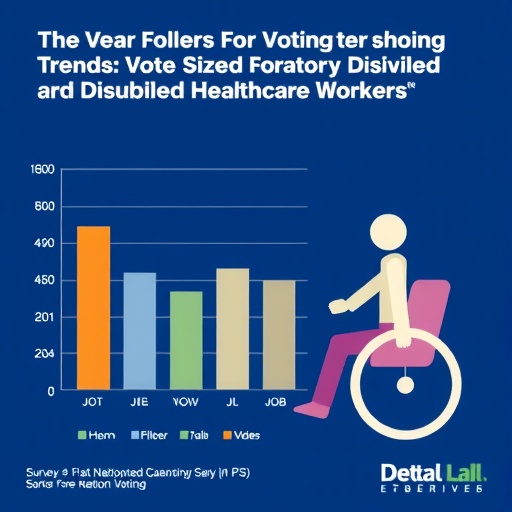
In a significant and timely examination of civic engagement, a recent national survey conducted by researchers Kakara and Morris sheds light on a topic that has long been underexplored: the voting behaviors and patterns of healthcare workers in the United States who live with disabilities. This groundbreaking study, which will be published in the esteemed Journal of General Internal Medicine in 2025, provides an analytical lens through which the intersection of healthcare, disability, and democratic participation is meticulously examined.
The findings reveal that individuals within the healthcare workforce, despite experiencing disabilities, display a unique set of voting characteristics that deserve attention and understanding. As voting is a fundamental right and a core component of democratic society, the participation of healthcare workers with disabilities offers insight into broader questions concerning inclusivity, representation, and policy-making within the healthcare system.
The researchers employed a comprehensive methodology in their analysis, utilizing a national survey that captured the responses of a diverse cohort of healthcare professionals across various settings. By aggregating data on voting habits, motivations, and barriers faced by these individuals, Kakara and Morris have created a robust dataset that stands to inform future discussions about civic engagement among disabled populations.
Among the most compelling aspects of this study is the acknowledgment of the systemic barriers that many healthcare workers with disabilities face when it comes to voting. These barriers range from physical access issues to informational gaps regarding the electoral process. By highlighting these challenges, the researchers call for reforms that not only enhance accessibility at polling locations but also increase awareness about voting rights within the healthcare community.
Moreover, the survey results indicate a positive correlation between workplace environment and voting participation rates among healthcare workers with disabilities. Institutions that actively promote inclusivity and support for employees with disabilities tend to see higher levels of voting engagement. This correlation suggests that healthcare workplaces can play a crucial role in fostering civic participation, ultimately contributing to a more representative democratic process.
Interestingly, the study also delves into the motivations that drive these workers to engage in voting. Many respondents indicated that their experiences within the healthcare system—both as providers and as individuals with disabilities—shaped their perspectives on social justice and health equity. This emotional and experiential connection to the electoral process underscores the vital role that personal narratives play in motivating civic engagement.
In addition to documenting the trends in voter turnout, the researchers analyzed the political attitudes held by healthcare workers with disabilities. The survey revealed a shared prioritization of specific health issues, including access to care, affordability, and healthcare reform. These common values not only reflect the perspectives of those within the healthcare workforce but also highlight the potential influence these healthcare professionals can exert on policy directions, should they choose to mobilize politically.
Crucially, the implications of these findings extend beyond the individual. The research encourages policymakers to consider how inclusive practices within healthcare organizations can serve as a catalyst for broader civic engagement initiatives. By ensuring that voices from all sectors of the healthcare landscape are heard, policies can be designed that are more reflective of the diverse needs and concerns of the population at large.
As the U.S. approaches significant electoral milestones in coming years, the study emphasizes the importance of outreach and education specifically targeting healthcare workers with disabilities. By equipping this demographic with the necessary tools and information about the voting process, stakeholders can not only empower individuals but also broaden the democratic landscape, allowing for a more inclusive society.
This pioneering analysis by Kakara and Morris thus serves as a clarion call for concerted efforts aimed at increasing the voting participation of healthcare workers with disabilities. Given that healthcare professionals often play a critical role in shaping public health policies, their engaged participation in elections can lead to more equitable health systems.
As discussions continue surrounding disability rights and voter access in the United States, the insights gleaned from this study will undoubtedly serve as a foundation for future research and advocacy efforts. The intersection of healthcare and civic participation is ripe for exploration and holds the promise of influencing both healthcare policies and electoral outcomes well into the future.
In summary, the national survey analysis conducted by Kakara and Morris provides a much-needed exploration into the voting behaviors of a vital yet frequently marginalized segment of the healthcare workforce. Their findings illuminate both the challenges and opportunities present at the intersection of disability and democratic participation, urging us to consider how we can better support and empower those who dedicate their lives to caring for others while advocating for their own rights within society.
Cite Scienmag News
Ophelia Keating. (September 15, 2025). Survey Reveals Voting Trends Among Disabled Healthcare Workers. Scienmag. https://scienmag.com/survey-reveals-voting-trends-among-disabled-healthcare-workers/
Ophelia Keating. "Survey Reveals Voting Trends Among Disabled Healthcare Workers." Scienmag, 15 September 2025, https://scienmag.com/survey-reveals-voting-trends-among-disabled-healthcare-workers/. Accessed 4 September 2026.
Ophelia Keating. "Survey Reveals Voting Trends Among Disabled Healthcare Workers." Scienmag. September 15, 2025. https://scienmag.com/survey-reveals-voting-trends-among-disabled-healthcare-workers/


