


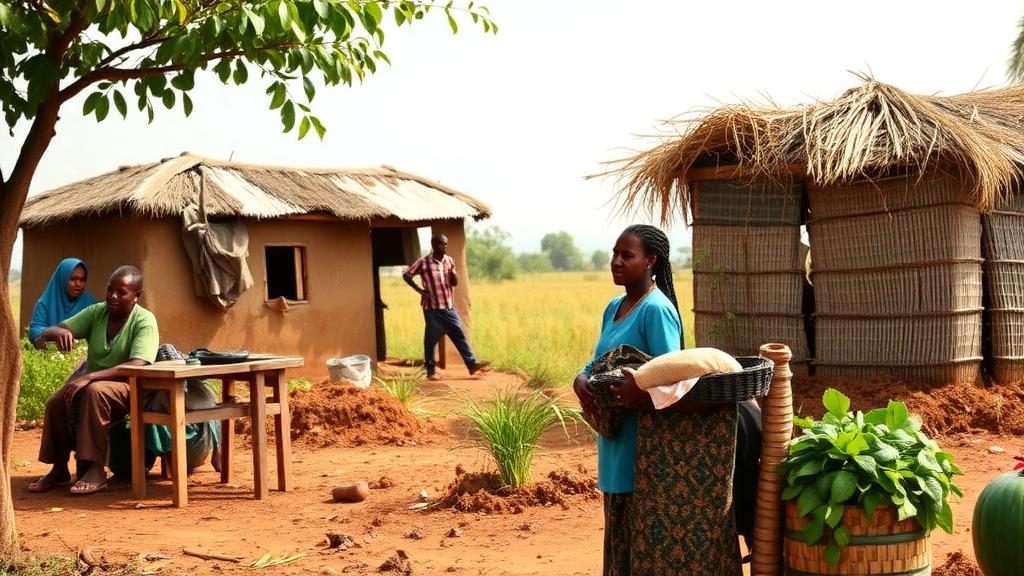
An analysis of 383 randomly selected households across three agro-ecological zones in northwestern Ethiopia found that several climate-variability adaptation practices were associated with improved multidimensional household food security. The strongest estimated association appeared for the integrated adoption of crop diversification, drought-resistant crops and short-maturing varieties, although relatively few households used this full package and the researchers cautioned against interpreting its estimated 31.4-percentage-point gain too confidently. The study was published in Discover Sustainability as peer-reviewed, accepted research on 27 September 2026.
The researchers used a multinomial endogenous switching regression model to examine the relationship between households’ adaptation choices and their multidimensional food security. Adaptation decisions were significantly associated with education, farming experience, landholding size, household size, distance to markets, agro-ecological location and access to climate information. The findings therefore describe estimated associations within the surveyed population rather than demonstrating that any strategy directly caused changes in food security.
Crop diversification alone was associated with a 25.4-percentage-point higher estimated food-security score, with the result significant at p < 0.01. The largest estimated gain was associated with combining crop diversification, drought-resistant crops and short-maturing varieties: 31.4 percentage points, also at p < 0.01. Most of the adaptation strategies examined were associated with statistically significant improvements in multidimensional food security, but the magnitude differed among adaptation portfolios.
The pattern was not strictly monotonic: some two-practice combinations produced weaker estimates or associations that were not statistically significant. The study did not formally test whether the practices were complementary in a technical sense, so the results do not establish that combining them always produces an additional benefit. Heterogeneity analysis also suggested that non-adopters could potentially obtain larger gains than current adopters, which the authors interpreted as evidence of substantial unmet adaptive capacity.
That conclusion is part of the model’s estimated implications, not a direct measurement of what would occur if particular households adopted each portfolio. The authors emphasized context-specific climate-smart agriculture supported by improved climate-information systems, extension services and targeted investment in infrastructure and productive assets. These measures were presented as potential priorities for strengthening resilience in climate-vulnerable agrarian systems, rather than as interventions whose effectiveness was tested in the household analysis.
Overall, the study links carefully chosen combinations of adaptation practices with stronger food-security outcomes, while its limited adoption of the largest package, non-monotonic estimates and lack of a formal complementarity test constrain stronger claims.
Subject of Research: Associations between climate-variability adaptation practices and household food security across three agro-ecological zones in northwestern Ethiopia
Article Title: Association between climate variability adaptation practices and household food security in three agro-ecological zones of northwestern Ethiopia
Article References: Nega, T. A., Gidelew, G. E., & Alemayhu, Z. S. (2026). Association between climate variability adaptation practices and household food security in three agro-ecological zones of northwestern Ethiopia. Discover Sustainability. https://doi.org/10.1007/s43621-026-04827-w
Image Credits: AI Generated
DOI: 10.1007/s43621-026-04827-w
Keywords: Ethiopia, food security, climate adaptation, crop diversification, drought-resistant crops, short-maturing varieties, smallholder agriculture, agro-ecological zones, endogenous switching regression, agricultural resilience, Association, between
Cite Scienmag News
Gavin Prescott. (October 19, 2026). Survey of 383 Ethiopian households links integrated adaptation to better food security. Scienmag. https://scienmag.com/survey-of-383-ethiopian-households-links-integrated-adaptation-to-better-food-security/
Gavin Prescott. "Survey of 383 Ethiopian households links integrated adaptation to better food security." Scienmag, 19 October 2026, https://scienmag.com/survey-of-383-ethiopian-households-links-integrated-adaptation-to-better-food-security/. Accessed 19 October 2026.
Gavin Prescott. "Survey of 383 Ethiopian households links integrated adaptation to better food security." Scienmag. October 19, 2026. https://scienmag.com/survey-of-383-ethiopian-households-links-integrated-adaptation-to-better-food-security/


