


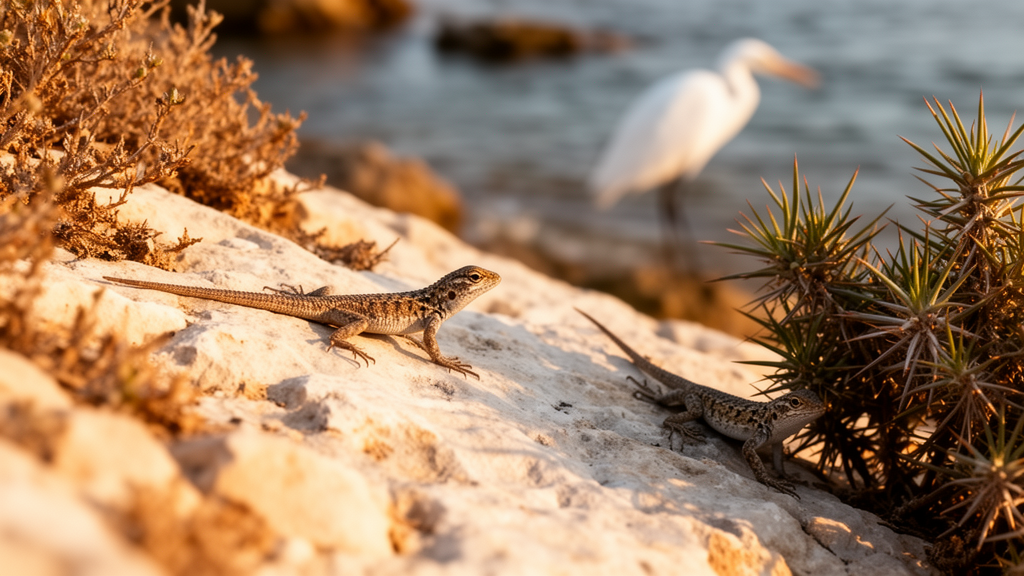
At the southernmost edge of their ranges in northern Israel, two lizards that share the same sun-drenched maquis woodlands are responding to a changing environment in strikingly different ways. A three-year field study spanning 272 woodland sites across a 120-kilometre gradient has revealed that climate, land use, habitat structure and predation pressure shape the fortunes of the Levant Green Lizard (Lacerta media israelica) and the Lebanon Lizard (Phoenicolacerta laevis) in almost opposite manners. The findings, published in the Journal of Biogeography… wait, the source is the Bulletin of the Geographical Society? No — the study appears in Frontiers of Biogeography, and its implications reach far beyond the Galilee.
The study’s sampling design deserves attention because it reveals how much ecological signal can be extracted from a single landscape. By spreading 272 woodland sites across a 120-kilometre geo-climatic gradient, the researchers captured the full span of conditions that northern Israel’s maquis ecosystems currently offer, from the wetter, cooler uplands of the Upper Galilee to drier southern slopes. This gradient matters because it allowed the team to disentangle variables that are often confounded in field studies: a site can be both warmer and more heavily grazed, for instance, and without broad geographic coverage it becomes difficult to know which factor is actually driving a species’ decline. The detection of 158 individual Levant Green Lizards across 16.5 percent of sites, compared with 1,162 Lebanon Lizards in 77.2 percent of sites, is itself informative. The roughly fivefold difference in occupancy underscores how unevenly the two species are distributed across the same landscape, even though they overlap geographically across most of their Israeli range.
The contrast between the two species’ responses to climate is particularly instructive for biogeographic theory. A long-standing expectation in ecology holds that populations at the edge of a species’ range should be especially sensitive to climatic conditions, because edge populations often sit at the limits of their physiological tolerance. The Levant Green Lizard, a cold-adapted species whose range extends from the Balkans southward to the southern Levant, fits this expectation: its abundance rose with wetter conditions, consistent with the pattern of range contraction it has already shown in recent decades, retreating from the Judea and Samaria mountains and Mount Carmel to strongholds in the Upper Galilee and northern Golan Heights. The Lebanon Lizard, however, defied this expectation. Its abundance was essentially unaffected by climate across the gradient, suggesting that the assumption of heightened climatic sensitivity at range edges does not apply universally, even among closely related species sharing the same boundary.
This discrepancy points to the role of local adaptation. The Lebanon Lizard is native to the eastern Mediterranean and has presumably occupied warm Levantine environments for a long evolutionary period, so the southern edge of its range may not represent a physiological limit in the same way it does for the Levant Green Lizard, whose lineage is rooted in cooler Balkan climates. The authors argue that biogeographic expectations about range-edge vulnerability should therefore be refined to account for the evolutionary history of each species rather than treating edge position as a uniform predictor of sensitivity. This has practical consequences: conservation assessments that rely on range-edge status alone may misidentify which populations are genuinely at risk and which are buffered by adaptation to local conditions.
The land-use findings carry their own weight. Traditional Mediterranean landscapes were maintained by goat grazing, wood clearing, agriculture and prescribed fire, practices that created a mosaic of open patches, shrublands and woodlands. That heterogeneity supported high species diversity, including reptiles that depend on sun-exposed patches for thermoregulation. The shift toward intensive cattle grazing, often combined with formal habitat protection, has produced a paradox: land set aside for conservation can undergo vegetation closure because the disturbance regimes that once kept woodlands semi-open have been removed or replaced. The result is homogeneous, closed woody formations that offer fewer basking opportunities and reduced herbaceous ground cover, which in turn diminishes arthropod prey availability. The Levant Green Lizard’s negative association with cattle grazing and its positive association with heterogeneous habitats align with this mechanism. As a large-bodied lacertid that favours structurally diverse, actively managed habitats, it appears to suffer when the mosaic it depends upon collapses into uniform canopy.
The Lebanon Lizard’s response to vegetation productivity adds another layer. Its abundance increased with greener, more productive vegetation, which may reflect its reliance on vertical microhabitats such as trees, rocky outcrops and shrubs. A lizard that climbs and perches may benefit from denser woody growth in ways that a ground-oriented, thermoregulation-dependent species does not. This divergence illustrates how habitat structure mediates climate effects: two species in the same woodland can experience the same vegetation closure in opposite ways depending on their microhabitat preferences and thermal biology.
The role of the Cattle Egret introduces a trophic dimension that is often overlooked in reptile conservation. The egret, a colonially nesting wader that has expanded dramatically across the Mediterranean since the mid-twentieth century, forages in pastures and maquis edges where it preys on lizards and other small animals. Its eruption in northern Israel has been linked to the expansion of cattle grazing, which provides the short vegetation and disturbed ground that egrets favour. The finding that Lebanon Lizard abundance declined with increasing egret predation pressure, while the Levant Green Lizard showed no such association, raises questions about differential vulnerability. The smaller Lebanon Lizard, at roughly 25 centimetres in total length, may fall within the egret’s preferred prey size range, whereas the larger Levant Green Lizard, reaching up to 42 centimetres, may be too big for most egrets to handle. Alternatively, the two species may use microhabitats that differ in exposure to aerial or terrestrial predators. Either way, the result demonstrates that predation risk can shape abundance patterns independently of climate and habitat, and that a generalist predator’s expansion can have species-specific consequences within a reptile community.
The potential interaction between the two lizards themselves adds a final layer of complexity. The study found a negative association between Lebanon Lizard abundance and Levant Green Lizard abundance, which is consistent with either exploitative competition for shared arthropod prey or intra-guild predation, in which the larger species occasionally consumes the smaller one. Large lacertids are known to take smaller vertebrates opportunistically, and the pronounced size asymmetry between these two species makes such interactions plausible. However, the authors note that this relationship has not been formally tested through dietary analysis or behavioural observation, so the negative association could also reflect shared habitat preferences that bring both species into contact without direct interaction. Distinguishing between these mechanisms would require targeted studies of gut contents, stable isotopes or experimental enclosure trials.
From a conservation standpoint, the implications are sobering for the Levant Green Lizard. The subspecies israelica is already classified as Endangered locally, owing to its restricted range, fragmented populations and deteriorating habitat quality. The new findings suggest that its decline cannot be attributed solely to habitat loss or feral cat predation, factors previously emphasised in Israeli assessments. Instead, the combination of climate-driven range contraction and the loss of heterogeneous, semi-open habitats appears to be the dominant pressure. Management responses might include restoring traditional disturbance regimes, such as controlled goat grazing or selective wood clearing, to reopen maquis canopies and recreate the patchy mosaics the species requires. Such interventions would need to be balanced against the needs of species that favour denser vegetation, illustrating the tension inherent in managing Mediterranean landscapes for multiple taxa simultaneously.
For the Lebanon Lizard, currently listed as Least Concern, the study serves as an early warning rather than an alarm. Its widespread status masks sensitivity to egret predation and possible negative interactions with the larger lacertid, and its apparent climatic tolerance should not be mistaken for immunity to environmental change. If cattle grazing continues to expand and egret colonies grow accordingly, predation pressure could intensify across the maquis, potentially affecting not only lizards but the broader reptile assemblage that depends on these habitats.
More broadly, the study contributes to a growing recognition that range-edge populations are not a monolithic category. The assumption that edge populations are uniformly stenoecious and vulnerable, while theoretically grounded in thermal biology, must be tempered by consideration of each species’ evolutionary history, ecological niche and biotic interactions. Two closely related lizards sharing the same southern boundary in the same woodlands can occupy entirely different positions along the vulnerability spectrum, one retreating in response to warming and habitat closure, the other holding steady but facing pressure from an expanding predator. For biogeographers and conservation practitioners alike, this argues for species-specific assessments grounded in empirical field data rather than general rules about range position, and for monitoring programmes that track not just presence and absence but the abundance, habitat associations and interaction networks that ultimately determine whether edge populations persist or fade.
Subject of Research: Comparative effects of climate, land use, habitat structure and predation on two range-edge lacertid lizards in Mediterranean Israel
Article Title: Contrasting effects of climate, land use, habitat structure and predation on two Mediterranean lacertids at their range edge
Article References: Talbi, R., Gavish, Y., Izhaki, I., & Bar-Massada, A. (2026). Contrasting effects of climate, land use, habitat structure and predation on two Mediterranean lacertids at their range edge. Frontiers of Biogeography, 19, Article e184423. https://doi.org/10.21425/fob.19.184423
Image Credits: AI Generated
Keywords: Lacerta media, Phoenicolacerta laevis, range edge, Mediterranean maquis, climate gradient, land use, cattle grazing, Cattle Egret, predation, habitat structure, biogeography, reptile conservation
Cite Scienmag News
Violet Maxwell. (October 19, 2026). Two Lizard Species, Diverging Fates: Climate, Habitat and Egret Predation Split Mediterranean Range-Edge Reptiles. Scienmag. https://scienmag.com/two-lizard-species-diverging-fates-climate-habitat-and-egret-predation-split-mediterranean-range-edge-reptiles/
Violet Maxwell. "Two Lizard Species, Diverging Fates: Climate, Habitat and Egret Predation Split Mediterranean Range-Edge Reptiles." Scienmag, 19 October 2026, https://scienmag.com/two-lizard-species-diverging-fates-climate-habitat-and-egret-predation-split-mediterranean-range-edge-reptiles/. Accessed 19 October 2026.
Violet Maxwell. "Two Lizard Species, Diverging Fates: Climate, Habitat and Egret Predation Split Mediterranean Range-Edge Reptiles." Scienmag. October 19, 2026. https://scienmag.com/two-lizard-species-diverging-fates-climate-habitat-and-egret-predation-split-mediterranean-range-edge-reptiles/


