


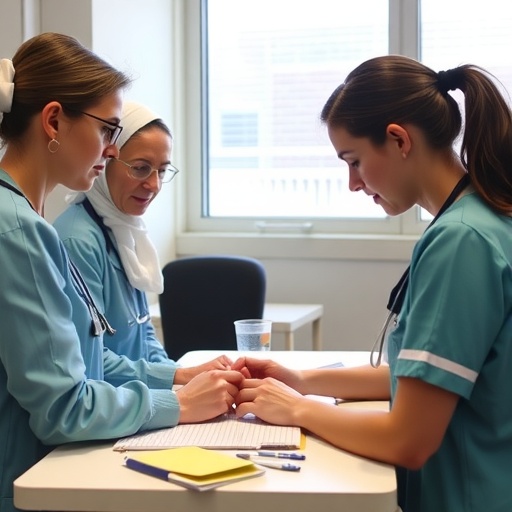
In a landmark study that marks a significant advancement in the field of nursing and healthcare, a team of researchers has successfully conducted the Turkish adaptation of the Nurses’ Sexual Harassment Scale (NSHS). This meticulously crafted research, led by prominent scholars including Derya Yeşilfidan, Fatma Adana, and Mustafa Özkan, focuses on validating and assessing the reliability of this crucial instrument. The relevance of this study cannot be overstated, as it addresses a critical issue that affects nurses in Turkey and potentially around the world.
The Nurses’ Sexual Harassment Scale is a vital tool designed to quantify and measure the prevalence and impact of sexual harassment within nursing environments. Its adaptation for a Turkish context highlights the urgent need to understand and tackle this pervasive issue, which has long been an overlooked aspect of healthcare environments. Sexual harassment in nursing not only undermines the mental well-being of the affected individuals but can ultimately compromise patient care and safety.
The research methodology employed by the authors is noteworthy for its rigor. They first conducted a comprehensive literature review to identify existing frameworks and items related to sexual harassment in healthcare. This foundational step ensured that the adapted scale would effectively address cultural nuances and specific challenges faced by nurses in Turkey. Following the initial adaptation, pilot testing was performed with a diverse group of nursing professionals, which provided valuable insights into the scale’s clarity and applicability.
To ensure its validity, the study applied both content and construct validity assessments. Content validity involved expert evaluations, where seasoned professionals in nursing and healthcare reviewed the items to ascertain their relevancy and comprehensiveness. Construct validity was tested through exploratory factor analyses, revealing how well the scale captured the underlying dimensions of sexual harassment specific to the nursing profession in Turkey. Such thorough validation processes are critical, as they ensure that the results derived from using the adapted scale would be both reliable and actionable.
Equally significant is the study’s emphasis on reliability testing. Researchers utilized various statistical techniques, including Cronbach’s alpha, to assess the internal consistency of the scale. A high Cronbach’s alpha coefficient emerged, indicating that the items within the scale consistently measure the construct of sexual harassment. Such robustness in the scale’s reliability promises to provide invaluable data to policymakers, healthcare institutions, and educators in a clinical context.
The implications of this research extend well beyond Turkey’s borders. As nursing professionals internationally confront similar issues of harassment, the Turkish adaptation of the NSHS can serve as a foundational model for other cultures and languages. The standardization of such scales fosters a global understanding of workplace harassment, allowing for better identification and intervention strategies.
Moreover, the importance of addressing sexual harassment within nursing cannot be understated. The healthcare setting is often characterized by power imbalances, unpredictable patient behavior, and societal perceptions of gender roles. Nurses, predominantly female, are frequently on the receiving end of inappropriate behaviors, which can lead to adverse psychological outcomes, including anxiety, depression, and post-traumatic stress disorder. By utilizing a scale validated for Turkish nurses, healthcare organizations can more effectively bring attention to this pressing issue and implement changes to improve working conditions.
In addition to addressing the immediate concerns of sexual harassment, the findings from this study can inform broader organizational policies and educational programs tailored to reduce harassment rates. Institutions can now rely on empirical evidence to develop training workshops, raise awareness, and encourage open dialogues about harassment in the workplace. Such initiatives will not only empower nurses but also promote a healthier workplace culture that prioritizes mutual respect and support.
Furthermore, by adopting sound methodology and rigorous testing, the researchers set a benchmark for quality research in healthcare disciplines. Their commitment to valid and reliable data reinforces the need for continuous scholarly work focused on critical issues encompassing the healthcare field. As this study gains traction, it is anticipated that it will inspire further research exploring the intersections between workplace safety, mental health, and professional conduct among nurses.
In conclusion, the Turkish adaptation of the Nurses’ Sexual Harassment Scale emerges as a pioneering effort that promises to make a transformative impact on the nursing profession in Turkey. By shedding light on the issues of harassment, validating a crucial measurement tool, and underscoring the importance of addressing workplace culture, this research paves the way for better understanding and actionable change. In the face of such a pervasive issue, the implications of this study resonate beyond academia; they echo the urgent need for improved safety, respect, and dignity in nursing environments everywhere.
This study not only contributes significantly to the academia surrounding sexual harassment in healthcare but also places the experiences of nurses at the forefront of societal discourse. Through continued dedication and research, there is hope for alleviating the burdens of harassment, ultimately fostering a culture of support and safety for nurses globally.
Yeşilfidan, D., Adana, F. & Özkan, M. Turkish adaptation of the nurses’ sexual harassment scale: validity and reliability study.
BMC Nurs 24, 1176 (2025). https://doi.org/10.1186/s12912-025-03831-1
Cite Scienmag News
Ophelia Keating. (September 25, 2025). Studying Turkish Nurses: Harassment Scale Validation Insights. Scienmag. https://scienmag.com/studying-turkish-nurses-harassment-scale-validation-insights/
Ophelia Keating. "Studying Turkish Nurses: Harassment Scale Validation Insights." Scienmag, 25 September 2025, https://scienmag.com/studying-turkish-nurses-harassment-scale-validation-insights/. Accessed 3 September 2026.
Ophelia Keating. "Studying Turkish Nurses: Harassment Scale Validation Insights." Scienmag. September 25, 2025. https://scienmag.com/studying-turkish-nurses-harassment-scale-validation-insights/


