


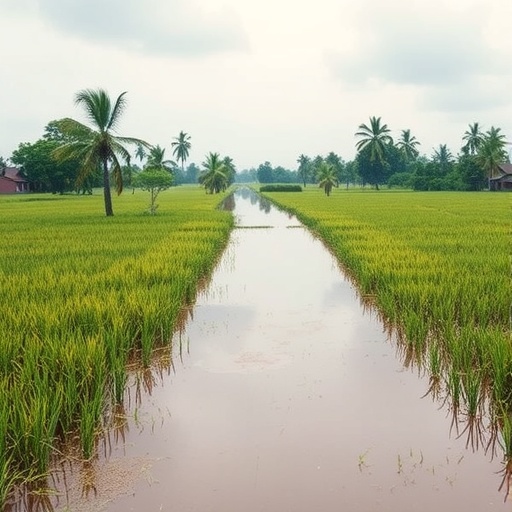
In a groundbreaking study published in Science Advances, researchers from Stanford University have revealed the staggering impact of severe flooding on global rice yields, underscoring an urgent threat to food security for billions worldwide. This investigation, spanning from 1980 to 2015, quantified an annual loss of approximately 18 million tons of rice, equivalent to a 4.3% decrease in yield attributed to floods. These findings illuminate a critical but previously underexplored dimension of how extreme hydrological events are reshaping agricultural productivity on a planetary scale.
Rice, a fundamental staple feeding over half of the global population, has historically been perceived as drought-sensitive, with water scarcity directly curbing production. While much scientific emphasis has been placed on the adverse effects of drought, this study draws attention to an equally pernicious phenomenon—intense and prolonged flooding. Unlike the beneficial shallow flooding that nurtures rice during its initial growth phases, excessive inundation, especially when crops remain submerged beyond a critical threshold, can prove devastating, explicitly decimating yields.
The researchers identified a pivotal benchmark for “rice-killing floods”: when rice plants are submerged underwater for a consecutive period of seven days or longer during their development cycle, widespread mortality ensues. This threshold, meticulously defined through integrating phenological data on rice growth stages with hydrological records, facilitates a refined understanding of flood-induced crop failures. Such specificity had eluded previous global assessments, rendering this measurement a novel contribution to agronomic and climatic sciences.
Utilizing a comprehensive fusion of datasets—including annual global rice production figures, detailed flood and drought event catalogues dating back to 1950, alongside sophisticated simulations of soil moisture and flood dynamics—the scientists charted the spatial and temporal evolution of flooding impacts on major rice-producing basins. Their multifaceted analytic approach enabled both retrospective evaluations and forward-looking projections considering climatic trends.
The period after the year 2000 exhibits an alarming acceleration in flood-induced rice yield losses. This increase correlates with heightened flood frequency and intensity across critical rice-growing regions, a trend that climate change models forecast will persist and potentially intensify. The intensified hydrological disturbances manifest through augmented precipitation extremes during peak rice-growing seasons, jeopardizing the stability of food supplies in vulnerable areas.
Projections based on climate-driven rainfall models indicate that by mid-century, the most intense single week of precipitation within key rice cultivation basins could escalate by roughly 13% relative to the 1980–2015 baseline period. This scenario portends severe challenges for agricultural resilience, demanding urgent innovation in crop management and flood mitigation strategies.
Amid these threats, promising advances in agronomy emerge through the development and dissemination of flood-tolerant rice varieties. These cultivars exhibit enhanced survivability during submergence and can significantly cushion yields against the deleterious effects of prolonged inundations. Targeted dissemination of these lines, particularly in high-risk geographies such as the Sabarmati Basin in India, North Korea, Indonesia, China, the Philippines, and Nepal, could meaningfully curtail anticipated production declines.
Intriguingly, not all flood events are detrimental. For example, empirical data highlighted regions like India’s Pennar Basin where flooding has paradoxically boosted rice yields. Researchers attribute this anomaly to climatic interplay, where rapid evaporation of floodwaters in these typically hot and dry zones alleviates water stress without inflicting crop mortality, underscoring the complexity of hydrological-agronomic interactions.
Beyond isolated flood and drought events, the study draws attention to the compounded damage resulting from sequences of extreme weather conditions. Prior research indicates that oscillations between drought and flood conditions within a growing season can nearly double rice yield losses compared to singular hydrological extremes. The mechanisms underlying these compounded stress effects remain an active area of investigation but suggest cumulative physiological strain on rice crops and soils.
The scientists advocate for holistic research frameworks that explicitly integrate the multifactorial stressors rice crops encounter—including flooding, drought, temperature extremes, and their temporal sequences—to develop resilient agricultural systems. Technological advances such as high-resolution climatological models, coupled with genetic improvements and adaptive water management, are pivotal in addressing the complexities of future food security under changing climate dynamics.
Researchers emphasize the imperative for policymakers and agricultural stakeholders to assimilate these new insights into adaptation strategies. Enhanced monitoring, early warning systems for flood events, and investment in resilient infrastructure must harmonize with breeding programs for flood-resistant rice. This integrated approach represents a beacon of hope amidst daunting predictions for crop security globally.
In conclusion, this seminal study charts a critical path forward by delineating the quantifiable toll of floods on one of humanity’s most essential food sources. It challenges the scientific community and global agricultural systems to recalibrate risk assessments and mitigation strategies in light of evolving climatic realities. Failure to adequately address these flood-related yield losses could imperil the sustenance of billions, amplifying food insecurity and socio-economic instability in the decades ahead.
News Publication Date: 14-Nov-2025
Web References:
References:
Li, Z., Gorelick, S., et al. (2025). Severe floods significantly reduce global rice yields. Science Advances. DOI: 10.1126/sciadv.adx7799
Cite Scienmag News
Alan Morgan. (November 15, 2025). Study Reveals Severe Floods Pose Major Threat to Global Rice Production. Scienmag. https://scienmag.com/study-reveals-severe-floods-pose-major-threat-to-global-rice-production/
Alan Morgan. "Study Reveals Severe Floods Pose Major Threat to Global Rice Production." Scienmag, 15 November 2025, https://scienmag.com/study-reveals-severe-floods-pose-major-threat-to-global-rice-production/. Accessed 4 September 2026.
Alan Morgan. "Study Reveals Severe Floods Pose Major Threat to Global Rice Production." Scienmag. November 15, 2025. https://scienmag.com/study-reveals-severe-floods-pose-major-threat-to-global-rice-production/


