


In the rapidly changing mosaic of Europe’s agricultural landscapes, a novel study published in Landscape Ecology reveals the untapped potential of strategically located poplar plantations to bolster forest connectivity for birds. This comprehensive research, led by Sara Pineda-Zapata of the University of Eastern Finland, challenges the prevailing notion of plantations solely as biomass producers, illuminating their multifaceted ecological role within fragmented habitats.
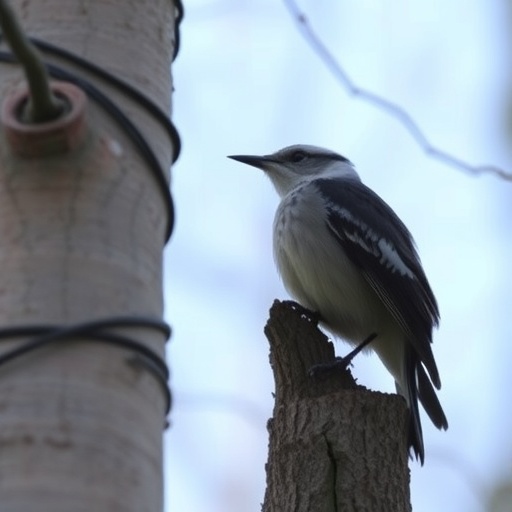
Fragmentation of natural forests remains a profound challenge to biodiversity, particularly in agricultural regions where habitat patches become isolated amid intensive land use. The capacity of forest birds to traverse between these patches, an essential process for population viability, is often impeded by such habitat discontinuities. This study specifically targeted three forest bird species exhibiting varying dispersal abilities, to rigorously evaluate how poplar plantations might mitigate these landscape barriers and sustain ecological connectivity.
Employing sophisticated spatial connectivity models, the team meticulously analyzed two European river sub-catchments—one located in Spain and the other in France. The models assessed interactions between extant natural forest patches and poplar plantations, both inside and outside the Natura 2000 network, Europe’s wide-reaching habitat conservation initiative. These simulations provided nuanced insights into how plantation placement influences their utility as ecological corridors or “stepping stones” that facilitate avian movement across seemingly inhospitable agricultural matrices.
Findings from Spain were particularly striking. Poplar plantations there demonstrated connectivity gains that exceeded expectations based solely on their spatial extent. Certain plantation patches emerged as critical nodes that substantially enhanced forest network cohesion, linking both protected Natura 2000 sites and other forest fragments. This amplification effect underscores that plantation quality and location may override mere size when it comes to ecological connectivity in human-modified landscapes.
In contrast, the French sub-catchment presented a more sobering picture. Poplar plantations there were comparatively isolated and contributed less effectively to overall connectivity. This discrepancy highlights the pivotal importance of landscape context and placement in harnessing plantations as functional ecological assets. The stark geographic differences observed serve as a clear reminder that ecological connectivity cannot be universally generalized but must be grounded in site-specific spatial configurations and habitat conditions.
The dispersal ability of bird species was another crucial variable shaping the effectiveness of plantations. Long-distance dispersers benefitted the most, using plantations to cross larger gaps between forest patches. By comparison, the common chaffinch, a species with limited dispersal range, experienced minimal connectivity enhancement except when plantations lay in close proximity to existing forest habitats. This finding elucidates the persistent barrier effects posed by even narrow non-forest gaps for less mobile species and underscores the need for fine-scale landscape planning tailored to species-specific ecological traits.
The implications of this research extend beyond connectivity per se. Strategically arranged plantations offer a pathway to reconcile productive forestry with biodiversity conservation. “Plantations are often evaluated solely for their timber output, yet they can also be key contributors to landscape structure and ecological flows,” says Professor Blas Mola, co-author from the University of Eastern Finland. This integrated perspective could transform conventional plantation forestry, enhancing multifunctionality that amalgamates economic and ecological objectives in intensively farmed areas.
Alejandra Morán of the University of Basel emphasizes the broader ecological relevance of connectivity in the context of ecosystem services: “Connectivity dictates species’ movement and persistence, fundamentally influencing landscape resilience in the face of environmental change.” This study’s insights fuel an emerging paradigm that land use planning should incorporate not just patch-level productivity but also the spatial dynamics that underpin ecological processes at the landscape scale.
However, the researchers caution against misconstruing plantations as substitutes for natural forests. Rémi Duflot of the University of Jyväskylä points out that plantations lack the structural complexity and ecological quality that many forest specialists require. Moreover, increasing tree cover indiscriminately may inadvertently diminish habitat availability for open-habitat species, emphasizing the need for balanced management strategies that conserve diverse habitat types in concert.
The path forward, according to the researchers, lies in employing landscape ecology principles to optimize the placement of plantations so that they yield maximal connectivity benefits. The integration of spatial modeling and ecological knowledge can inform targeted reforestation and agroforestry practices that simultaneously support biomass production and biodiversity objectives. Such dual-purpose landscapes hold promise for sustainable multifunctional land use in densely populated regions.
As Dr. Pineda-Zapata concludes, “Well-placed plantations can be part of the solution in fragmented landscapes, paving the way for productive regions that are also vibrant with biodiversity.” This integrative outlook advocates for adaptive management that transcends binary conservation-versus-production paradigms and embraces the complexity of real-world landscapes.
This pioneering study is a clarion call for policymakers, land managers, and conservationists to rethink the ecological functions of plantations within agricultural matrices. By strategically harnessing plantations to complement natural habitats, it becomes possible to forge resilient ecological networks that facilitate wildlife movement, support species persistence, and enhance landscape-scale biodiversity outcomes amid human land use pressures.
The study’s rigorous methodology, coupled with its relevance to multiple regions and species, positions it as a landmark contribution to landscape ecology and conservation science. Future research might expand on these findings by incorporating additional taxa, temporal dynamics, and socio-economic factors influencing plantation establishment and management.
As Europe contends with balancing agricultural productivity, timber demand, and biodiversity conservation, this research exemplifies how ecologically informed plantation placement can serve as a linchpin for sustainable landscape design—an innovative nexus where human industry and wildlife needs converge.
News Publication Date: 28-Feb-2026
Web References: https://doi.org/10.1007/s10980-026-02316-z
Cite Scienmag News
Margaret Porter. (April 20, 2026). Strategically Positioned Poplar Plantations Boost Forest Connectivity for Birds. Scienmag. https://scienmag.com/strategically-positioned-poplar-plantations-boost-forest-connectivity-for-birds/
Margaret Porter. "Strategically Positioned Poplar Plantations Boost Forest Connectivity for Birds." Scienmag, 20 April 2026, https://scienmag.com/strategically-positioned-poplar-plantations-boost-forest-connectivity-for-birds/. Accessed 3 September 2026.
Margaret Porter. "Strategically Positioned Poplar Plantations Boost Forest Connectivity for Birds." Scienmag. April 20, 2026. https://scienmag.com/strategically-positioned-poplar-plantations-boost-forest-connectivity-for-birds/


