


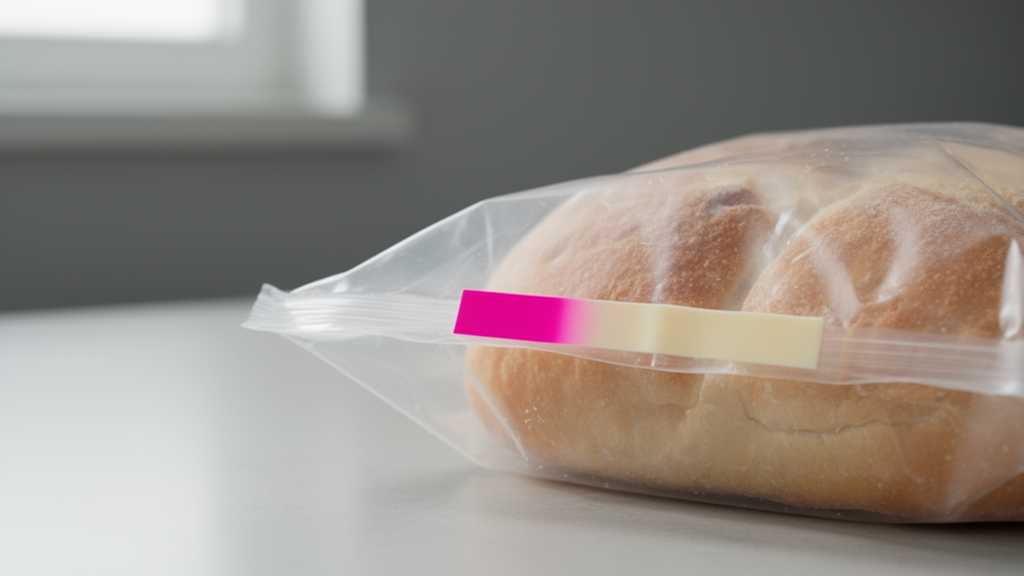
A small cylinder made of starch, sitting quietly inside a packet of crackers, has just demonstrated one of the most elegant low-cost solutions to a problem that plagues the global food industry: how do you know, without opening the package or running laboratory tests, whether the food inside is still crisp? Researchers at the São Carlos Institute of Chemistry at the University of São Paulo (IQSC-USP) have developed a biodegradable, starch-based sensor that changes color in response to moisture, shifting between shades of blue and pink as humidity rises and falls inside sealed packaging. The work, published in June in the journal Food Chemistry, was supported by the São Paulo Research Foundation (FAPESP) through three research projects, and it points toward a future in which the freshness of a snack can be judged with nothing more sophisticated than the naked eye or the camera of a cell phone.
The active ingredient in the sensor is cobalt chloride, a salt with a long and well-documented history as a humidity indicator. In its anhydrous, or water-free, form, cobalt chloride is blue. When water vapor is present, the salt undergoes hydration: water molecules coordinate with the cobalt ions, altering the compound’s chemical structure and, with it, the way it absorbs and reflects light. The result is a dramatic and easily visible shift to pink. Because this transition is reversible, the sensor does not merely record a single event; it continuously tracks the moisture conditions inside a package, responding within seconds to changes in the surrounding environment. When the salt is dry, the sensor reads blue; when it becomes hydrated, it turns pink, signaling the presence of water vapor and, by extension, a potential loss of product quality.
What distinguishes the Brazilian team’s device from earlier humidity indicators is its physical form. Rather than a flat strip or a coating applied directly to packaging material, the sensor is a small cylinder fabricated from starch cryogel, a highly porous material the research group has been developing using a freeze-based manufacturing process. The starch gel is frozen and then subjected to freeze-drying, a dehydration technique in which the frozen water is removed by sublimation, passing directly from the solid state to vapor without ever becoming liquid again. This gentle removal of the aqueous phase preserves the delicate porous structure that forms during freezing, producing a scaffold with an enormous internal surface area and a high capacity for interacting with the surrounding atmosphere.
That large surface area is the key to the sensor’s sensitivity. Bianca Maniglia, a professor at IQSC-USP and the research advisor on the project, explained that the expanded contact area allows the device to register a wide range of humidity conditions inside packaging. In a very dry environment, the sensor responds by holding its blue state; in a very humid one, it responds by turning pink. The gradations between these extremes produce a spectrum of intermediate shades, giving the device a dynamic range that a simple yes-or-no indicator cannot match. In practical terms, this means the sensor does not just flag the presence of moisture but reflects the actual conditions the food is experiencing over time.
To validate the technology, the researchers turned to cream crackers, a product chosen deliberately for its vulnerability. Crackers belong to the class of low-moisture foods whose appeal depends almost entirely on texture: the snap of a crisp cracker is a direct consequence of its low water content, and even modest moisture uptake from the surrounding atmosphere is enough to soften it into staleness. The team placed the starch-based cylinders near crackers stored under different conditions and observed the color transitions. The results showed that the color change corresponded to increases in moisture and was strongly correlated with the loss of texture in the crackers, indicating that the sensor faithfully mirrors the real storage conditions that determine whether the product remains enjoyable or ends up disappointing the consumer.
The implications extend well beyond crackers. Any food whose quality depends on maintaining a moisture balance, from breakfast cereals and snack foods to powdered beverages and baked goods, could in principle be monitored this way. For manufacturers, a visual moisture sensor embedded in packaging would offer a way to verify that sealing processes are working, that transport and storage conditions have not compromised the product, and that shelf-life claims hold up in practice. For consumers, the promise is even more direct: a glance at the package, or a quick look through a cell phone screen, would reveal whether the contents are still crisp before the bag is ever opened. The researchers expect that, in the future, both industry and consumers will be able to use the technology to determine the crispness and moisture content of a wide variety of products.
The commercial stakes are considerable. According to recent data released by the Brazilian Packaging Association (ABRE), the packaging sector generates approximately 165.7 billion Brazilian reais per year in Brazil alone, and quality assurance is a significant share of the value embedded in that figure. Food waste driven by texture loss and perceived staleness represents a parallel cost, one borne by retailers, consumers, and the environment alike. A cheap, biodegradable indicator that communicates product condition in real time could help reduce waste by distinguishing between food that is genuinely past its best and food that is perfectly good but has merely passed a printed expiration date. Because the sensor’s matrix is starch, a renewable and biodegradable polymer, the device also avoids adding persistent plastic waste to the packaging stream it is meant to improve.
The inspiration behind the device is as charming as the chemistry is rigorous. While developing the project, Maniglia recalled the weather rooster, a kitchen ornament inspired by the Rooster of Barcelos, one of Portugal’s national symbols, that was common in Brazilian and Portuguese homes in the 1980s. The glazed ceramic rooster changed color to indicate whether the day would bring rain or sunshine, functioning as a household humidity gauge long before electronic sensors became ubiquitous. That childhood memory prompted the researchers to experiment with coating their sensor in the same kind of material used on the roosters, eventually adapting the approach to the cryogel platform. It is a fitting lineage: a folk technology for reading the weather reborn as a precision instrument for reading the inside of a snack bag.
Significant work remains before the sensor can reach supermarket shelves. The most important limitation is the cobalt chloride itself. Although effective as a color-switching salt, cobalt compounds raise toxicity concerns, and in its current form the sensor cannot be allowed to come into direct contact with food. Maniglia noted that for commercial use, conventional packaging would need to be redesigned to accommodate the sensor safely, keeping the cobalt chloride physically separated from the edible contents while still exposing it to the internal atmosphere of the package. Encapsulation strategies, barrier layers, and revised package geometries are all plausible routes, but each would require additional testing to confirm that the sensor’s responsiveness survives the modifications.
The research group is already exploring alternatives that could sidestep the toxicity problem entirely. Among the candidate materials are bioactive compounds derived from fruits, including pigments extracted from jabuticaba peel, the dark purple skin of a Brazilian grape beloved for its antioxidant properties. These natural pigments are sensitive to pH variations, exhibiting color changes that can serve as visual indicators, and they bring antioxidant activity as an added benefit. In that configuration, the researchers envision a system capable of monitoring the spoilage process of perishable foods such as meat, where microbial activity and chemical degradation shift the internal chemistry in ways the pigments could reveal. Maniglia also emphasized that incorporating these natural compounds adds commercial value to fruit-processing byproducts that would otherwise be discarded, closing the loop on an already sustainable concept. From a childhood memory of a color-changing rooster to a starch cryogel that reports the crispness of a cracker in real time, the project illustrates how curiosity-driven chemistry, rooted in everyday observation, can yield technologies with the potential to reshape how the world’s food is packaged, monitored, and trusted.
Subject of Research: A biodegradable starch cryogel sensor with cobalt chloride that visually indicates moisture and food crispness in packaging.
Article Title: Starch-based sensor changes color to indicate moisture in food packaging
Article References: Starch-based sensor changes color to indicate moisture in food packaging. (n.d.). Original publication
Image Credits: AI Generated
DOI: Not provided
Keywords: food packaging, moisture sensor, cobalt chloride, starch cryogel, freeze-drying, food crispness, Food Chemistry, University of São Paulo, FAPESP, biodegradable materials, food quality, jabuticaba peel
Cite Scienmag News
Bethany Barker. (October 17, 2026). Starch Sensor Turns Pink to Reveal Hidden Moisture in Food Packaging. Scienmag. https://scienmag.com/starch-sensor-turns-pink-to-reveal-hidden-moisture-in-food-packaging/
Bethany Barker. "Starch Sensor Turns Pink to Reveal Hidden Moisture in Food Packaging." Scienmag, 17 October 2026, https://scienmag.com/starch-sensor-turns-pink-to-reveal-hidden-moisture-in-food-packaging/. Accessed 17 October 2026.
Bethany Barker. "Starch Sensor Turns Pink to Reveal Hidden Moisture in Food Packaging." Scienmag. October 17, 2026. https://scienmag.com/starch-sensor-turns-pink-to-reveal-hidden-moisture-in-food-packaging/


